
The US National Defense Strategy published by the Trump administration in January 2026 reassures allies that the European component of the North Atlantic Treaty Organization (NATO) "dwarfs Russia in economic scale, population, and, thus, latent military power." Non-US NATO GDP is $26 trillion compared to Russia's $2 trillion. Their economic clout is not even close. But this comparison is misleading. At purchasing power parity, which reflects the purchasing ability of different currencies, Russia's military spending is almost the same as that of the European Union and the United Kingdom.
On the other hand, Russia's economy itself is more than 10 times the size of Ukraine's. Yet four and a half years into an invasion Moscow expected to finish in three days, Ukraine is still fighting back.
In a different part of the world, Iran's economy is barely 1 percent the size of the United States' economy. Yet over the eight months of war, Tehran has tied down US forces, burned through half to two-thirds of US missile defense interceptors that will take at least five years to rebuild, and is still holding global energy markets hostage, while driving up US inflation. Composite measures such as the Composite Index of National Capability narrow the gaps, but they measure potential, not mobilization.
What explains this imbalance between the size of an economy and its ability to wage war?
If countries seek to convert economic power into military success, economists and the military need to cooperate more closely. Indeed, economists' contributions grow in importance as wars settle into long wars, wars of attrition, or asymmetric conflicts. In such cases, economic management must be part of military strategy, not just a backdrop.
Of course, economists cannot replace the military's ability to deploy armed forces. Nor can economists replace bargaining: Wars still end at the negotiating table. But converting economic power into military power determines how long each side can hold out and how much each side can afford to lose, thus setting the stage for negotiations.
A proposed new research agenda on the economics of war
This blog post presents a brief overview of the current literature on the economics of war—much of it outdated and siloed in the different disciplines of economics, international relations, and political science—and maps out a research agenda, highlighting what work has been done and what still needs to be done rather than attempting to resolve central questions. Four building blocks—generating resources, converting resources into military capabilities, denying resources to an adversary, and staying in power—can help us understand how economic size becomes sustained fighting power, where that conversion breaks down, and what economists and military specialists need to understand together.
For example, nationwide mobilization requires paying for production, finding cost-effective ways to wage war, mobilizing the right number and type of people, adopting new technologies faster than the adversary, and denying the other party resources through economic warfare. These imperatives raise economic issues as much as military ones.
The post Cold-War record indicates that economists and generals rarely work together, except in rare cases like Finland, Singapore, and increasingly Russia and Ukraine.
The absence of a large-scale war between industrial states in recent history has erased wartime economic expertise from institutions on both sides. Defense studies have recently begun to take an interest in the economics of mobilization, and the economics profession should refresh its own frameworks for the economics of war.
Historians of past wars—including Paul Kennedy, Mark Harrison, and Stephen Broadberry in their comparative volumes on the First and Second World Wars, and Alan Milward in the postwar period—have shown that productive capacity shapes outcomes over the long run. Recent work has advanced individual topics. Economists Jonathan Federle, Dominic Rohner, and Moritz Schularick find that windfall revenue gains raise a country's odds of winning, enabling them to increase military spending. Political scientist Rosella Cappella Zielinski explains how states choose to pay for wars. Economists Jeffrey J. Schott of PIIE; Edward Fishman, author of Chokepoints; and the historian Nicholas Mulder trace the rise of sanctions as a tool of modern war. Mark Harrison now distills lessons for defense industrial policy, among them that costs matter in long wars and autarky is a costly delusion, and Phillips Payson O'Brien, strategic historian, argues, controversially, that wars are won by full-spectrum powers able to sustain them. The field even has its own journal Defence and Peace Economics. The recent wars suggest that it is time to bring it back to the mainstream.
The four building blocks that can help us understand the importance of economics as it relates to war are as follows:
1. Generating resources: Mobilizing funding and labor, and related trade-offs
War finance depends on the speed and credibility of mobilizing capital and the trade-offs between taxation, debt, money creation, and, increasingly, reliance on external financing. The core choices are how much to finance through taxes versus debt, with which instruments, particularly which taxes, and which nominal or inflation-indexed bonds.
The economist John Maynard Keynes's volume How to Pay for the War, written nearly a century ago for an economy constrained by supply rather than demand, remains an important part of the debate on rearmament. Central banks make up the financial rear: keeping payment systems running, banks liquid and solvent, and monetary policy predictable. Central banks not only help avoid a financial crisis but also help preserve confidence that the state still governs and will survive the war.
External support has increasingly become an important but still understudied input. We can also think of the absorptive capacity of countries receiving such support as the multiplier: Ukraine converts allied aid into fighting power, while the $145 billion the United States spent rebuilding Afghanistan over 20 years did not prevent its government's collapse. Labor mobilization also requires trade-offs—between the war front and the home front. Ukraine lost roughly a quarter of its effective labor force during Russia's 2022 invasion. Yet wage flexibility, remote work, and hiring women and older workers kept the decline in job-matching efficiency to about 15 percent. In Israel, prolonged call-up of reservists and exclusion of Palestinian workers are weighing on the economy.
2. Converting resources: Technological adaptation and innovation
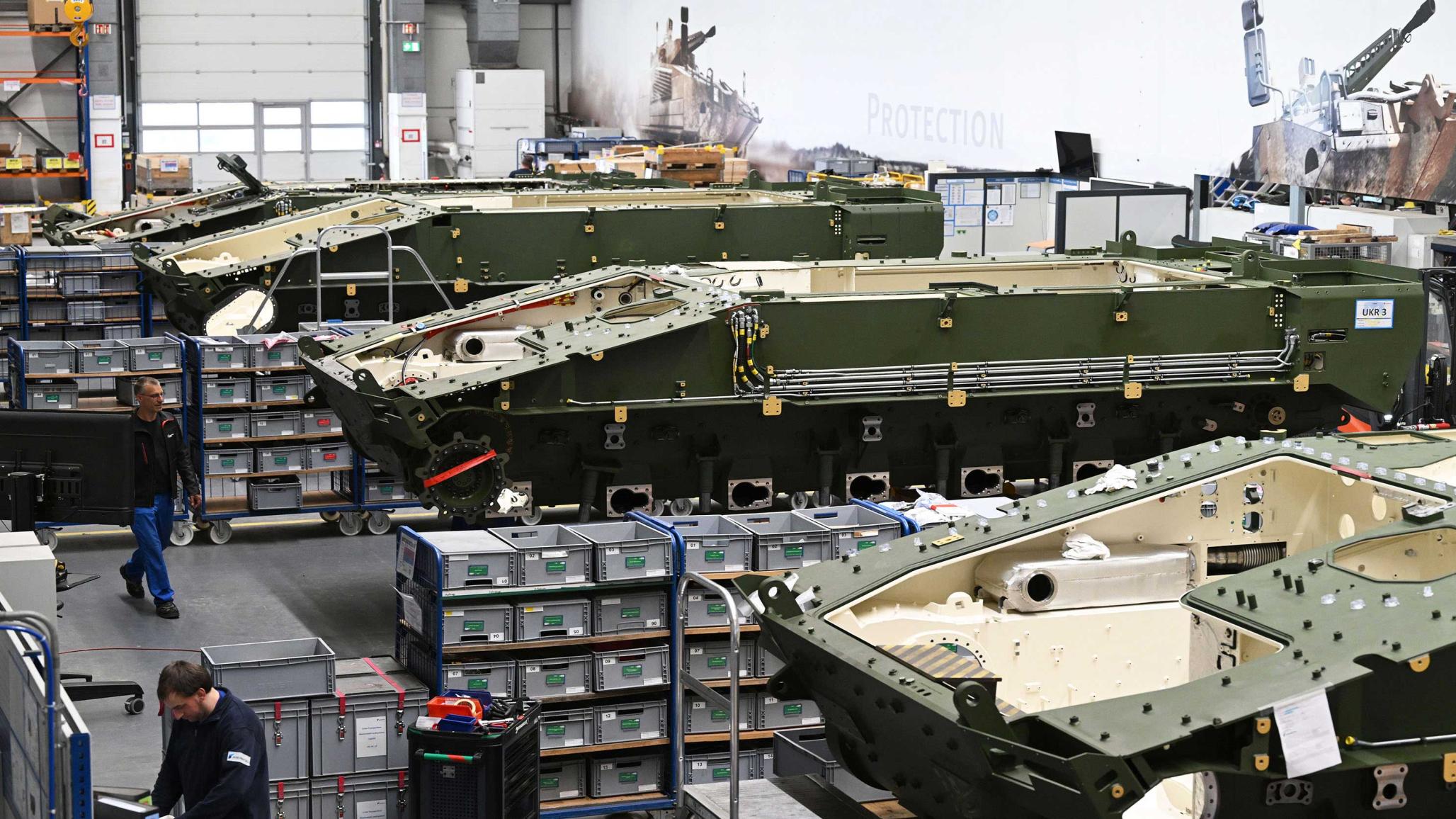
Choosing where to focus military production is a critical economic choice. Over the past few decades, the United States and Germany have tended to invest more in highly sophisticated and expensive materiel that takes years, if not decades, to produce. Ukraine and Iran are at the opposite side of the spectrum. Ukraine has been forced to mobilize production rapidly because of shortages of manpower and financial resources, and Iran by decades of isolation.
But these scarcities can serve as an advantage: Existing large corporates in the United States and Germany have a history of government contracts for specific types of capital-intensive, bespoke, highly sophisticated military equipment. These companies want to protect their status, so when cheap drones are suddenly needed, it is hard for new companies to enter the market. By contrast, in Ukraine and Iran, there are few incumbents to resist shifting away from capital-intensive military industry.
Russia lags Ukraine in innovation, though it is closing that gap and is also more successful at scaling production, mostly of older, proven technology. Ukraine's ability to expand its industrial base across more than 180 European partnerships should help it achieve scale as well. Finally, recent wars have reversed the traditional defense research and development model: After decades of lower post–Cold War spending, civilian technology is now pulled into military use rather than the other way around.
3. Denying resources: Economic warfare
Denying the adversary its capacity to convert economic power into military advantage is the flip side of building your own. Economic warfare cannot win wars by itself but can make an important contribution. Sanctions are one instrument of economic warfare alongside blockades, strategic bombing, and long-range strikes on oil refineries and shipping lanes. Coalition size, costs borne by the sanctioning country, adaptation, and enforcement are the main constraints. US Senate hearings with experts and companies revealed a pressure point: More than 40 percent of 2,500 components in Russian weapons used in Ukraine came from four American suppliers. Meanwhile, Iran's disruption of the Strait of Hormuz shows how a much smaller economy can wage asymmetric warfare, imposing steep, far-reaching costs on a much richer adversary.
4. Constraints: Staying in power
Narratives directed at the domestic or international community can reduce the cost of every other input. Credibility with bond markets, the public, and allied militaries—whose supply chains can assist a smaller state—keeps finance and materiel flowing and people at work. Government can also use its ability to shape narrative to suppress statistics or shape how people understand wars being waged. Leaders' choices are constrained by the need to keep the support of those who can keep them in power, even when doing so comes at the expense of the wider public. As political scientist Stephen Biddle and defense analyst and researcher Robert Zirkle explain, what secures the cooperation of elites is not always what is best for the economy, and coup-proofing—organizing the military to keep a country's ruler safe from overthrow, rather than for maximum efficiency—and patronage impose deadweight loss on converting economic power into military power. Political scientists Abramo Fimo Kenneth Organski and Jacek Kugler demonstrate how relative political capacity measures how much a government can use its potential. Political scientist Randall L. Schweller shows why fragmented states fail to do enough to counter an external threat because internal disagreements prevent them from building defenses or forming effective alliances.
After the Iran-Iraq war, Iran's Revolutionary Guards understood the need to control resources to continue to militarize; Iranian economists are often left to manage the consequences, and the best are often pushed out of government. Venezuela shows how a regime can survive while an important economic resource, in this case the oil industry, decays. It offered no resistance to an intervention by a foreign power, namely the United States. Regime survival and national capability are different things.
As the United States and Europe commit trillions of dollars to increasing their military capabilities, they cannot rely on aggregate GDP, or even defense spending as a share of GDP, to deter or win protracted conflicts. They must measure what that spending actually delivers: using purchasing power parity to compare resources, and tracing how funding, including allied support, becomes production, deployable capabilities, and battlefield effects. That work requires economists and military specialists to build a common framework.
Data Disclosure
This publication does not include a replication package.
