
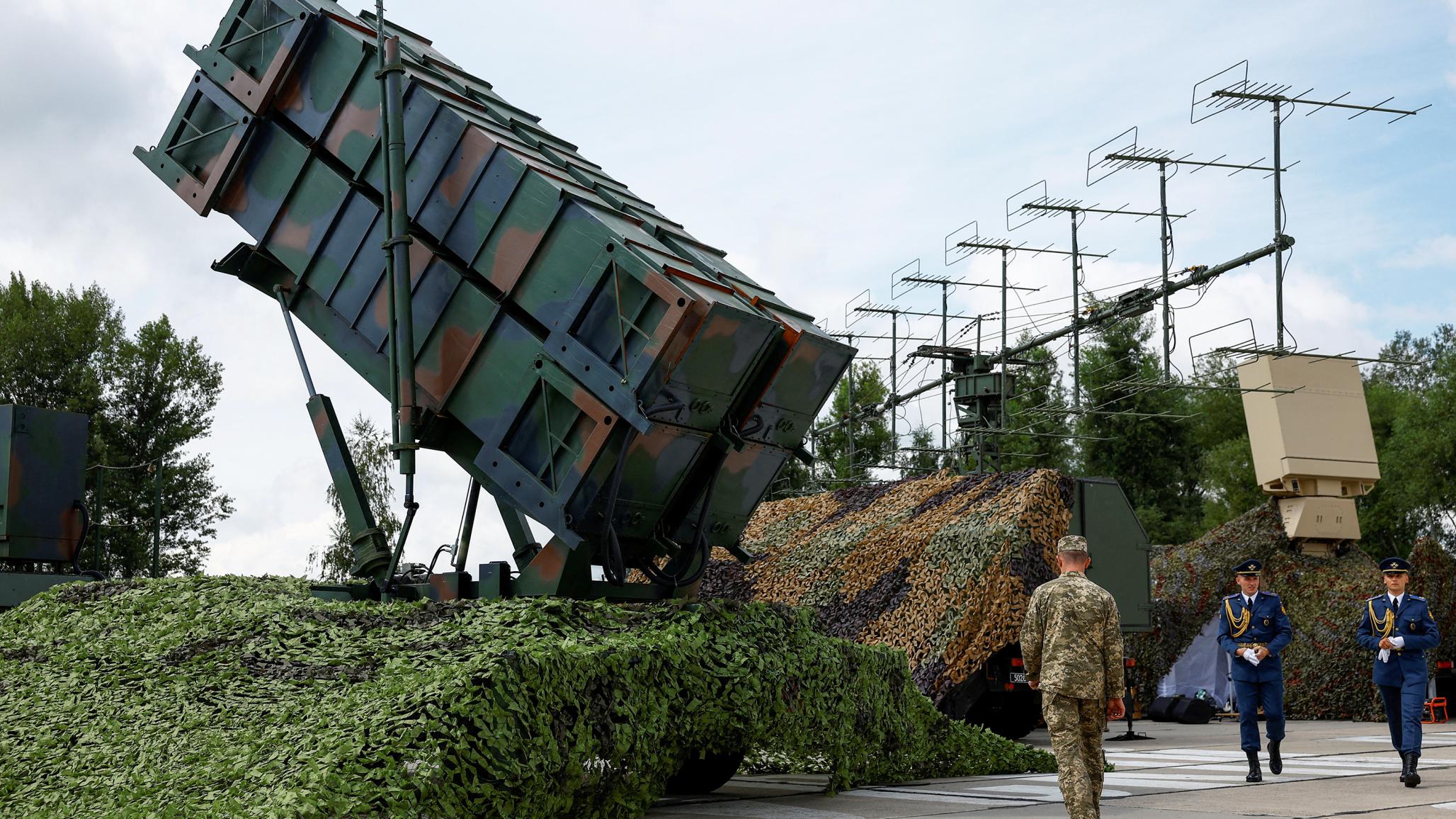
In signaling a sharper focus on common European security, European Commission President Ursula von der Leyen's September 16, 2026, State of the Union address was unsurprising. But one sentence deserves more attention. Von der Leyen referenced Freyja, a joint Europe-Ukraine antiballistic missile-defense project. This could mark a positive step in a context in which Kyiv endures barrages of Russian missiles and drones, while supplies of the anti-ballistic missiles Ukraine needs to defend itself are insufficient.
Patriot interceptors from the United States are becoming harder to obtain. Buying some additional Patriots with EU money will not solve the structural supply problem. A new pan-European missile defense system is thus critical. Freyja brings together companies, innovation and technology from Ukraine, Denmark, France, Germany, Italy, the Netherlands, Norway, Spain, Sweden, and the United Kingdom. At an estimated $700,000 per interceptor, Freyja—for which there could be a prototype by mid-2027—could offer a European-produced alternative at roughly one-fifth of the cost of a Patriot missile.
Freyja is one of many defense partnerships between European and Ukrainian firms that have already been formed. Warfare is changing rapidly and rapid adaptation is both a military necessity and a necessity for the entire defense industrial base. At least 180 international business-to-business partnerships involving Ukraine have been formed, of which 20 percent are with German firms, 10 percent with Danish firms, and 9 percent with US firms.
Further EU funding for Ukrainian security should emphasize cooperation between European and Ukrainian defense firms for three reasons.
First, it would strengthen both Ukrainian and European security. A European missile-defense system developed with Ukraine and produced in Europe will reduce dependence on the US and restore deterrence in Europe.
Second, testing weapons in real combat in Ukraine will give European defense firms an opportunity to become world-class. The European defense industry has spent decades building advanced components, sensors, radars, and guidance electronics. With Ukraine, it can integrate them into a complete, active defense system, then test and refine them against a sophisticated enemy. In Ukraine, the feedback loop between the battlefield and the factory has been compressed into weeks and months, rather than decades—and the Brave1 Test in Ukraine program has already been established to facilitate this.
Third, innovation that comes out of Europe-Ukraine cooperation will not stay within the defense sector. Modular, rapidly upgradable systems built under wartime cost and time pressures will push advances in manufacturing, software and hardware interaction, sensor fusion (combining data from multiple sources), and supply chain resilience. These will have civilian applications, in the same way that defense research during the Cold War seeded decades of dual-use innovation, from satellite navigation to the internet.
However, Europe-Ukraine cooperation is not without challenges. More than one in five Europe-Ukraine industrial partnerships stalled postlaunch. Partnerships led by private Ukrainian firms succeed roughly 96 percent of the time, against 62 percent for state-owned enterprises. The gap reflects how much cooperation depends on informal speed and flexibility, rather than predictable rules. Financing is similarly fragmented. Denmark's channeling of funds directly through Ukraine's Defence Procurement Agency with strong oversight has proved scalable. But faster bilateral deals involving other partners lack shared mechanisms for setting priorities or monitoring results.
Meanwhile, hold-ups in Ukraine on tying foreign money pledged for security to reform mean Ukraine's 2027 draft budget risks underfunding defense expenditure because of lack of external support. From 2027, a significant share of Ukraine's defense production will have to come from joint ventures with European firms, to replace some US systems and to confront new threats from Russia.
In that context, EU programs, including the European Defence Industry Programme (EDIP), Security Action for Europe (SAFE), and the Ukraine Investment Framework (UIF), are small. They also presuppose that Ukrainian companies already have significant contracts that would make them credible to partners. A cash-constrained Ukrainian procurement budget cannot guarantee such contracts.
Ramping up cooperation between Ukrainian and European defense firms will be difficult. Different models are discussed: from codifying Danish-style cooperation via multilateral mechanisms, possibly via the multilateral Defence, Security, and Resilience Bank or a Multilateral Defence Mechanism, to a new cooperation agreement between the EU and Ukraine.
Whichever is chosen, joint ventures and their financing need to grow significantly to meet Ukrainian and European defense needs, serving the Ukrainian front line and rebuilding European stocks. There should be a move from project-by-project grants to multiyear purchase commitments large enough to make joint ventures bankable in Europe. The challenge is to turn Freyja and projects like it into a functioning and scaled Europe-Ukraine defense cooperation system.
Nataliia Shapoval is chairwoman of the KSE Institute (Kyiv School of Economics). Guntram B. Wolff is a senior fellow at Bruegel.
Data Disclosure
This publication does not include a replication package.

© Bruegel. Reposted with permission.