
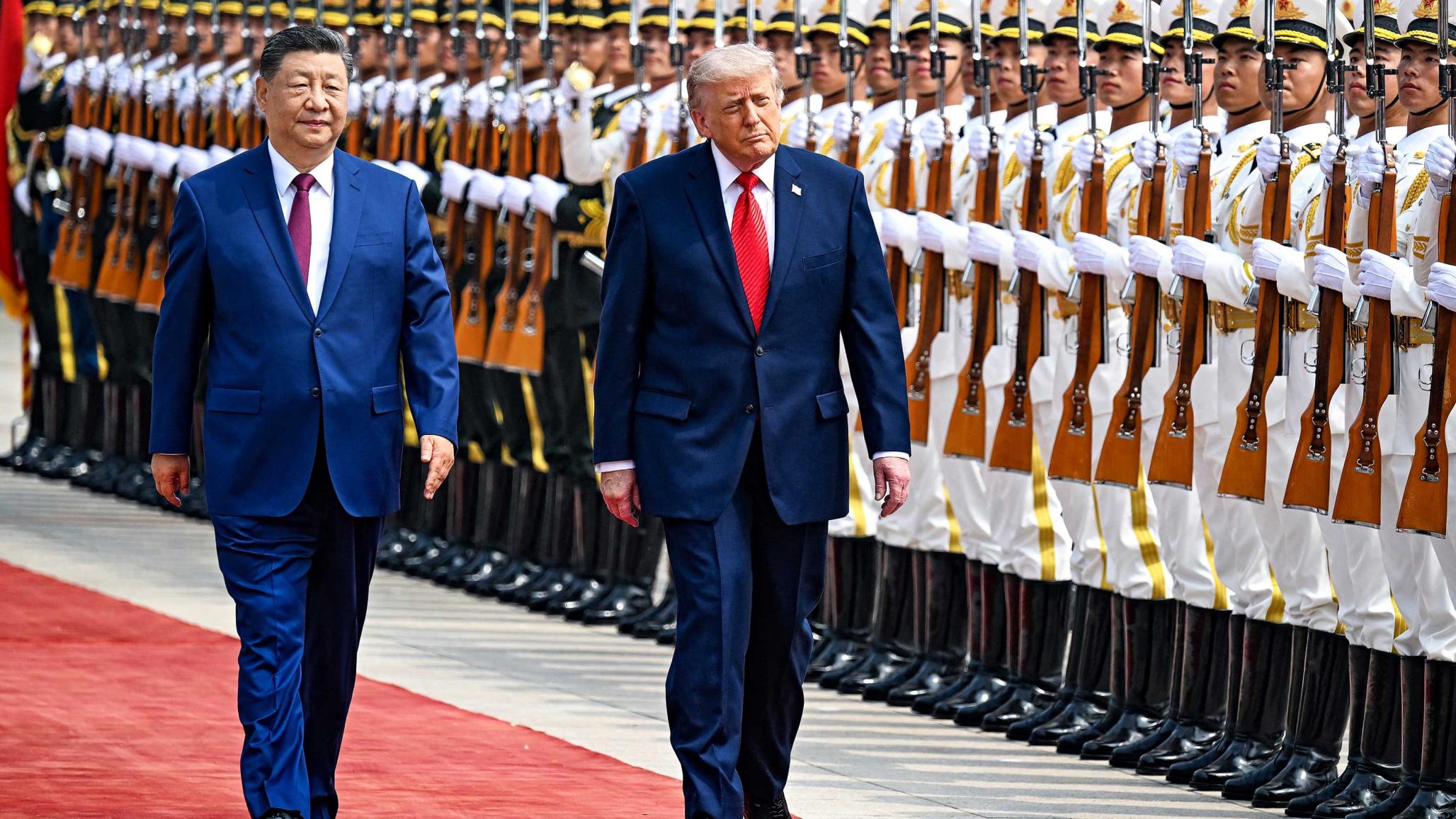
US Secretary of Defense Pete Hegseth said in a May 2025 speech that China was preparing to invade Taiwan, and he mentioned the self-governing island five times. Twelve months and a Trump-Xi summit later, Hegseth declared that US-China relations were "better than they've been in many years," saying the countries' militaries were communicating, and making no mention of Taiwan. His markedly softer new tone suggests he may earnestly believe Beijing's recent talk of a US-China reset, managed economic competition, and a winding down of the trade war.
But the reality is still sobering. The specific features that make the US-China trade war so dangerous have little to do with optics or a more cautious approach at the podium. The risk of further escalation, and even military conflict, remains because the conditions that have prevented other trade wars from turning violent are not present here.
The typical stylized facts that provide reassurance of eventual peaceful resolution—that trade wars don't typically lead to shooting wars, great powers have too much to lose, and leaders make decisions about war and peace in a dispassionate, rational manner—are either wrong or specifically inapplicable to the situation at hand. The US-China trade war is not a referendum on globalization and openness generally. It's a case study in how the security context and the nature of modern trade interact to make this relationship particularly combustible.
True, most trade wars have not led to armed conflict, and there are good structural reasons why. The post-WWII cases that inform our intuitions of how trade wars begin and end—the Pasta War, the US-Japan semiconductor disputes, the transatlantic steel fights—all shared a key characteristic: The combatants were military allies.
That does not apply to the US-China relationship. What does apply is a set of structural features that are historically novel, combined with two leaders for whom the trade war has become something more than an economic policy dispute. Because of these factors, the US-China conflict does not fit four stylized facts that characterize the historical patterns of other post-WWII trade wars. Analyzing these historical differences and similarities reveals why the US-China conflict is the most dangerous trade war in over a century.
- Most trade wars have not led to armed conflict. Trade wars, or disputes in which two or more countries use tools like tariffs, import quotas, and currency manipulation to restrict each other's access to their home markets, generally do not lead to shooting wars. This does not make trade unique: Most international disputes—whether over territory, shared natural resources like rivers, or policy disagreements—do not lead to armed conflict. War is costly in blood and treasure, unpredictable both in its course and consequences, and risky for leaders who initiate it. Competing claims and policy disputes are omnipresent in the international system; war is rare.
- Many post-WWII trade wars have involved the United States and its security clients in Europe and Asia, and are thus a misleading basis for drawing conclusions about any link between trade wars and shooting wars. The Pasta War of 1985–86 (United States versus European Economic Community) or the US-Japan trade wars of the 1980s and 1990s were always delimited by the simple fact that Europe and Japan were—and remain—deeply reliant on US alliances, forward bases, arms sales and transfers, and the US nuclear deterrent for security. But the incentives were not one-sided: US grand strategists assessed that the costs of import competition from Japan and Germany were outweighed by the benefits of having vibrant capitalist economies on the Soviet Union's eastern and western flanks. The current situation bears no resemblance to these episodes.
- Trade wars are easier to start than end. Whatever sparks a trade war, the political economy of protectionism—which favors smaller, better organized groups with more skin in the game over domestic consumers, who have less riding on the outcome—tilts political incentives toward escalation. Between countries, the logic is similar: Once a war starts, it is natural for each side to want to "win"—even if the most likely outcome is a costly stalemate. The escalation-biased political economy of trade wars is manageable when the hard security realities of alliance politics (see previous point) put a ceiling on the conflict. But there is no such ceiling governing US-China competition.
- Pre-WWII trade wars were different in character. Before the 20th century, trade wars tended to pit the raw materials and finished goods of one country against those of another: Supply chains were mostly domestic (or from respective colonial empires), so a stand-off over agricultural goods or industrial machinery was a battle for market share. In the modern global economy, trade in intermediate goods—goods that get made into another good before reaching the final buyer, like auto parts—surpasses trade in finished goods. Intermediate goods have been a larger share of global trade than finished goods for most of the postwar era, meaning that post-war trade wars have the potential for much vaster collateral damage across the economy.
Modern trade wars don't just affect market share—they affect the ability of economies to produce finished goods at all. Recent flashpoints over critical minerals and neodymium magnets make this clear. China produces nearly 80 percent of the world's neodymium magnets, a key input in everything from electric vehicles to guitar speakers. When China imposed export controls on rare earth materials and magnets in April 2025, it wasn't targeting finished goods competing with American products—it was targeting the ability of American (as well as European and Japanese) manufacturers to make their own finished goods. No neodymium, no magnets; no magnets, no motors; no motors, no electric vehicles. A pre-WWII trade war could not have been waged this way, because the supply chains that make this kind of leverage possible didn't exist. If old trade wars were 17th century–style battles—legible, fought by symmetrically armed and organized forces, the US-China trade war is more like medieval siege warfare.
In contrast, the US-China trade war is historically unique: It involves security rivals, not patrons and clients, and the competition is not principally over finished goods but over the inputs that determine who can make the next generation of finished goods or services (think artificial intelligence and semiconductors) at all. The collateral damage falls on industries with no stake in the original dispute—a school music program that can no longer afford student violins has nothing to do with electric vehicles or leading-edge semiconductors, but it pays the price anyway. This is not an argument against trade—it is an argument against the combination of deep integration and growing strategic rivalry.
The closest historical precedent might be the trade war and arms race between Germany and the United Kingdom that preceded World War I, making it among the most sobering of all cautionary tales. But on further inspection, that conflict was less about the bilateral relationship per se than about competing in third markets during a period where mercantilist logic predominated. Germany and the United Kingdom continued to trade a mix of finished and intermediate goods during the period according to their revealed comparative advantage (Germany exporting iron, steel, and chemicals, as well as sugar, the United Kingdom exporting coal, textiles, and re-exporting raw materials from its empire) even as they competed for spheres of influence abroad. And while this competition certainly had implications for how Germany and the United Kingdom responded to the assassination of Austrian archduke Franz Ferdinand, they were not the cause of the assassination or the ensuing rapid escalation that set off WWI. The Germany-UK case may be the closest precedent we have, but it still obfuscates as much as it illuminates.
None of this means a US-China shooting war is very likely. Mutually-assured destruction, continued economic interdependence—the US-China trading relationship is still the third-largest bilateral trade relationship in the world—and sheer costliness of great power conflict all still operate as brakes on US-China escalation.
But the US-China trade war is unusual in that the factors that have historically helped resolve globalization-era trade wars peacefully—a shared security umbrella, diplomatic off-ramps or credible third-party mediators, the mutual recognition that the relationship is worth preserving—are either absent or severely weakened. What remains are two leaders for whom the perceived costs of backing down may outweigh the mounting damage to their own economies.
Very few people rise to positions like president of the United States or general secretary of the Chinese Communist Party without great ambition.1 But even among heads of state, Donald Trump and Xi Jinping are extreme in the degree to which they see the world through the lens of personal legacy and historic destiny—Trump as the president who restored American dominance and settled long-standing scores, Xi as the statesman who completed China's century-long national renewal. For both men, the trade war is not primarily an economic policy instrument. It is a test of will, and being seen to lose that test may feel more costly than any economic damage. So, for both countries—and by extension, the rest of the world—the costs are mounting while the risk of more violent conflict remains.
These costs are not the costs of economic openness, generally speaking: They are the costs of openness between adversaries, without guardrails, managed by leaders who prioritize personal legacy over prosperity. These are highly specific circumstances, and they provide no rationale for the vast majority of countries trading the vast majority of products to embrace economic nationalism.
Note
1. George Washington, Gerald Ford, and Jiang Zemin are the only counterexamples that really come to mind.
Data Disclosure
This publication does not include a replication package.
