
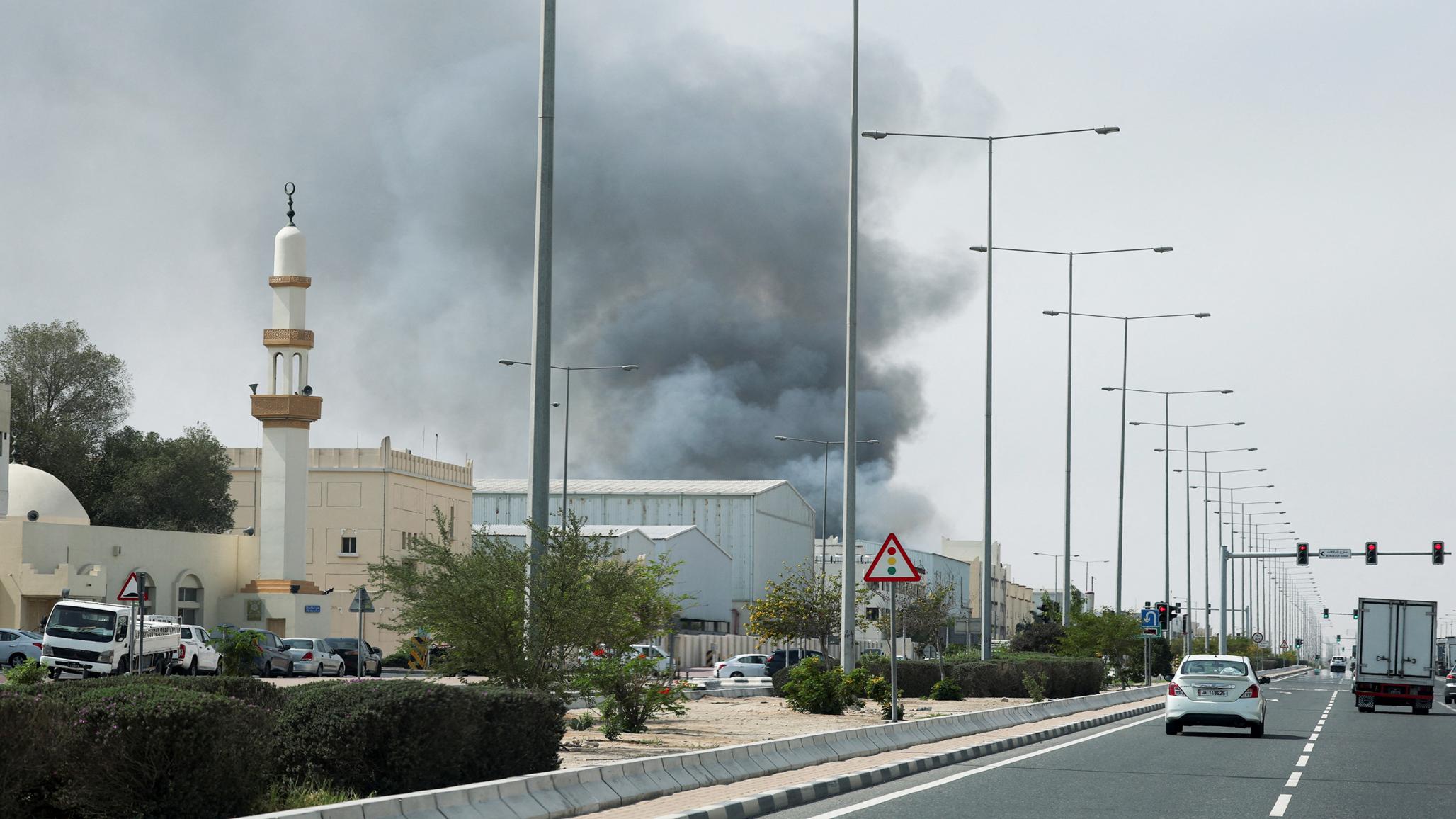
The expanding war in Iran is disrupting, if not devastating, the global economy. Meanwhile, the sound of silence from normally voluble leaders of China and Russia is telling. From their point of view, silence is the best way for them to let Washington entangle itself in a protracted war in the Middle East, opening space to expand the influence of President Vladimir Putin of Russia in Europe and for President Xi Jinping of China in the Indo-Pacific.
Iran’s strategy of closing the Strait of Hormuz using naval mines, coastal missile batteries, and drone swarms is holding the global economy hostage as energy prices have surged. If the US plan with Iran was to mirror the Venezuela playbook by achieving a swift, overwhelming action to remove a perceived threat and declare victory, it has backfired horribly.
Meantime, China and Russia are sitting on the sidelines. Why? China is dependent on Iran, which supplies 13 percent of China’s oil imports at discounted prices. Since 2021, Iran has been locked into a 25-year cooperation agreement with Beijing, securing $400 billion of oil at below-market prices in exchange for Chinese investment and security cooperation. Russia, for its part, has relied on Iran as its most important Middle Eastern partner since Western sanctions on Russia began in 2014. Both countries had been propping up Tehran financially, militarily, and diplomatically for years. Yet their response to the strikes amounts to little more than condemnations of the US.
One would expect more from Moscow and Beijing. But their muted response is not a mistake. It is a strategic calculation: why interrupt a war waged by the US as it is getting stuck in an expensive quagmire in the Middle East? Both Russia and China are benefiting from this war in many ways.
Russia’s Ukraine focus has achieved a fiscal windfall
Russia’s muted response reflects, first and foremost, the constraint on its capacity to intervene. The war in Ukraine has exhausted Moscow’s military and financial bandwidth, and the Kremlin is determined to use its remaining leverage to win its war in Ukraine. Moscow will not come to the rescue of any regime when doing so conflicts with that primary objective.
But restraint should not be confused with inaction. Russia has been providing Iran with satellite imagery on the locations and movements of American troops, ships, and aircraft. Russia also likely advised Iran on drone tactics. It is no accident that Iran’s strike patterns resemble the Russian approach in Ukraine—swarms of drones hitting infrastructure followed by precision strikes on radar and command-and-control systems. Russia sees Iran’s defense as a direct tit-for-tat for Western support to Ukraine’s targeting capabilities. Washington has not only chosen not to publicly confront this Russian escalation but also delivered a windfall to Russia by temporarily waiving sanctions so that Russia can export oil to its customers. This action validates Putin’s logic of calibrated ambiguity: condemning the attacks while avoiding criticizing President Donald Trump directly.
The financial windfall for Russia is dramatic. Before the Iran crisis, Russia’s energy revenues were in freefall: oil export earnings had fallen below $10 billion in February. The Kremlin was reportedly preparing 10 percent cuts to all non-security spending. The Trump administration's easing of sanctions on Russia could not have come at a better time.
According to a report by the KSE Institute, Russia could get as much as $45 billion–$151 billion in additional budget revenues in 2026, depending on the conflict’s duration, when you also account for the recovery of suppressed export volumes—sanctions have recently pushed Russian exports down—and the narrowing of the discount on Russian crude, as well as revenues from other energy exports. Even in an optimistic scenario—a six-week war with fast recovery—Russia earns an additional $84 billion in export earnings and $45 billion in budget revenues compared to a no-war baseline. In the central scenario of a three-month war, the windfall reaches $161 billion in additional export revenues—roughly $0.5 billion a day—with an extra $97 billion in budget revenues, more than Russia’s entire 2025 fiscal deficit. In a pessimistic six-month scenario, Russia could run a budget surplus and replenish its sovereign wealth fund, sustaining elevated war spending for years to come.
Russia’s renewed nuclear signaling is a strategic reminder that Russia is different from Venezuela or Iran—it is a nuclear power. Most of Russia’s rhetoric has carefully avoided direct criticism of Trump personally. Putin likely remains hopeful that Trump will continue to side with Russia in Ukraine, as US Treasury sanctions relief on Russian oil already suggests. This sanctions relief will boost budget revenues without meaningfully increasing global supply. In the meantime, a US consumed by the Middle East frees Russia to consolidate its sphere of influence in Europe—including pursuing maximalist demands in Ukraine—while additional energy revenues provide the financial means to open new fronts, hybrid or otherwise.
It is not all bleak for Ukraine and Europe, however. American-made air defense systems like the Patriot are expensive, scarce, and carry long lead times—the economics of shooting down a $35,000 Iranian drone with a $3.7 million Patriot interceptor are unsustainable. But Ukraine has gained revenue and leverage because Gulf countries and the US have turned to Ukraine for its unequalled expertise in interceptor drones, layered air defense, and electronic warfare at low cost and at scale. In Ukraine, drones now engage 80–85 percent of frontline targets, and some of these drones cost only $800–$7,000 apiece. Ukraine can leverage its expertise to shift the power dynamics with Western partners; it can be a factory to produce innovative drones at scale, rather than just a recipient of aid. The change in war dynamics in the Middle East will also drive the much-needed capital to Ukraine’s defense industry. That is the foundation on which Europe’s own rearmament can be built—with Ukraine as a contributor, not just a recipient.
China emerges as a strategic winner
China is positioned to benefit as well, despite its dependence on the Gulf for oil. The Strait of Hormuz carries roughly 5.4 million barrels per day to China from Gulf suppliers, more than double what it receives from Russia. Beijing, therefore, has a genuine stake in the reopening of the Strait. But it has no incentive to help Washington do it. Instead, China has been doing something more subtle: engaging in direct diplomacy with Tehran to secure safe passage for Chinese-flagged vessels, with over 11 million barrels of Iranian crude continuing to flow eastward in the conflict’s first weeks alone, paid for in renminbi through China’s Cross-Border International Payment System (CIPS).[1]
China had been preparing for the risk of disruption of its oil supplies. Perhaps anticipating an attack by the US and Israel, China surged oil imports in January and February alone by 16 percent, with Russia exporting around 300,000 additional barrels per day to China. These actions brought Russian seaborne exports to China to around 2.1 million barrels per day. China’s combined strategic and commercial reserves now stand at 1.3 billion to 1.4 billion barrels, covering roughly four months of imports. China was filling its tanks while Russian oil was still heavily discounted and before markets priced in the coming disruption.
China’s gains extend well beyond energy resilience. Unlike the US, which entered the conflict with lingering inflation, China was suffering from deflation: falling factory prices, barely 1 percent wage growth, and the risk of a Japan-style stagnation trap. A moderate oil-price rise is reflationary for Beijing. China absorbs this inflation better than rivals because it buys Russian crude at a steep long-term discount, holds vast reserves, and its integrated refining sector partly offsets pricier crude. As a result, Chinese factory goods stay competitive as Western input costs rise faster.
On the other hand, China’s geopolitical risks are significant. If the US achieves dominance in Iran—dismantling its regional influence, installing a more pliable regime—Beijing’s hard-won diplomatic gains in the region would be undermined, even if China were ready to work with any regime in Iran that could benefit it economically. The 2023 Saudi-Iran rapprochement, brokered by China under its Global Security Initiative, was a landmark achievement in countering US dominance in the Gulf. Beijing had been building influence by pushing for Iran’s admission to the Shanghai Cooperation Organization (SCO) and BRICS led by China, Russia, Brazil, and India, as part of a multipolar architecture Beijing is shaping to its liking. A US victory in Iran might unravel all of that architecture and signal to the Global South that China’s security guarantees are hollow. Conversely, a US withdrawal—forced by domestic costs, Iranian resilience, or both—would open space for expanded Chinese diplomacy and investment across the region.
There is also an intelligence dimension that goes beyond the current conflict. Observing US naval operations in the Gulf in real time—carrier movements, missile intercept patterns, logistics flows—is itself strategically valuable for China as it thinks through scenarios involving the Strait of Taiwan. The more the US deploys and reveals its operational playbook and weaknesses in the Gulf, the better calibrated Beijing’s own planning for a military takeover of Taiwan becomes.
The biggest downside risk from the war is a severe global recession. China’s economy remains structurally dependent on export demand. Europe alone absorbs 15 percent of Chinese exports. A sustained energy shock that tips Europe and the US into recession would collapse Chinese export orders, compound the ongoing property crisis, and expose the weakness of domestic demand, which remains squeezed by a property crash. Standard modeling suggests China’s GDP falls roughly 0.5 percent for every 25 percent rise in oil prices. And unlike Western governments, Beijing has little fiscal room to protect consumers: the 2026 deficit target leaves no space for consumption-side stimulus.
Stuck in a quagmire, the US faces tough choices
The US-Israel war on Iran has not only produced a military stalemate but also undermined the credibility of the US sanctions regime by demonstrating again that the US is bound to yield the moment energy prices risk rising at home, particularly ahead of the elections. The US Treasury’s extension of sanctions relief on Russian oil—described as a narrow market-stabilization measure—has political consequences in the US and abroad, because it has led to Moscow providing Iran with satellite targeting data on American troops, ships, and aircraft. This is the first major relaxation of sanctions on Russia since 2014 and risks completely eroding the already weak credibility of the regime. Every dollar Russia saves from narrowed oil discounts finances the war in Ukraine.
Second, with Brent crude having surged from below $70 in late February to above $120 before settling into a volatile $90–$100 range, the Federal Reserve confronts a difficult choice: hike rates to fight rising energy-driven inflation and risk tipping a slowing economy into recession, or cut rates to support growth and risk letting inflation run. The US risks walking into a stagflation trap that was entirely avoidable.
The US struck Iran purportedly to prevent nuclear proliferation. Instead, it risks getting stuck in an uncertain, expensive quagmire. Meanwhile, Russia and China stand to quietly benefit, even if some might say they have demonstrated themselves as fair-weather partners to Iran and Venezuela. The fact is that neither has ever committed to the security guarantees for these authoritarian regimes in a way that Western leaders tend to understand them. Russia and China both are and have been, first and foremost, focused on objectives closer to home. As a result of the US-Israel war on Iran, Russia receives a fiscal rescue worth tens of billions of dollars, while China's strategic position is potentially strengthened. The US sanctions regime—already fragile—is further hollowed out by the administration's waivers. Finally, the US-European alliance deteriorates further as US weapons and attention are diverted toward the Middle East. This is more than Moscow and Beijing could have hoped for—even if they had planned it.
Alicia García Herrero is a senior fellow at Bruegel and an adjunct professor at the Hong Kong University of Science and Technology.
Note
1. CIPS enables renminbi transactions to bypass the SWIFT network by using its own dedicated messaging and settlement infrastructure. As a result, these transactions can avoid Western sanctions because they do not need to rely on SWIFT, which is monitored by the US and its allies for enforcing financial restrictions.
Data Disclosure
This publication does not include a replication package.
