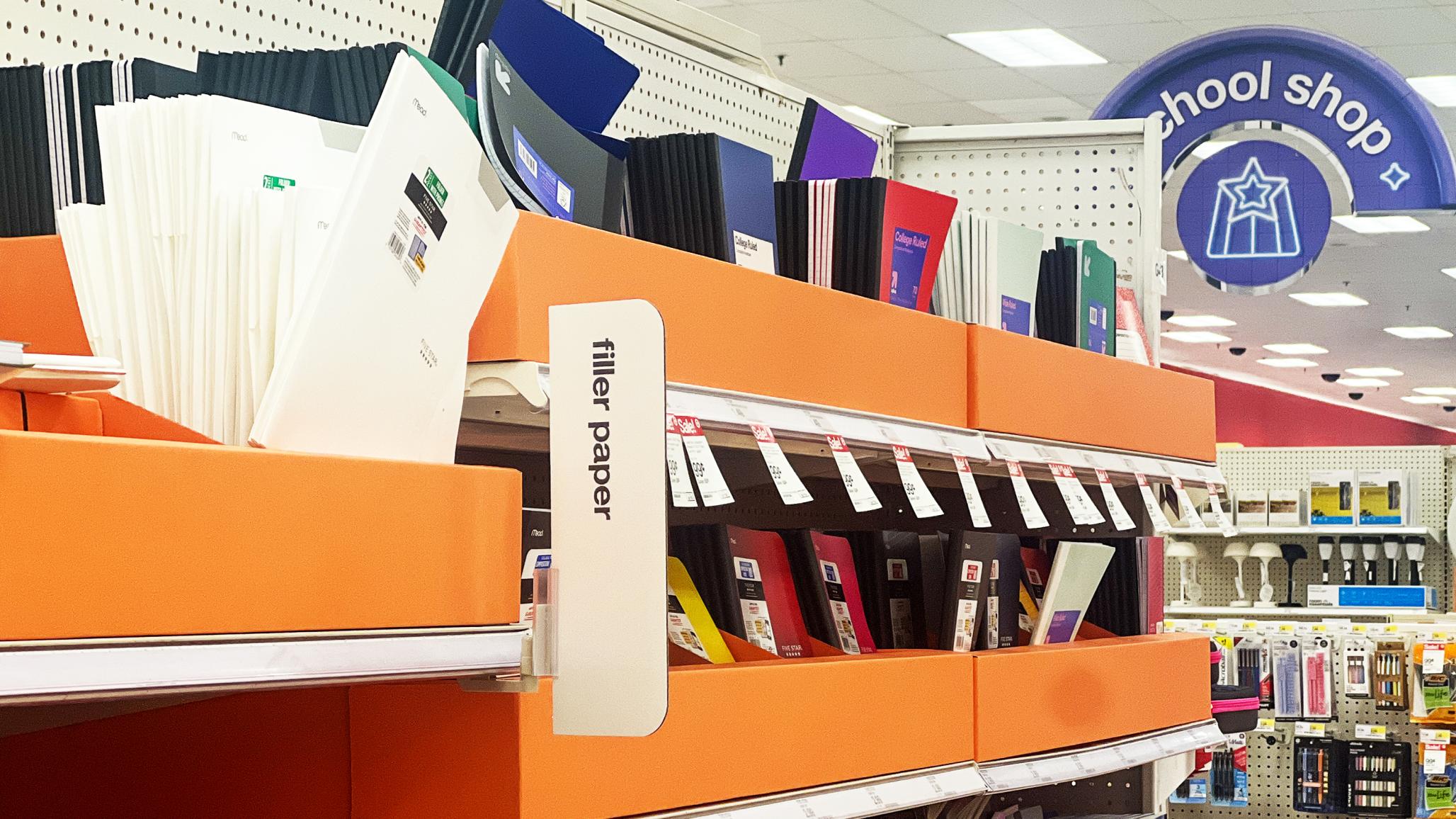
Autumn means back-to-school shopping for many households. This year, consumers face higher prices for many basic supplies because of President Donald Trump's tariffs.
Backpacks, calculators, notebooks, and shoes are among the products in six categories hit with higher tariffs since he returned to the presidency in early 2025. Nationally, the annual tariff costs for these goods are projected to average $79 higher per US household this year than in 2024.
The table below shows the change in US tariff revenue, expressed as a percentage of the goods' total import value (cost, insurance, and freight, or CIF value) for selected categories of products between the first half of 2024 and the first half of 2026. Tariff revenue rose by 6 to 13 percentage points in each of six different school-related categories, but it barely changed for tablets and laptops. Tariff revenue from these goods increased the most for school backpacks, by about 13 percentage points, followed by footwear and calculators. The United States depends heavily on imports for these basic low-cost products.
| Tariff revenue and total import values (cost, insurance, and freight, or CIF values) for selected back-to-school goods and estimated increase in import cost, Jan-Jun 2024 and Jan-Jun 2026 | ||||||||
| Selected products |
Monthly tariff revenue, millions of dollars |
Total import value (CIF),millions of dollars |
Monthly tariff revenue as percent of monthly total import value (CIF) |
Difference between 2024 and 2026 tariff revenue as a percentage of CIF import values, Jan-June |
Calculated increased cost in Jan-Jun 2026,millions of dollars |
|||
|
Jan–Jun 2024 |
Jan–Jun 2026 |
Jan–Jun 2024 |
Jan–Jun 2026 |
Jan–Jun 2024 |
Jan–Jun 2026 |
|||
| Calculators |
1.37 |
7.72 |
51.52 |
59.11 |
2.7% |
13.1% |
10.4% |
6.14 |
| Clothing |
5,267.95 |
8,804.93 |
38,116.27 |
37,049.05 |
13.8% |
23.8% |
9.9% |
3,684.48 |
| Footwear |
1,564.00 |
3,037.91 |
13,434.44 |
13,475.02 |
11.6% |
22.5% |
10.9% |
1,469.19 |
| Notebooks |
32.2 |
61.32 |
548.27 |
500.27 |
5.9% |
12.3% |
6.4% |
31.94 |
| Pencils/pens |
49.63 |
105.72 |
821.23 |
740.3 |
6.0% |
14.3% |
8.2% |
60.98 |
| School backpacks |
345.16 |
633.23 |
2,301.60 |
2,276.82 |
15.0% |
27.8% |
12.8% |
291.79 |
| Tablets/laptops |
158.38 |
287.93 |
61,232.53 |
195,665.88 |
0.3% |
0.1% |
-0.1% |
-218.17 |
| Notes: Harmonized System (HS) categories used for the listed products: HS 61-62 for clothing, HS 64 for footwear, HS 8471 for tablets/laptops, HS 4820 for notebooks, HS 9608-9609 for pencils and pens, HS 847010 for calculators, and HS 420292 for backpacks. The calculated increased cost in Jan-Jun 2026 (last column) is the total CIF import value in Jan-Jun 2026, times the difference in tariff revenue ratio between Jan-Jun 2024 and 2026. | ||||||||
| Source: United States International Trade Commission (USITC) DataWeb. | ||||||||
The figure below portrays the table data as a bar chart. Contrary to White House claims, the analysis shows that tariffs result in higher prices of landed imports (in other words, the total cost of imports, shipping and tariffs). In other words, tariffs on school supplies are paid by American households and businesses, not foreign exporters.
The combined cost of Trump's increased tariffs on the products shown in the table and the figure amounts to $5.33 billion for the first half of 2026. At that rate, the total for the full year will be $10.65 billion. Importing firms that pay the tariffs decide how much of their increased costs to pass on to consumers through higher prices. Some firms raise prices by less or by more than the cost of the tariffs. Since US households number approximately 135 million, fifth grade arithmetic indicates that the average annual cost per household would be about $79 higher this year than in 2024.
Data Disclosure
Related Documents
- Document2026-08-26-hufbauer-ye.xlsx (156.37 KB)