
Believe it or not, the holiday shopping season is just around the corner, with holiday lights and artificial Christmas trees already crowding store aisles. Many parents are eager to give presents that encourage young people to put down their screens and pick up something else: a bat and ball, a sketchbook and colored pencils, or a musical instrument. Others want their gamers to have the latest consoles. But if you have an athlete, artist, musician, or gamer on your shopping list, be ready: your gift-giving dollar won't stretch as far as it did in the 2024 holiday shopping season, or even last holiday season, when tariffs on these goods hit a recent peak.[1]
Each of these hobbies runs largely on imported gear, especially the entry-level items most parents buy. Musical instruments, sports equipment, paints, pencils, and crayons are overwhelmingly made abroad. The trade and price data tell a consistent story: tariffs on these goods have eased a bit since last year but remain high, and imports have fallen. Retail prices are higher, and they aren't coming back down despite some tariff relief. Even video games, the hobby many parents are trying to pull kids away from, weren't spared.
Tariffs peaked last holiday season and remain high
Before 2025, imports of these goods—athletic equipment, art supplies, and musical instruments—were lightly taxed at the port. In the 2024 holiday season (September through December), the effective tariff rate, meaning calculated duties as a share of the value of imports for consumption, was 5.6 percent on sports equipment, 5.0 percent on pencils and crayons, and 5.7 percent on instruments. Something else, of course, happened during that window, too: Donald Trump was elected to serve a second term as US president, having campaigned on a pro-tariff platform that he claimed would lead to a manufacturing renaissance.
When Trump returned to office in early 2025, he quickly ratcheted up the trade war against China, where most of these goods are made. By the 2025 holiday season, effective tariff rates had jumped to 27.7 percent on sports equipment, 26.6 percent on pencils and crayons, and 21.2 percent on instruments. The rates have declined a bit since the Supreme Court struck down some of Trump's tariffs, but not by much. Through August,[2] effective rates were 17.2 percent on sports equipment, 16.1 percent on pencils and crayons, and 14.1 percent on instruments.
Higher tariffs mean fewer goods
At least so far, Trump's tariffs have not resulted in a US manufacturing boom, either in terms of employment or construction. They have, however, reduced imports of these goods, a pattern clearly evident in the 2025 data. Holiday-season imports from all countries in 2025 fell 24 percent for musical instruments and 17 percent each for sports equipment and for pencils and crayons, compared with 2024.[3] Football may be life on Ted Lasso, music may nourish the soul, and coloring outside the lines may foster creativity—but for most households these goods are wants, rather than needs, and among the first things households cut when prices climb. In the main, price increases for these imported goods didn't drive consumers to domestically produced alternatives because these products largely don't exist at entry-level prices. Instead, the tariff-driven higher prices destroyed US demand, which here meant fewer kids finding a hockey stick, trumpet, or colored pencils under the tree.
Tariffs are down—but prices are not
Tariff relief has been welcome, especially for the importers of record who are now receiving refunds, little of which is likely to be passed on to the consumers who ultimately paid. But slightly lower tariffs are not translating into lower prices: prices for all three classes of goods rose in 2026 relative to 2025, and they have risen faster than core goods prices (excluding food and energy) since 2024 (see figure). There are three reasons. First, many importers anticipated the Trump tariffs and spent much of 2025 selling stock imported before the tariffs took effect. Prices in 2026 thus reflect the higher tariffs that prevailed until the Supreme Court decision in February 2026. Second, retail prices tend to rise quickly when costs go up and fall slowly, if at all, when they come down, so tariff relief rarely shows up at the register. Third, underlying inflation remains elevated: core consumer prices are up 5.7 percent over the past two years, stoked by spillovers from the war with Iran and large fiscal deficits. This further erodes general purchasing power, forcing harder choices about needs versus wants.
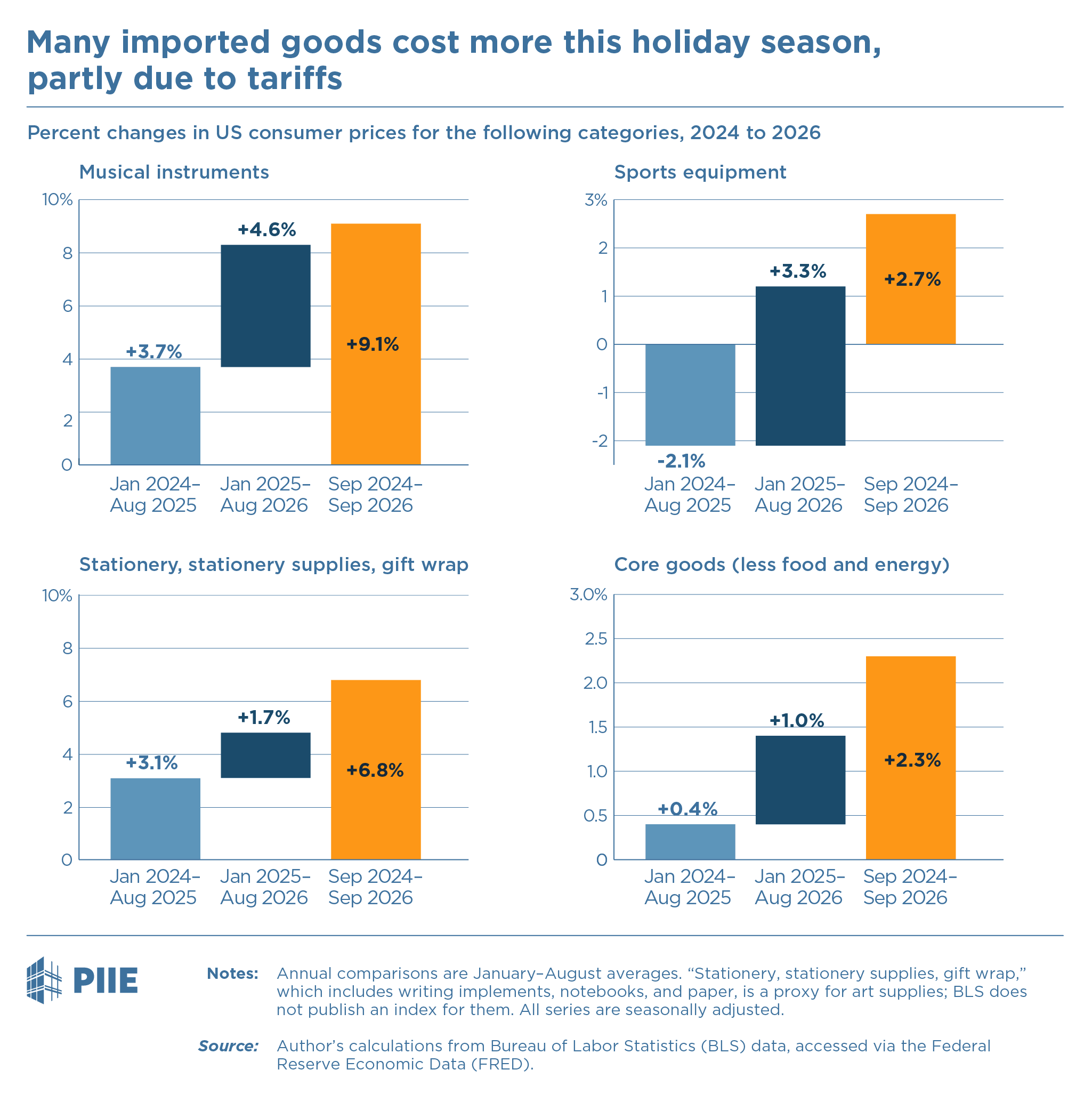
But general inflation can't explain these increases on its own. Core goods prices rose just 2.3 percent over the same period, a small fraction of the 9.1 percent increase for musical instruments. Of the three, musical instruments have been hit hardest, with the steepest price increases and the largest drop in imports.
Video game consoles and machines faced the same tariff surge. Their effective rate went from zero in the 2024 holiday season to 19.7 percent in 2025, and calculated duties rose from nothing to $508 million. Imports spiked in early 2025 as importers front-ran the tariffs and Nintendo launched the Switch 2, then fell 33 percent over the 2025 holiday season; through August 2026 imports were 10 percent below 2024 levels. List prices rose, too, and kept rising.[4]
Why it matters
These economic losses are significant, and not only for US-based sellers of imported instruments, sports equipment, and art supplies. Cheap imported beginner gear doesn't so much compete with American manufacturing as feed it: the kid who learns on an imported starter guitar or drum kit is tomorrow's buyer of a US-made Gibson or Ludwig. Similar dynamics are evident in sporting goods like mountain bikes—Trek makes its entry- and mid-tier models in Asia while producing its top-tier bikes in Wisconsin—and in footballs, where Wilson's Ohio factory makes the NFL's game balls. Firms like these already split production this way, making entry-level lines abroad and high-end ones at home. That is the pattern Bernard, Fort, Smeets, and Warzynski find more broadly: firms that offshore keep making the same goods at home, upgrade to higher-quality varieties, and shift their workforce toward technology jobs. Tariffs on beginner gear thin out the next generation of customers for the very domestic producers they are meant to protect. And the losses are not confined to importers, retailers, or manufacturers.
First, alternatives to screen time are getting harder to come by, even as the US grapples with childhood screen addiction and rising obesity rates. Tariffs raised the price of video games too, but they have also made the alternatives scarcer and, in the case of instruments, considerably more expensive. Second, parents aren't the only buyers. School music, art, and athletic programs buy instruments, sports equipment, paints, and pencils on fixed budgets, so every tariff dollar means less gear for the kids who use it. For many low-income families, those programs are the only point of access: the school-owned trumpet or the team's equipment locker is the only way in. When schools buy less, low-income families feel it first.
Third, much of what is lost simply cannot be priced. The look on a child's face as they unwrap their first guitar, baseball glove, or set of colored pencils lasts a few moments. But the gift itself can lead to a lifetime of playing, competing, and making art—and, for those who eventually stop, a lifelong appreciation of these pursuits. School music, sports, and art programs are how poor and working-class kids like Quincy Jones, Wilma Rudolph, and Andy Warhol started their journeys to becoming global icons. Those losses never show up at any port, but they are real.
Tariffs aren't just taxing imported goods. They're taxing the tactile, offline activities that enrich young lives and feed American culture. Tariffs were supposed to shield American industry, but they haven't: there's no domestic manufacturing revival to show for them. What they may be doing instead is snuffing out the next generation's sparks of passion before they're ever lit. And while the administration has handed out firm-specific tariff relief to producers of many other products, the goods that build skills, human capital, and joy in kids have gotten no such break.
Bah, humbug.
Notes
1. To paraphrase Homer Simpson, "You mean peaked so far."
2. Data cover January through August 2026; August is the most recent month for which USA Trade Online has published data.
3. Imports are measured as imports for consumption, the basis on which Census calculates duties. Values are deflated with the relevant Bureau of Labor Statistics (BLS) import price indexes.
4. Sony raised the price of the PS5 from $499.99 to $549.99 in August 2025 and to $649.99 in April 2026. Microsoft took the Xbox Series X from $499.99 to $799.99 in three steps between May 2025 and August 2026. Nintendo raised the price of the original Switch by $40 in August 2025 and the Switch 2 by $50 this September.
