
The Trump administration has mounted many varied claims to support its trade war, but a central argument is that foreigners, not US citizens, pay the price for tariffs. As discussed in our first blog, even if one thought it appropriate to foist tax burdens onto foreigners, there are more efficient and effective ways to do so. Further, multiple practical issues impede the use of so-called optimal tariffs to improve national welfare. Perhaps the biggest of these is that US households and businesses have borne most of the burden of Trump's tariffs in practice.
Do foreigners pay for tariffs?
The Trump administration (and previously the Trump campaign) has often asserted that foreigners bear the burden of US tariffs, and indeed, the eagerness with which foreign governments have negotiated speaks to the fear of Trump's tariff threats abroad. If foreign export firms could easily redirect exports to other partners without cutting prices, their governments could simply ignore US tariff threats without much consequence.
Still, study after study of the 2018-19 US tariffs found that US buyers of imports suffered essentially the entire burden of the tariffs, with nearly complete pass-through shown in the data.[1] Preliminary assessments of the 2025 tariffs, reviewed in Clausing and Obstfeld (2025), also held that US consumers and firms were likely to bear the vast majority of the burden.
Sixteen months have passed since President Trump's "Liberation Day" tariffs, invoking emergency powers that were later invalidated by the Supreme Court. Since then, multiple sophisticated studies have further clarified the impact of US tariffs. One clear finding from the recent literature is that US consumers are paying higher prices because of the tariffs, although the degree to which US importing firms pass the costs through to US consumer prices varies across studies. One recent study (Minton, Ray, and Somale 2026) finds that pass-through to consumer prices is complete about seven months after implementation, with 1-to-1 price effects. The authors find that tariffs account for the entirety of post-pandemic excess inflation (relative to pre-pandemic inflation). Another examination using earlier data (Cavallo, Llamas, Vasquez 2026) finds clear increases in consumer prices due to tariffs, but incomplete pass-through as of six months after tariff implementation, with a cumulative effect on the consumer price index (CPI) of about 0.8 percentage points by early 2026.
Amiti et al. (2026), Fajgelbaum and Khandelwal (2026), and Gopinath and Neiman (2025) all find a degree of pass-through that implies that US buyers of imports—US consumers and firms together—bore about 90 percent of the tariff burden in 2025. Another recent study finds that US importers bear the full burden of paying the tariffs. It also finds that the quality of US imports has declined (Ahn, Rotunno, and Ruta 2026), illustrating another key mechanism of firm response to tariffs.[2]
Thus, the preponderance of evidence indicates that, as of mid-2026, the incidence of US tariffs burdens US consumers, contributing to today's salient concerns about grocery prices, the high cost of living, and the ever-present laments about affordability. If policymakers desire a quick and easy response to affordability concerns, removing the tariffs would be an obvious answer.[3]
But tariffs take time to affect consumer prices. There are multiple rationales for lagged effects. There is substantial legal and policy uncertainty around the tariffs, as multiple rounds of Trump tariffs have been found unlawful by courts, and the administration has a near constant stream of new trade policy announcements that continue to roil business decisions.[4] In the face of policy uncertainty, firms may be more willing to suffer reduced margins in the short run to avoid price increases that they might have to reverse later. They may pause price increases while lobbying for tariff exemptions or seeking cheaper foreign suppliers (Leibovici and Chinagorom-Abiakalam 2026)—another set of business costs of the tariff regime. Indeed survey evidence suggests that firms are still planning price increases in response to tariffs that were imposed some time ago. Macroeconomic factors can also affect the price impact of tariffs, causing lagged effects on inflation (Halbersleben, Jordà, and Nechio 2026; Kalemli-Ozcan, Soylu, and Yıldırım 2026).
Effect on intermediate business costs
A second clear finding of recent research is that US firms are harmed by the tariffs through higher costs of intermediate inputs. Tariffs reduce exporting firms' ability to compete in foreign markets, since US manufacturers must pay more for imported inputs than their competitors abroad. Even the Trump administration recognizes this dynamic, which is why it has exempted some key firms and industries (including AI) from tariffs on inputs.
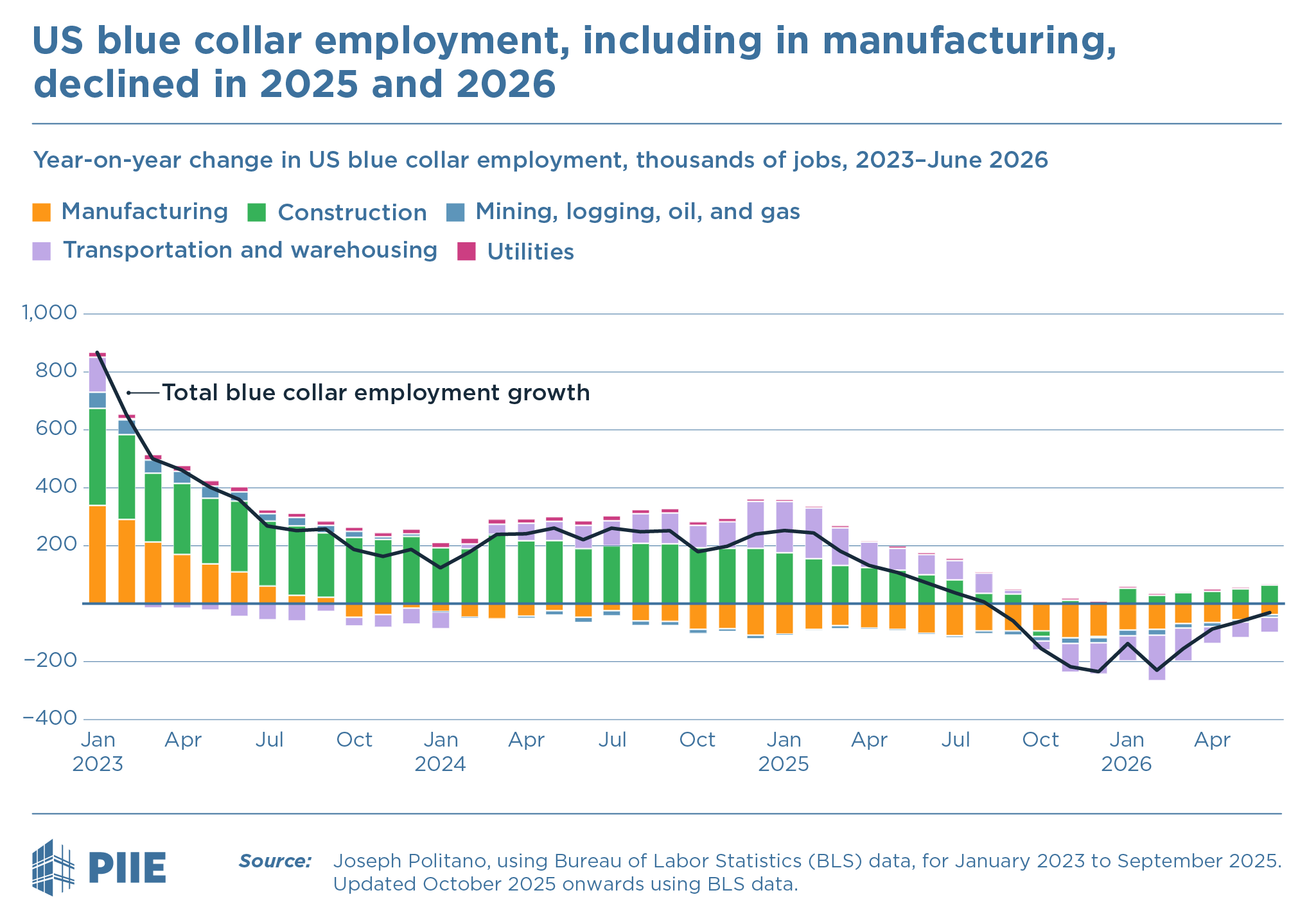
Yet other manufacturing firms are less lucky (e.g., tariffs on steel and aluminum remain), and as a result, the overall jobs picture for blue collar employment has been disappointing at best, as shown in the figure below. The intermediate-input cost channel is also negative for the macroeconomy, one reason den Besten et al. (2026) find that tariffs have tended to have contractionary macroeconomic effects throughout history. Recent analysis from JPMorganChase (2026) notes that midsize firms may be bearing an especially significant cost from tariffs.
In June 2026, Stephen Miran, former chair of President Trump's Council of Economic Advisers, claimed that the One Big Beautiful Bill Act (OBBBA), the 2025 tax legislation, could offset the impact of higher tariffs on US firms' costs of imported intermediate inputs, since these higher costs can simply be deducted due to more generous investment provisions in OBBBA. Any business knows this contention is far from a solution to higher costs. Indeed, most business costs can be immediately deducted, but the business still pays the after-tax cost of their inputs, whether imported or domestic. Indeed, Miran's logic implies that a $25 minimum wage wouldn't be a problem for firms either, since wage costs are deductible.[5]
Forgone scale economies—which normally lower costs for higher trade volumes—can also generate increased costs from tariffs, as tariffs reduce the size of import orders, simultaneously cutting into exporter margins and harming the importers. This one-two punch implies that both parties can together face burdens that total more than 100 percent of the size of the tariff, harming exporters and importers simultaneously due to the loss of scale economies (see Ganapati and Hottman 2026). In short, while tariffs can meaningfully harm foreign exporters, that does not leave US buyers off the hook.
Conclusion
In the end, tariffs hurt everyone: foreign exporters, US importers—both businesses and consumers—US foreign relations, and the US economy writ large. Tariffs also present opportunities for corruption and rent-seeking—including lobbying for exemptions or for new tariffs on competitors—even as they generate distortions that shift resources away from their optimal uses. The "optimal tariff" is a mirage, useful as a classroom exercise but with little practical relevance. The postwar trade system aimed to prevent countries from pursuing it. Sadly, the Trump administration's tariff warfare both undermines that system and, in the end, demonstrates the system's wisdom in the first place.
Authors' note: We thank Ariyasuren Baldansenge, Madona Devasahayam, Samantha Elbouez, Mary Lovely, Benjamin Wallace, and Steven Weisman for their help. All errors and opinions are ours.
Notes
1. See Clausing and Lovely (2024) for a review of those studies, which include Amiti, Redding, and Weinstein (2019), Cavallo et al. (2021), Fajgelbaum et al. (2020a, 2020b), Fajgelbaum and Khandelwal (2022), Flaaen, Hortaçsu, and Tintelnot (2020), and Houde and Wang (2023).
2. Bai, Jaccard, and Stumpner (2026) also show a novel mechanism of firm response, using scanner-level consumer price data during the 2018-2019 China tariff episode. They find full tariff pass-through into consumer retail prices alongside a quantitatively important product replacement channel, whereby old products were replaced by new products (with different bar codes) that had higher price/weight ratios ("shrinkflation"). This mechanism can explain the combination of full pass-through at the border coupled with more meager retail price increases of existing products.
3. While addressing housing, healthcare, and education costs is likely even more important, those sectors require more difficult and sustained reforms. (But removing tariffs on construction materials would be significant for the building industry.)
4. The Supreme Court ruled the tariffs imposed under the International Emergency Economic Powers Act (IEEPA) unlawful in February 2026. The US International Trade Court ruled that the replacement Section 122 tariffs were also unlawful in May 2026, but that case is being appealed to the federal circuit and it was not resolved prior to the initial expiration date of the Section 122 tariffs (July 24, 2026). The expanded use of Section 301 tariffs to recreate the IEEPA tariff regime is also vulnerable to legal challenges (Wolff 2026). To justify new tariffs on Canada, the administration has invoked Section 338 of the notorious Smoot-Hawley tariff law of 1930.
5. Further, the higher deficits/debt from OBBBA imply higher interest rates, which crowd out domestic investment.
Data Disclosure
Related Documents
- Document2026-08-03-clausing-obstfeld.zip (365.22 KB)


This blog post is the second of a two-part series. See part 1 here.