
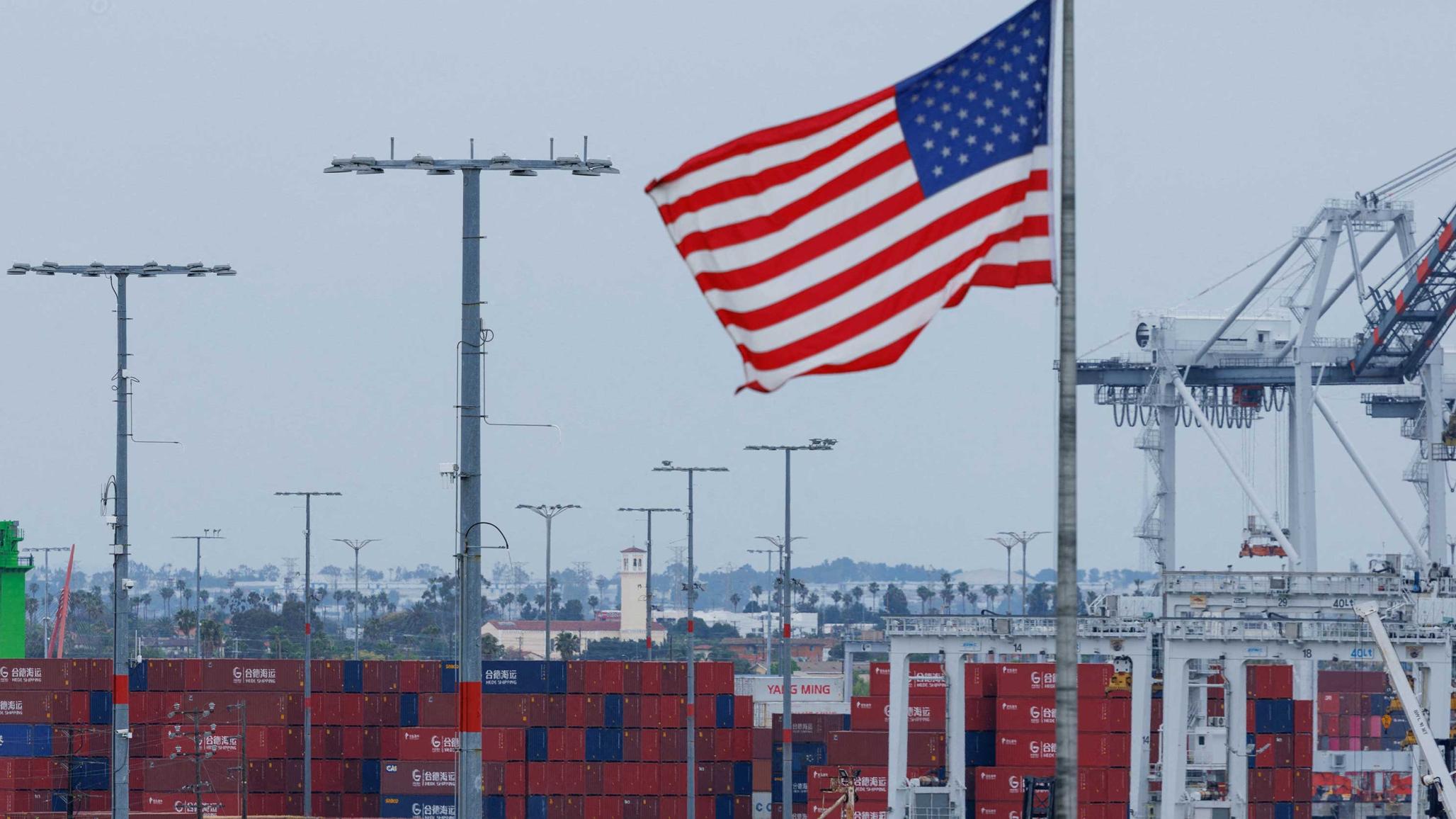
President Donald Trump is continuing his efforts to restore blanket tariffs in place of those struck down by the Supreme Court on February 20. He responded to that ruling by invoking a statute allowing him to impose new temporary tariffs, which already face legal challenges. A look at his latest tariff policy at this point shows it is creating continued uncertainty, added costs, and promises no clear benefits.
US tariffs now average just over 12 percent, up from around 2.5 percent the day before Trump began his second term as president on January 20, 2025, but down from a temporary peak of 28 percent last year. The average added cost per American household is now around $1,230 per year. The costs for businesses are somewhat harder to measure, as the effects of the 2025 tariffs continue to ripple through supply chains. Meantime, the war in Iran has driven US gasoline prices to as high as $6 per gallon in some parts of the country, and the cost of home heating oil in New England has risen to $5.58 per gallon from $3.60 last December. It is impossible to predict what those prices will look like in a few weeks, and many analysts predict that prices will rise further. The gas and oil prices are the unintended consequences of Trump's military actions. By contrast, he sets the tariff levels consciously, by country and by product.
A procession of authorities to impose tariffs: first IEEPA, now Section 122, and next Section 301
The Supreme Court's recent decision nullified the broad tariffs Trump imposed by claiming authority under the International Emergency Economic Powers Act (IEEPA). To keep his tariffs in place temporarily, the president responded by invoking the balance of payments (BOP) authority contained in Section 122 of the Trade Act of 1974 to an interim additional blanket tariff of 10 percent, which will expire after 150 days unless extended by Congress. (He subsequently said he would raise the level to 15 percent but has not done so yet.) The Trump tariffs first announced on April 2 last year look to be staying with us well into the future.
The current tariffs imposed under BOP authority are merely a halftime interlude in the procession of authorities used to impose these additional charges on imports, first under the IEEPA and next under retaliation authority: The Trump administration is seeking to impose new blanket tariffs on a more durable legal basis. The trade retaliatory authority is contained in Section 301 of the 1974 Trade Act. As the president's trade deals depend on having tariffs of the breadth and heft of his "reciprocal" tariffs that existed until February 20, it is reasonable to expect that he will try to ensure there will be no major gap in tariff coverage after the BOP tariffs expire.
A coalition of 24 attorneys general and governors has sued to block the BOP tariffs, arguing they are unlawful, unprecedented, and based on trade deficits rather than true "balance of payments" crises. This and another lawsuit, filed by the Liberty Justice Center on behalf of Burlap & Barrel and other private plaintiffs, both ask that the Court of International Trade prevent the Trump administration from collecting the tariffs. It is unlikely that the courts will act before the BOP tariffs expire. Given that these tariffs are temporary and that if the government loses, there will be tariff refunds declared once again, the courts are unlikely to see an urgent need to intervene now rather than going on to trial.
In an effort presumably to keep substantial tariffs in place, the US Trade Representative (USTR) just a few days ago launched 76 new Section 301 investigations of acts, policies, and practices that can provide a basis for imposing additional US tariffs—60 investigations for inadequate foreign enforcement against forced labor and 16 investigations concerned with "structural excess manufacturing capacity."
What to expect from Section 301 investigations
Section 301 allows the president and the USTR to impose retaliatory import restrictions against any country that engages in an act, policy, or practice that is unreasonable and burdens US commerce. Section 301 might be harder to dispose of through legal challenge than the prior two tariff assaults. It is clearly a tariff statute, which the court said IEEPA was not. There is no readily accessible legal off-ramp for the courts to take to be found in the wording of this statute to avoid applying tariffs. The Congress clearly gave the president and the USTR wide discretion as to what sort of practices they might deem to be unfair and a burden on US commerce. As opposed to all other trade remedy statutes, there is no independent agency charged with making findings. The USTR is within the executive office of the president and has delegated authority from the president to act.
What should the world expect from these investigations? There are some ominous signs:
- The current tsunami of Section 301 investigations diverges sharply from what has been the norm in administration of this US trade law. Until now, Section 301 cases have been initiated on average at a rate of less than three per year during the fifty years the law has been on the books.
- USTR notes that these cases cover 99 percent of US imports. This is not a coincidence, given the recent Supreme Court decision ruling the far-reaching IEEPA tariffs illegal. This implies that broad coverage is intended.
- The president's trade deals are conditioned on there being Trump tariffs, from which there is remission but leaving a residual base of 10 percent additional tariff still in effect. Not finding an actionable practice for any given country would deprive the president of both the leverage to obtain a deal and the authority to impose the 10 percent remaining tariff.
- The president has heralded the influx of revenues from broadly applied tariffs, including the 10 percent minimum for all imports as a general rule. The likelihood is that the Section 301 findings will be designed to maintain that revenue.
- The subject matter of these investigations should give rise to its own concern. What is being investigated is whether foreign governments have tolerated imports into their countries made by forced labor or whether they have supported structural excess capacity, or both. There is not a lot of precedent, if any, with regard to either of these situations as a basis for trade retaliation, little to give guidance as to what would justify either culpability or exculpation. Were these problems caused by so many countries very threatening, why isn't that obvious from reading recent editions of the USTR's annual National Trade Estimate (NTE) Report, a compendium of foreign practices adversely affecting US trade interests? The major forced labor problem cited involves conditions in a Chinese province. Section 307 of the Tariff Act of 1930 already bans such imports. Nor has the buildup of foreign capacity previously resulted in US retaliatory measures.
The American public and our trading partners should be concerned. Trade retaliation breeds nothing but uncertainty, bringing its own costs and no clear benefits. There are clear signs that the Section 301 investigations appear to be a prelude to an attempt at restoration of the "reciprocal" tariffs canceled by the Supreme Court.
Data Disclosure
This publication does not include a replication package.
