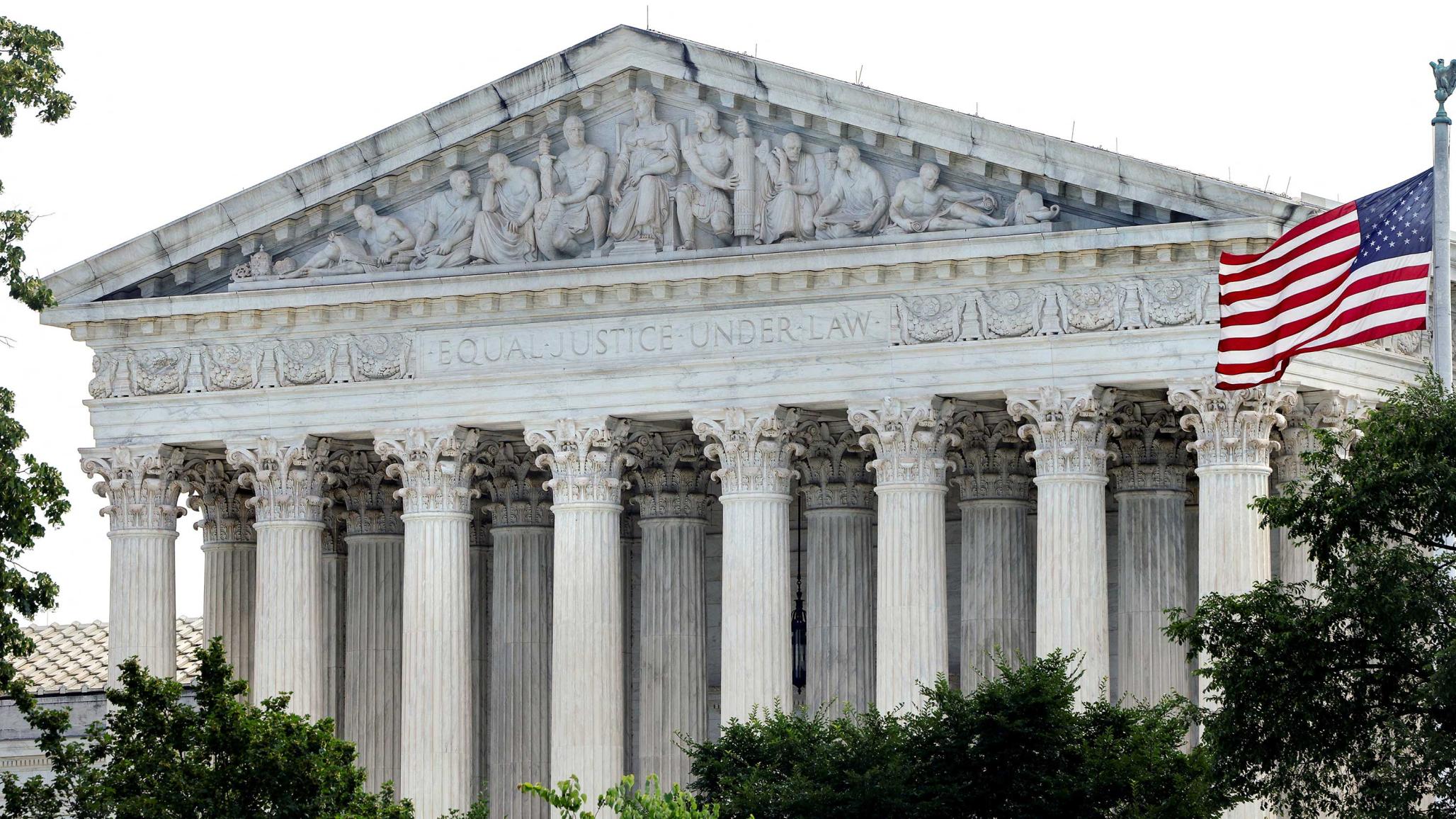
Will President Donald Trump prevail at the Supreme Court on the pending case challenging most of his tariffs? The trial and appellate courts ruled against the “Liberation Day” tariffs he announced on April 2 and the “trafficking tariffs” he says are aimed at curbing drug flows into the US. The lower courts deemed these measures illegal, finding that Congress had not delegated to the president sufficient authority to impose them. When the Supreme Court hears arguments on the tariff case in November, Trump’s legal team will argue that Congress’s delegation of authority under the International Emergency Economic Powers Act (IEEPA), combined with the president’s power to conduct foreign affairs, makes the tariffs legal.
The starting point for weighing the tariffs’ legality is that Article I of the US Constitution grants Congress the power to regulate commerce with foreign nations and to set tariffs. Article II grants the president power over foreign affairs. The president does not have an independent authority to regulate trade and impose tariffs: The president can do so only if Congress delegates that authority. The lower court decisions being reviewed now have focused on the extent to which the Congress can properly delegate trade matters to the president.
Since the earliest days of the Republic, the president and Congress have stayed in their lanes where foreign commerce is involved: Congress passes trade laws and the president implements them. But there also is a long history of the two branches collaborating on international trade since Congress cannot negotiate agreements with foreign countries nor implement them.
Presidents George Washington and Thomas Jefferson were given limited authority to administer trade embargoes that Congress imposed by statute. In modern times, the separation of powers when foreign affairs and trade are both involved is seen in the Reciprocal Trade Agreements Act of 1934 (RTAA). Congress allowed President Franklin D. Roosevelt to commit the nation to maintaining lower tariffs through trade agreements with foreign countries and to implement the pacts within statutorily prescribed limits. Congress repeatedly extended that tariff agreement implementing authority. Starting with the Trade Act of 1974, in what was called Fast Track, Congress gave the president a means of obtaining implementing legislation within a fixed time and without amendment.
Throughout much of 1973 and 1974, Congress vigorously debated the different roles of the two branches as it crafted legislation on nontariff trade barriers. President Richard Nixon’s proposed 1973 trade bill would have allowed the president to change any law to implement a trade agreement if not overidden by either the House or the Senate. Congress rejected the approach as giving too much power to the executive branch.[1] But Congress, in the Trade Act of 1974, did allow the president to enter into trade agreements and implement them, subject to congressional approval by joint resolution and provided that he received negotiating priorities first from the Congress and consulted fully with that body and the private sector. The result was an operating partnership agreement between the two branches that lasted for nearly fifty years. Later renamed Trade Promotion Authority (TPA), it was repeatedly renewed until 2021 when President Joseph R. Biden Jr. allowed it to expire.
Congress usually plays a critical role when the president conducts foreign affairs in ways affecting US trade. The US Supreme Court, in the case of United States v. Curtis Wright Export Corp. (1936), invoked the president’s foreign affairs power to justify Congress delegating to the president the authority to prohibit the sale of arms to countries engaged in conflict. The court noted that the president exercised inherent powers but that he used it to implement a statute passed by Congress. The court held that legislation that affects the international field can accord to the president some greater discretion and freedom that would not be required if it involved domestic affairs alone. Still, that delegation must be clear, bounded, and unambiguous.
Wishing to foster peace in the Middle East, an important foreign policy objective, Presidents Ronald Reagan, Bill Clinton, and George W. Bush all negotiated or signed free trade agreements (FTAs) with Israel and Jordan based on clear authority granted by Congress. Reagan signed the US-Israel FTA in 1985. Clinton signed the US-Jordan FTA in 2000 and helped establish Qualifying Industrial Zones (QIZ) authorized by Congress in the Israel FTA implementing legislation in 1996. George W. Bush later signed the implementation act for the US-Jordan FTA into law in 2001.
In the Trade Act of 1974, Section 122 grants the president authority to impose a tariff for balance of payments purposes, but only under strict bounds set by Congress. Section 301 envisions the US Trade Representative (USTR) entering into agreements with foreign governments to remedy foreign unfair trade practices, but only within limits and under certain conditions set by Congress. A Congressional Research Service paper issued on September 25, 2025, covers much of this history of Congressional delegations of authority to regulate trade. It takes no position on the legality of the Trump tariffs.
There is one precedent that the Supreme Court will definitely consider. This is the case of the United States v. Yoshida International. The case involved a declaration of a national emergency that the Court of Customs and Patent Appeals found to be a basis for President Nixon imposing a temporary import surcharge on August 15, 1971, to deal with a serious balance of payments crisis. The 10 percent additional tariff lasted for four months and was carefully applied so that no tariff would be greater than previously legislated by Congress. In effect, Nixon sought during the emergency to suspend tariffs specified by Congress. The authority under which the surcharge was upheld on appeal to the Court of Customs and Patent Appeals (today’s Federal Circuit Court), however, was a World War I statute, the Trading with the Enemy Act enacted October 5, 1917, (TWEA) which allowed for the declarations of national emergency during which the president could regulate trade. That statute was, however, not cited in Nixon’s proclamation.
Congress enacted several statutes in short order to make sure that the Trading with the Enemy Act authority was never used again to deal with a domestic economic crisis, while preserving the TWEA for use in times of war.
The fact that the United Kingdom, the European Union, Japan, and other economies have struck informal tariff agreements with the Trump administration does not grant the president any new legal authority to impose tariffs. Nor does a national emergency of any dimension change the fact that the president’s foreign affairs power does not include the authority to impose tariffs. The courts have cited the president’s foreign affairs power as a reason to be more open to interpreting delegations of authority more broadly, especially in national security cases under Section 232 of the Trade Expansion Act of 1962. This does not change the basic need for the delegation to be there in the first place.
Conclusion
Why then might the Supreme Court defer to the president, if that is the outcome? Deference would likely be based on packaging several reasons to interpret IEEPA as a sufficiently broad delegation of authority to underpin the broad tariffs. These would include: exercising the foreign affairs power combined with the president’s declarations of national emergency[2] and the fact that an adverse decision by the Court will have a serious economic impact due to the sudden loss of tariff revenues.[3] This amalgam of reasons for finding a massive transfer of tariff authority from the legislative to the executive branch could be advanced as giving rise to an expansive reading of the statutory delegation of authority in IEEPA,[4] brushing aside the nondelegation doctrine (that Congress cannot delegate this much of its constitutional commerce power even if it wanted to) and the major question doctrine (that delegations need to be given extra scrutiny if a large grant of authority is claimed where there is ambiguity in the breadth of the delegation).
Invoking the foreign affairs power to justify Trump’s tariffs would be an attempt to add an aura of legitimacy to them. But that power does not give the president any authority over tariffs beyond what Congress clearly delegates.
The Constitution has been the basis for two and a half centuries of a workable partnership between the legislative and executive branches, in which neither branch has sought to usurp the powers of the other. In the one clear precedent of the president imposing an across-the-board tariff, in Yoshida, the appellate court interpreted a delegation of wartime emergency authority as a valid underpinning of the president’s action. The legislated delegations were subsequently much narrowed. The invocation of the foreign affairs power cannot change the outcome of the question: Was there was an impermissible transfer of tariff authority to the executive branch?
The separation of powers has been respected by the Supreme Court since the founding of the republic. Consider the reverse set of facts. Suppose that after the mid-term elections, the Congress is in the hands of the party in opposition to that of the president. Could the Congress form a Joint Committee on Public Safety that assumes the role of commander-in-chief of the armed forces and orders troops deployed in the states back to their barracks, despite the Constitution in Article II explicitly granting this authority to the president? Obviously, the Congress could not legitimately do so.
The legislative-executive relationship in the field of trade has been one of co-equal branches, each taking the lead in its own area of competence and authority, and working in harmony together.
Notes
1. This is detailed in an article I wrote in 1975, having been the chief draftsman for the Nixon and Ford administrations of the Trade Act of 1974, The Evolution of the Executive-Legislative Relationship in the Trade Act of 1974.
2. Approximately 70 emergencies under IEEPA had been declared before January 20, 2021, with none challenged successfully in the courts and none overturned by Congress.
3. “Too big to fail” was used as a rationale to bail out AIG and a number of other large financial institutions during the Global Financial Crisis, for example. The enormity of the economic challenge did not confer authority on the executive branch to deal with the crisis. Congress provided the authority.
4. This is the path that the dissent at the Federal Circuit in V.O.S. Selections v. Trump took to support the president’s imposition of his broad tariffs. An issue not before the court was whether there might not be narrower tariff authority properly delegated to the president in IEEPA. This would allow, for example, the president to use tariffs as a cudgel to cause countries to mirror stronger US sanctions on Russia (say, India with respect to Russian oil purchases). Were that situation to occur, there would be a link between the use of president’s foreign affairs power and IEEPA to read tariff authority into IEEPA.
Data Disclosure
This publication does not include a replication package.