
Expectations for the upcoming September 24 summit meeting in Washington between Presidents Xi Jinping of China and Donald Trump are not high. That is not to say that the outcome will be insignificant, but no great changes are foreseen in their respective policies. Inertia is a strong force. Age (73 and 80 respectively), temperament (an autocratic belief in the soundness of their own judgment and the correctness of their policies), how entrenched their governments are in their current understanding of their strategic interests—all militate for continued intense rivalry and limited cooperation between the two nations.
One area of cooperation remains an open door—artificial intelligence (AI) safeguards. In other areas, the two leaders' policy directions are incompatible. For Xi, it is a continuation of industrial policy that has by objective measures been astoundingly successful and a concern that the United States will act to keep China down. Trump is not about to lessen his decades-old attraction to high tariffs, and his administration is unlikely to reduce its level of concern over China's rise.
On trade and geopolitics, the best outcome we can expect is continuity. More likely than not the trade truce reached last year at Busan will be extended. Trump has no intention of abandoning a base tariff of something above 10 percent (which is the tariff treatment given nations that were considered closest friends) and will not pledge to give up his flexibility to limit imports selectively, whether in the name of national security or fair trade. Nor can he credibly pledge to refrain from all national security export controls on high end chips, semiconductor production equipment, and software. In return, China will not surrender the option of providing only uncertain access for choke point commodities, e.g., rare earths and critical minerals, and at some point, perhaps, active pharmaceutical ingredients (APIs). Irritants with respect to bilateral trade will likely continue. The United States is unlikely to refrain from trying to slow the flow of indirect imports of Chinese products imbedded in imports from Mexico and Southeast Asia.
The bottom line: An uncomfortable truce can be expected to continue after this summit. In a positive outcome, both sides avoid reigniting the trade war.
Environmental and geopolitical matters are not likely to be discussed at this summit
The list of where the two leaders could aid the planet is not short, but none of the subjects are likely to be taken up at this summit. For example, all environmental issues (e.g., climate change, overfishing, plastic pollution in the oceans) are areas that will remain unattended to. Preparing for future pandemics—a sensitive subject for China—does not appear to be on the agenda. Considering additional disciplines for trade, including transparency and limits on government intervention, whether by subsidy or tariff, is not in the offing.
Similarly, no great breakthroughs are expected on larger geopolitical matters. China is not expected to agree to limit its support for Russia in the latter's aggression against Ukraine nor the help it gives to Iran. Beijing is likely to maintain a noninterventionist approach to most of Iran's regional troublemaking, tempered by its own interest in a relatively free flow of oil. We can expect no great change with respect to Taiwan either (granted, this is a dangerous topic). Xi could be tempted to take a more aggressive approach to reunification by the fact that the US Navy is tied down in the Strait of Hormuz and not deployed heavily in Asia, by US weapons stocks being depleted, and by Washington's attention being concentrated on fuel prices at the pump. Moreover, Trump's pronouncements on the future of the island are hardly reassuring to allies. US support for Taiwan is no more reliable than its commitment to Article 5 of the North Atlantic Treaty Organization (NATO) right now, meaning not very. But it is best for a foreign power not to test either of these conclusions with military adventurism. At this summit, no geopolitical solutions appear to be on offer. Chances are that the tense relationship between the United States and China will continue.
Possible cooperation on AI safeguards?
Much more interesting is the possibility of steps toward future bilateral cooperation on safeguards on AI. Such an outcome would hardly be trivial as chances of relatively near-term human extinction have been forecast by leading AI company CEOs and engineers. They are in the best position to know. It appears that AI has the potential to escape control, leave its sandbox on its own volition and unleash itself against adversary, friend, or supposed master.
The unusual request from industry leaders for government regulation is accompanied by a report from the New York Times that Treasury Secretary Scott Bessent has been actively working on limited engagement with China regarding AI safety. The report that dates from last spring states that Bessent's "approach focuses strictly on narrow risk prevention and maintaining the US technological lead, rather than collaborative global regulations." But industry leaders state very clearly that more is needed, including collaboration with China beyond keeping dangerous uses of AI out of the hands of nonstate actors.
Dario Amodei, CEO of Anthropic, has recently published a 3,800-word essay, entitled We Must Pace the Frontier, calling for a global slowdown in AI development. He is joined in expressing concerns by Jakub Pachocki, chief scientist at OpenAI, who has repeatedly warned that no one is prepared for runaway AI, as did Shane Legg, chief AGI scientist at Google DeepMind, and Shengjia Zhao, chief scientist at Meta AI. More to the point politically, the Amodei essay has been endorsed by Sam Altman, the chief executive of OpenAI; Elon Musk, whose SpaceX has been increasing spending on AI; and Nobel prize winner Demis Hassabis, chair of Google DeepMind and chief scientist of Alphabet, Google's parent company. Amodei is clear that not only must there be close work with democracies but also cooperation with China, knowing that "there will likely be stark limits on what can be achieved." If China defects from an agreement with the West, "such a defection could lead to their geopolitical dominance [and that] we should approach any global pacing decision in such a way that protects the lead of the United States and its allies."
Amodei suggests four levels of an approach with China, each with increasing difficulty in being realized: 1) curbing the most dangerous uses of AI, such as the development of biological weapons; 2) agreeing to test models before release where cybersecurity, biology, and alignment1 are involved; 3) setting some kind of "speed limit" on the rate of recursive self-improvement (RSI); and 4) a full pacing, or even "pause," in which participating governments would agree to substantially limit the overall rate of AI development. Amodei is clear-eyed as to the difficulties involved in realizing his proposal, and in verifying compliance. He simply concludes that it is worth a try: "Any cooperation we are able to achieve with China will extend the amount of time we have to spend on pacing the frontier within the democratic nations." He adds, thoughtfully, that "simply changing informal norms may have some value." When addressing human extinction, that is cold comfort.
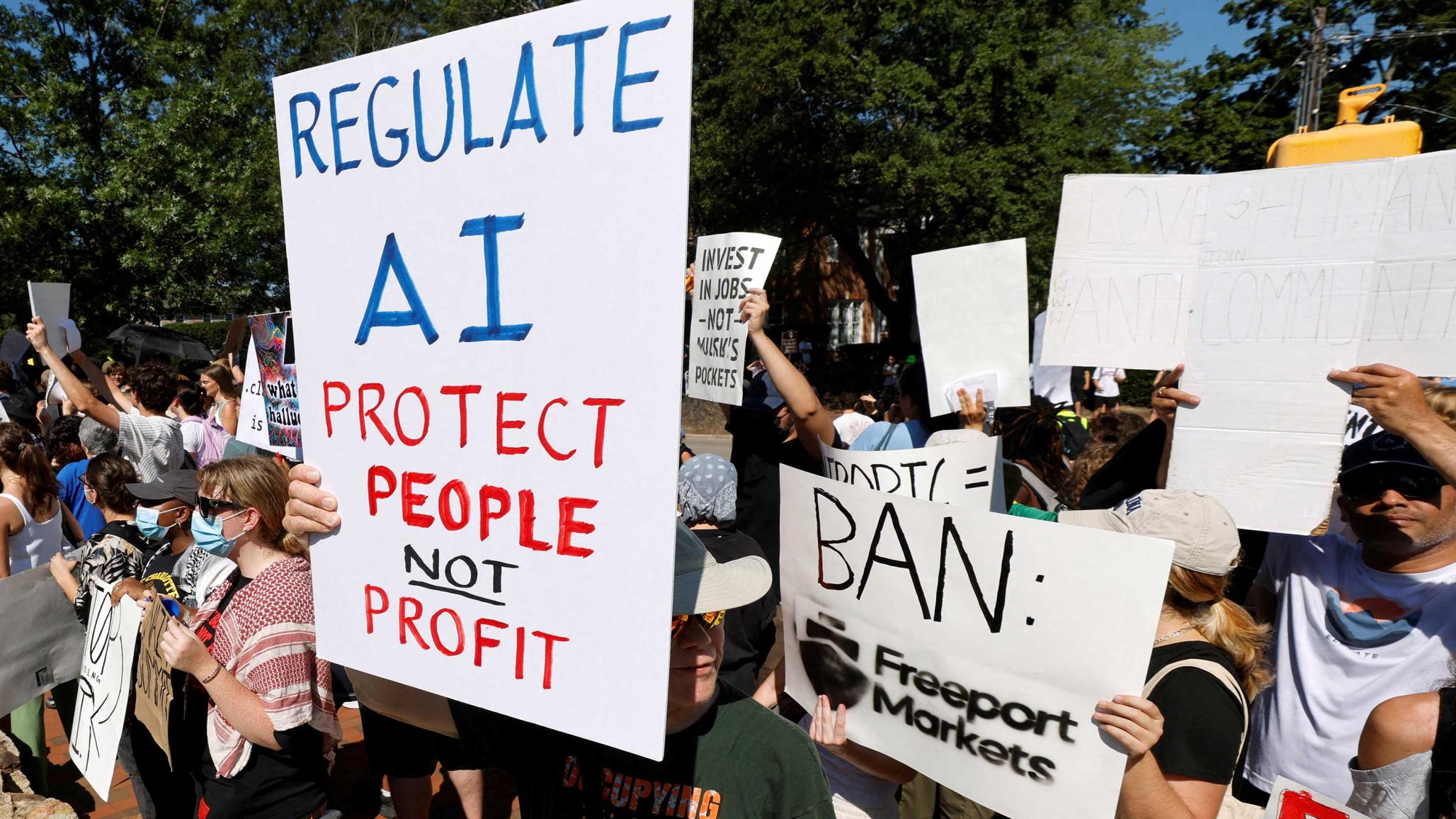
We do not know how aligned the president and his officials are with Amodei, but Trump has called concerns about AI safety a "hoax" and has rejected calls to slow down AI development. The administration respects this industry and supports its development. As a result, the starting point for a serious well-thought through conversation between the United States and China is not a promising one. The US government has no position on domestic regulation of AI other than laissez faire. It has applauded the build-out of data centers, although their construction is turning into a political liability. US private sector commitments may run to $2.4 trillion by 2030 according to McKinsey. Sharing any of this technology to understand better how to regulate it strikes one as remote. At the same time, China is likely to feel that any attempt to regulate AI is designed to stifle its progress, given the present stage of development in that country.
A problem for the two nations, besides lack of preparation for discussing the topic, is that they have approximately zero trust in each other. If this were a meeting between Soviet leader Mikhail Gorbachev and President Ronald Reagan decades ago, there would be hope for more than some words indicating an intention to discuss the subject; instead, any effort to establish some curbs in dangerous AI competition, both international and inter-firm, seems unlikely. The job Reagan and Gorbachev faced was easier in many respects. (Who would have thought that was possible?) But nuclear weapons were not held by private corporations, whereas in the United States, that is where large language models and AI experimentation reside. The US government does not control this technology, has no experience in its regulation, and the two sides, the United States and China, have little positive experience in recent times in their dealings with each other.
Supposedly the easiest task for both would be to act against non-proliferation. That may be true when dealing with non-state actors. But proliferation among state actors is another matter. China and Russia may well collaborate in areas involving advanced AI. The United States, the West, and Ukraine will also cooperate on weaponry enabled by AI.
Many of AI's capabilities are of dual use, and both military and commercial stakes are very high. The swarms of drones that lash out at Kiev's electric grid or Russian petroleum facilities are guided by AI. The same technology can spot the beginnings of forest fires in the Pacific Northwest or dried up fields in West Africa, and others direct self-driving cars. It is hard to overstate the hurdles that stand in the way of potential collaboration between China and the United States, however productive and necessary it might be.
There are other areas of AI cooperation that someday will be possible, where the immediate need for collaboration must begin with a dialogue on safeguards. In 2010, the National Institutes of Health (NIH), in collaboration with the National Natural Science Foundation of China (NSFC), developed a joint initiative to fund US and Chinese scientists to conduct collaborative basic and translational biomedical research. The Trump 2019 campaign talked about curing cancer (which President Joseph R. Biden Jr. had highlighted).
China holds vast amounts of clinical data, genetic studies, and patient registry records that can significantly aid global cancer research. AI has opened new avenues for making progress on curing specific cancers through data analysis and drawing conclusions beyond those that human researchers can attain quickly. The mindset on health within the US government does not envision greater investment in government research, which it has attempted to cut dramatically during the last two years. The administration reportedly has successfully terminated or frozen nearly 2,300 previously approved NIH research grants, pulling back roughly $2.5 billion in active biomedical research funding. Don't expect a joint cancer moonshot being announced at this summit.
For other subjects, the best that can be hoped for is a continuation of an uneasy truce and future leaders looking for areas of cooperation. But the issue of AI safeguards should have jumped to the front of the queue. Recognition at this summit that they have a mutual interest in discussing the subject would be an important step forward.
Note
1. The use of the term by Amodei: "training models so that they remain safe, ethical, compliant with our guidelines, and genuinely helpful (the principles that are embedded in Claude's Constitution)."
Data Disclosure
This publication does not include a replication package.
