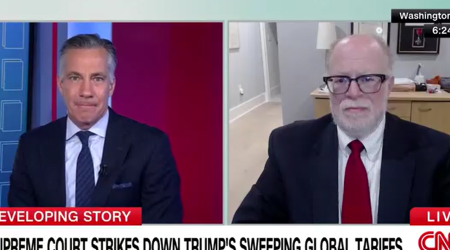
In a clear rebuke to President Donald Trump’s tariff policies, the Supreme Court ruled on February 20 that many of his tariffs—those that invoked the International Emergency Economic Powers Act (IEEPA)—were unconstitutional. The statute does not authorize the use of tariffs. Moreover, as the ruling emphasized, the president does not have authority to tax. The power to tax, including the imposition of tariffs, lies instead with the US Congress, in the unambiguous words of the US Constitution.
Undeterred, the president has now turned to another legal authority, Section 122 of the Trade Act of 1974, which allows temporary across-the-board tariffs when the United States has “large and serious balance-of-payments deficits.” A few hours after the court’s decision, Trump announced across-the-board tariffs of 10 percent, and the next day boosted those to 15 percent—their maximum level. They expire after 150 days unless extended by Congress.
Does Section 122 justify new tariffs? The first thing to note is that the statute does not apply to the current US international payments position. Indeed, the president’s own lawyers argued in the IEEPA case that Section 122 was no substitute for IEEPA, since balance of payment deficits are conceptually distinct from the current account and trade deficits that Trump has characterized as an emergency.
A balance of payments deficit arises when a country has insufficient private financial inflows to finance its current account deficit—which is the sum of its trade balance in goods and services, its net income on international assets, net international transfer payments, and a few other items. When a country has a current account deficit, foreigners’ net lending must cover the difference, so foreigners accumulate financial claims that are equal and opposite in value to the current account deficit; the two are sides of the same coin.
If private foreign asset purchases are insufficient, a country with a current account deficit can also run down its foreign reserves (and/or foreign governments could increase their holdings of the deficit country’s assets). This situation is described as a balance of payments deficit—a definition widely accepted by economists and already standard in 1974.
Under a floating exchange rate, however, potentially insufficient private financial inflows are remedied by a currency depreciation, which acts to put all domestic assets and exports “on sale,” precluding a possible balance of payments deficit before it starts. Because the United States has a floating exchange rate (and has for more than 50 years) as well as a large supply of attractive financial assets, it is facing no difficulty financing US current account deficits, even though they are large. If foreigners reduce their enthusiasm for US assets, the dollar depreciates, making US assets more attractive to foreigners and inducing the necessary financial inflows while also reducing the trade deficit.
Section 122 also allows the president to use tariffs “to prevent an imminent and significant depreciation of the dollar in foreign exchange markets.” While the dollar has indeed depreciated (in effective terms) by about 9 percent since Trump took office, this is not an unusual fluctuation over a year in the floating-rate era. The main causes of the decline are Trump’s erratic tariff policies themselves and his aggressive calls for the Federal Reserve to cut interest rates—not any notable weakness in the US ability to finance its current account.
Trump’s pivot after IEEPA to an arcane and inapplicable trade authority will elicit further legal challenges. Will the courts rule against these tariffs too? It is more likely that the tariffs will lapse in 150 days, prior to any such judgment. Meanwhile, Trump could move to invoke other possible trade authorities.
The court’s ruling and the president's immediate deployment of Section 122 both demand that Congress do its job. By requesting an extension vote in 150 days, Trump could ask Congress to authorize tariffs explicitly. However, both the House and the Senate have passed bills disapproving of the IEEPA tariffs and would be unlikely to comply.
What about the consequences for US businesses and consumers? Tariff rates are set to be similar overall to their level prior to the court ruling, so consumers will continue to feel this tax increase. Prices will likely be higher at the store because the longer tariffs last, in whatever form, the more their costs are passed through to consumers. Businesses will still face both higher input costs as well as continued policy uncertainty. Further, the competitive playing field will remain tilted, as large, well-connected firms garner favorable tariff treatment while small, less well-connected firms pay up.
However, the pattern of protection will likely change, at least temporarily, because of the across-the-board nature of the Section 122 tariffs. Countries with prior tariff levels that were lower may seek their own special treatment, as the UK government has already vowed to do. But it is unclear whether they will be successful.
In general, the Section 122 regime has a nondiscriminatory nature. It authorizes across-the-board tariffs, not tariffs that differ for each trading partner based on the whims of the moment. This will make it more difficult for the Trump administration to use them to engage in bilateral deal-making. The even pattern of tariffs may help the economies that wish to renegotiate the so-called deals they struck when much higher IEEPA tariffs were in force. Or they may simply slow-walk complying with the terms of those deals, many of which were reached under administration pressure more akin to extortion.
All this could change when the tariffs likely expire after 150 days. And even before then, Trump has other cards to play, including tariff authorities that rely on national defense considerations or findings of unfair trade practices. These routes require investigations and findings of fact, some of which are underway. The administration is likely to use the 150-day window of Section 122 tariffs to lay the procedural groundwork to impose tariffs under these authorities. Depending on how aggressively such measures are applied, countries may prefer to adhere to the so-called trade agreements they negotiated under threat of the IEEPA tariffs. Beyond tariffs, the president could also employ economic sanctions, military measures, and other levers.
To be sure, these short-term effects are only part of the story. Perhaps the most important consequence of the court’s decision was the assertion of the rule of law and the constitutional separation of powers. These features of the American system of government are fundamental to the US economy’s past and future success. While litigation will continue, the ruling sends a clear message to Trump, Congress, the nation, and indeed the world: The power to tax lies with the legislative branch. The president’s powers are, in the end, limited.
Data Disclosure
This publication does not include a replication package.