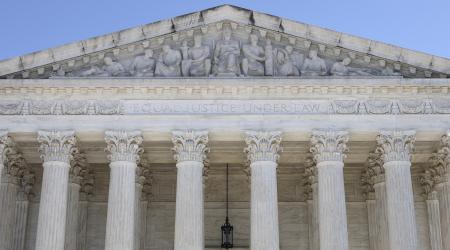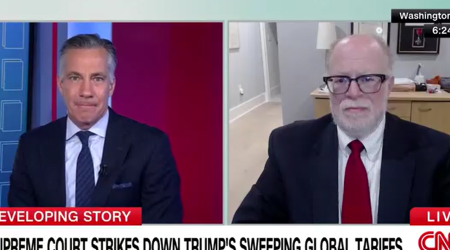
This much all the world knows—most of the Trump tariffs were declared by the Supreme Court last Friday, February 20, to be illegal. The Court said that the statute Trump used, the International Emergency Economic Powers Act (IEEPA), contained no tariff authority. Consider why the majority acted. It was because the full tariff power of the United States under the US Constitution belongs to the Congress, not the president.
The president seeks no limits on the tariffs he wishes to apply to any country and any product in any amount of his choosing—that is, the naked power to tax, to impose tariffs of his choice, with no limits. That will not stand.
SECTION 122
Trump’s immediate action was to invoke balance of payments (BOP) authority to impose a 15 percent additional tariff on all goods from all countries (with some important exceptions). Under that statute, Section 122 of the Trade Act of 1974, he has 150 days to find some other authority besides Section 122 to continue his tariff, either through obtaining new legislation or using other delegated trade authorities. While the criteria for imposing a BOP measure are arcane, and can be difficult for a court to challenge, the measure is by statute temporary, not to exceed 150 days without Congressional action.
The courts are unlikely to substitute their judgment as to whether this test is met during this relatively short period as a practical matter. It is highly unlikely that an injunction will be issued to stay the president's hand during the 150-day interim. The true test under the statute is whether the president can command a majority in both houses of Congress to impose a more permanent trade measure. The president has said that he does not intend to go to Congress for authority through legislation.
What's next? The president has already ginned up the machinery of his very responsive executive branch to determine whether there are unfair trading practices or national security threats that require the use of other statutory authorities. It is a foregone conclusion that these will be found by his staff in many such instances. More litigation is certain, and the courts will then determine whether a plethora of individual trade cases is legitimate. It would be naive to think that a significant number of trade cases could not be justified. But that is not the fundamental issue.
The risk for the Trump administration is that it again engages in overreach. Will the use of alternative statutory authorities, in a transparent sham to largely restore the tariff wall, be rejected by the Supreme Court? The president’s staff gave him the tablets to display on April 2 showing a comprehensive tariff scheme. If they in effect give him tablets that apply tariffs as broadly but citing other statutory authorities, that is likely to trigger the same reaction from the courts that he received last week, despite the existence of other authorities to impose tariffs.
What are the president’s other authorities? The three most widely mentioned are Section 301 of the Trade Act of 1974, Section 232 of the Trade Act of 1962, and Section 338 of the Trade Act of 1930.
SECTION 301
The one that has the least limits and process attached to it is Section 301 of the Trade Act of 1974, the president's retaliatory authority. It was enacted in the period when the threat that was perceived to American commerce was posed by Japan. Fifty years ago, the Japanese market was considered often impenetrable by American manufacturers and agri-business, and its “industrial targeting” of subsidies and other government support was considered a threat in world markets, including at home.
A solution was for Congress to arm the president with unprecedented and virtually unlimited authority to retaliate against unreasonable and unjustifiable policies and measures of a foreign government that burden US commerce. By using the term “unjustifiable,” Congress meant violations of trade agreements. “Unreasonable” is a very subjective standard. Any court would have trouble substituting its judgment for that of the president. The statute was first used by the (generally pro free trade) Reagan administration to impose retaliatory 100 percent duties on $300 million of Japanese goods for Japan’s having failed to live up to an agreement to stop dumping semiconductors on world markets and for Japan to purchase at least 20 percent of its supply of semiconductors from imported sources from any country, not just the United States.
SECTION 232
The second authority the president said he is considering using is Section 232 of the Trade Act of 1962, to adjust imports that enter the United States in such quantity or under such circumstances as to threaten the national security. An investigation is required by the secretary of commerce assisted by the secretary of defense to determine if this is the case. The final determination of whether to act is the president’s but it would have to be evidence based. Originally, the statute was used primarily to place a quota (later changed to a fee) on imports of petroleum in the belief that doing so would incentivize domestic drilling and somewhat greater energy self-sufficiency based on oil production. Other industries were generally not successful in gaining relief from imports under this statute. That changed with the first Trump administration, which placed tariffs on imports of steel and aluminum. Investigations and actions have proliferated during the president’s second term. Invoking this statute would have to follow an investigation into a specific import that was then found to be vital to the nation’s security.
SECTION 338
The third tariff statute, Section 338 of the Tariff Act of 1930, is an authority to act against countries that discriminate not only against US products but in favor of the goods of America’s foreign competitors. This is a situation that has never been found to be a basis for presidential action in the nearly hundred years since the statute was enacted. If those circumstances are found to be met now, it could be a potent trade weapon, with tariffs of up to 50 percent and an embargo authorized if the discrimination continues. There are serious questions as to whether the tests could be met when the administration is seeking blanket authority on all goods. Using this statute for across-the-board tariffs would be seen as invoking a substitute authority similar to the one that the Supreme Court just found to be illegitimate, avoiding the limits the Constitution applies to delegations of Congressional tariff authority.
While the decision of the court on February 20 could be seen as being narrow, simply holding that the emergency statute IEEPA did not have any tariff authority at all, combining these other authorities to recreate the “reciprocal” tariffs announced in the Rose Garden in April 2025 will inescapably raise the larger question of whether the president and not the Congress has the tariff power. It is true that these alternative authorities are tariff statutes, but the Constitutional principle remains the same. Article I referencing the powers of Congress contains the tariff power, not Article II, which references presidential power. The attempt by the president to go too far with these delegated authorities will almost certainly be seen as illegitimate. Any broad action may even be enjoined by the courts, unless the Congress authorizes the action.
Data Disclosure
This publication does not include a replication package.