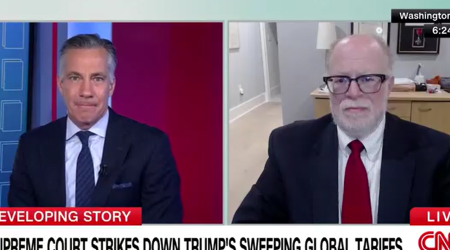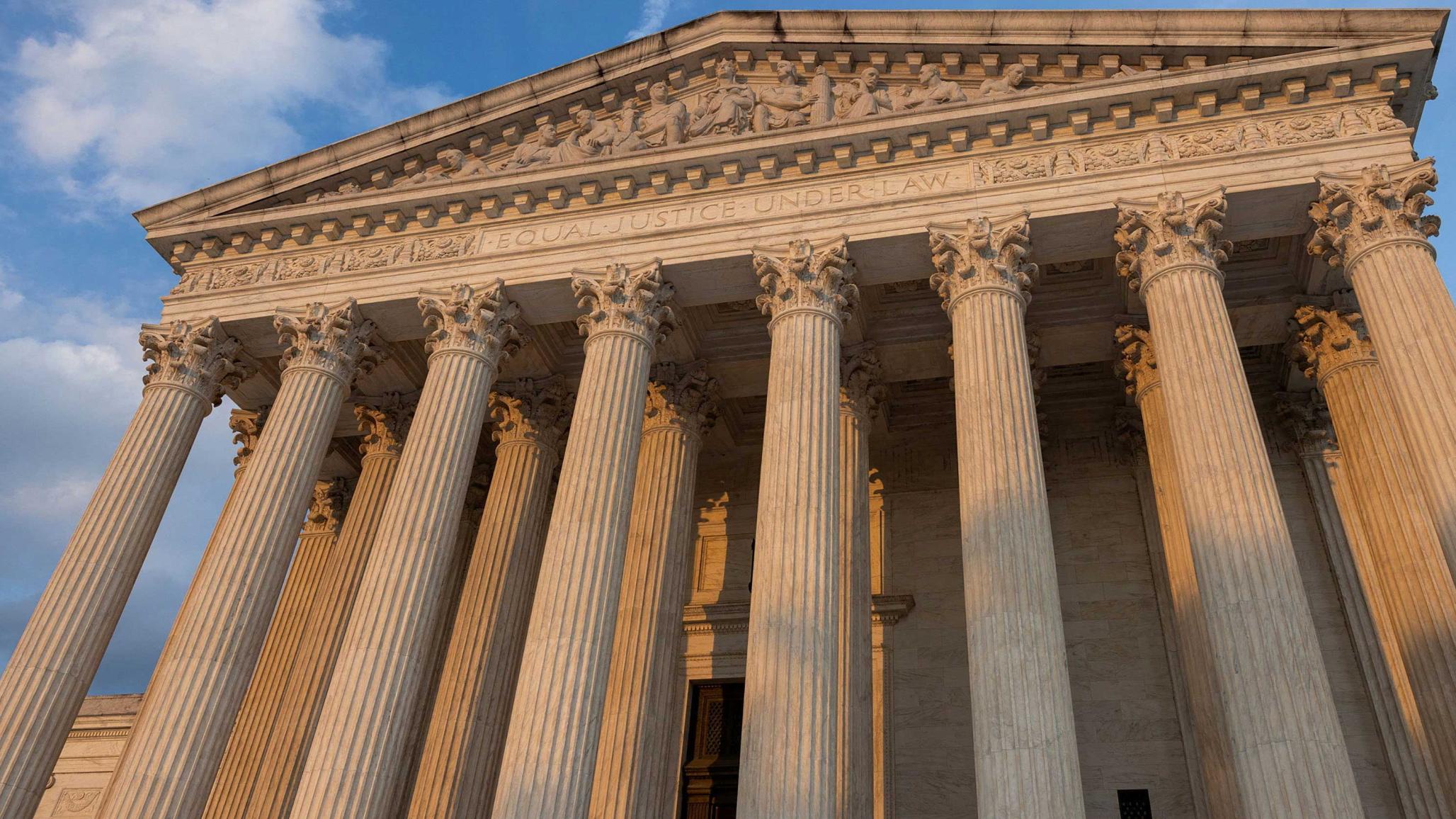
Shortly after the Supreme Court struck down President Donald Trump’s worldwide tariffs imposed under one US law, he promised to impose a new 10 percent global tariff under a different statute, and then raised the figure to 15 percent a day later. The new duties will probably be challenged in court as well, but it will take a while, probably a year or more, before new legal issues are resolved—leaving more uncertainty over the policy for consumers, businesses, and trade partners.
The Supreme Court found on February 20 that Trump was wrong to claim authority to impose tariffs under the International Emergency Economic Powers Act (IEEPA). He had invoked the law on April 2, 2025, when ordering so-called reciprocal tariffs on imports from nearly all countries and other tariffs to combat fentanyl trafficking and illegal immigration. The court held that IEEPA is not a tariff statute, that an attempt to stretch IEEPA to cover any and all tariffs violated the major question doctrine, which says that executive orders with a large economic impact must be based on clear statutory authority. Moreover, if IEEPA had provided that authority, it would violate the nondelegation doctrine prohibits Congress from delegating carte blanche tariff authority to the president. In the majority opinion, Chief Justice John Roberts stressed that tariffs are taxes, and the Constitution gives Congress the power to tax.
Later that day, Trump ordered a 10 percent temporary global tariff under Section 122 of the 1974 Trade Act to “address fundamental international payments problems.” Tariffs created under that law expire after 150 days unless extended by Congress. He said the next day that he would raise that rate to 15 percent.
The Supreme Court’s opinion in the IEEPA cases strongly constrains presidential power to use tariffs as a substantial tool to raise federal revenue in the absence of congressional authority. This means Trump’s new global tariff will probably be challenged as inconsistent with the purposes of Section 122.
In particular, Section 122 allows limited, temporary “measures to restrict imports” if needed “to deal with large and serious” US balance-of-payments deficits—a situation in which a country’s total payments to other countries are more than its total earnings. Plaintiffs challenging Trump’s new tariff will question whether a “balance-of-payments deficit,” as the term was understood in 1974, actually exists in 2026.
In 1974, a balance-of-payments deficit did not equate to a trade deficit in goods, which is the heart of Trump’s concern. Before President Richard Nixon closed the gold window in August 1971—ending foreign governments’ ability to exchange US dollars for gold—a balance-of-payments deficit was widely interpreted to mean that the US was shipping gold to foreign central banks. For the next few years, the term generally meant that the US engaged in official intervention to support the dollar. Today, private capital markets provide the financing to cover the difference between current account payments for goods and services and current account receipts.
Section 122 also permits, within limits, temporary measures to restrict imports “to prevent an imminent and significant depreciation of the dollar in foreign exchange markets.” It is not evident that the US faces this issue today. US Treasury Secretary Scott Bessent has claimed that a strong dollar policy is the administration’s goal and has been achieved.
Finally, Section 122 reads in part that limited, temporary import restrictions can be employed “to cooperate with other countries in correcting an international balance-of-payments disequilibrium." There is no such ongoing international cooperation.
My PIIE colleague Alan Wm. Wolff wrote recently about the major limitations of Section 122 and other statutes (Sections 338, 122, 232, and 301) that Trump will likely use as authority for new tariffs. The Supreme Court’s ruling implies that Trump will face serious legal challenges as he invokes these statutes as instruments to raise substantial revenue through tariffs, rather than as instruments to address specific foreign practices.
Data Disclosure
This publication does not include a replication package.