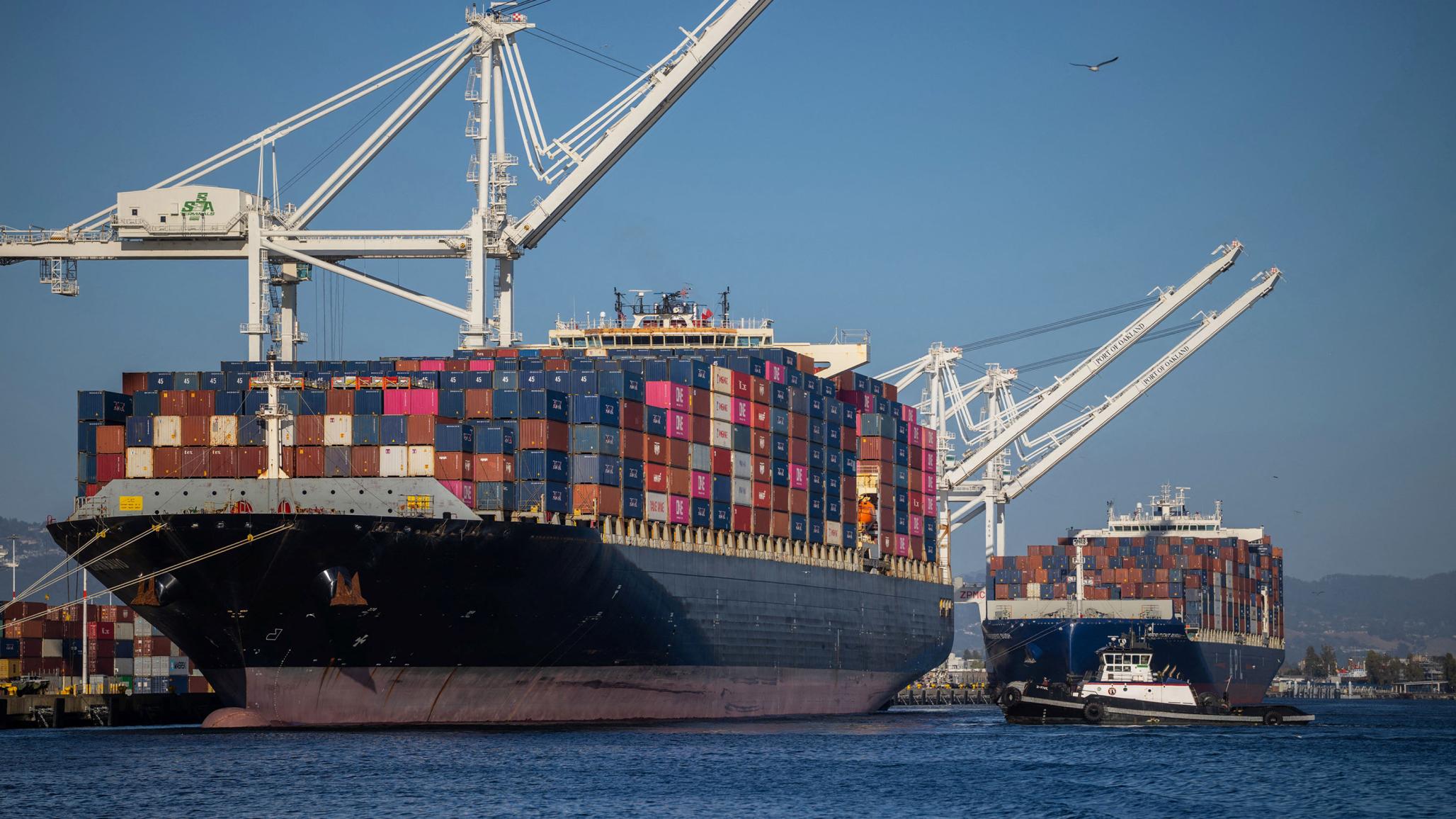
President Donald Trump's cascade of new tariffs, including the "Liberation Day" tariffs of last April, were aimed at reducing imports, and these steps were accompanied by other policies designed to spur exports. Yet the data show that imports surged in the first half of 2025, whereas exports declined in the same period.
Why Trump's actions had the opposite of their intended effects, at least initially, is complicated. One reason that imports surged is that importers were trying to bring more goods into the United States before the tariffs took effect. And paradoxically, exports declined in the same period, in part because inputs for those exports were either more expensive or not available.
The "Liberation Day" tariffs were declared on April 2, imposed on almost all imports from all countries. In other announcements the president imposed product-specific tariffs on categories like steel and autos, and country-specific tariffs on China and Brazil.
Cumulative US real imports bulged between January-March 2025, about 25 percent above the January-March 2024 level. Despite the implied inventory accumulation, during the months following the imposition of major tariffs, namely April to July 2025, real imports of major products including machinery, optical instruments, animal products, and prepared foodstuffs continued to increase over their April to July 2024 levels.[1] The most significant decrease of imports involved transportation equipment, principally autos, trucks, and parts.
At the same time, real exports of most major products decreased by varying percentages between April-July 2024 and April-July 2025, an unforeseen consequence of the higher cost or lessened availability of intermediate inputs as a result of Trump's tariffs.
Table 1 reports the change in real trade volumes for US imports between April-July 2024 and April-July 2025, organized by sector groups of the Harmonized Tariff Schedule (HTS), which is produced by the US International Trade Commission, an independent federal agency. The 2025 data are adjusted for inflation. Table 1 also reports the change in tariff revenue between 2024 and 2025, expressed as a percentage of import value for each chapter.
| Table 1 US cumulative real merchandise imports, expressed in 2024 prices, billions of dollars, April–July 2024 and April–July 2025 | ||||
| Categories and HTS chapters | Cumulative import value in Apr-Jul 2024 (billions of dollars) |
Cumulative real import value in Apr-Jul 2025 (billions of dollars) |
Year-to-date comparison, Apr-Jul (percent) |
Difference between 2024 and 2025 tariff revenue as a percentage of CIF imports, Apr-Jul (percentage points) |
| Animal or vegetable fats and oils | 5.7 | 5.1 | -10.8% | 3.3% |
| Animal products | 15.6 | 16.1 | 3.3% | 5.5% |
| Arms and ammunition, parts and accessories thereof | 1.6 | 1.4 | -10.2% | 6.3% |
| Base metals and articles of base metals | 57.7 | 58.2 | 0.9% | 15.2% |
| Footwear | 11.3 | 11.3 | 0.5% | 13.0% |
| Hides and skins | 4.9 | 4.8 | -0.3% | 7.0% |
| Machinery | 333.7 | 376.3 | 12.8% | 5.4% |
| Mineral products | 97.2 | 88.7 | -8.7% | 0.0% |
| Miscellaneous manufactured articles | 39 | 35.5 | -9.0% | 11.7% |
| Optical and instruments | 44.5 | 46.7 | 4.9% | 7.5% |
| Pearls, stones, precious metals, imitation jewelry, and coins | 26.2 | 23.3 | -10.9% | 1.6% |
| Plastics and articles thereof; rubber and articles thereof | 38.4 | 38.8 | 1.1% | 7.6% |
| Prepared foodstuffs, beverages, and tobacco | 36 | 37.3 | 3.5% | 4.3% |
| Products of the chemical or allied industries | 125.2 | 124.4 | -0.6% | 2.0% |
| Special classification provisions; temporary legislation; and others | 43.9 | 49.7 | 13.3% | 0.1% |
| Stone and glass | 9.4 | 9.3 | -1.8% | 7.9% |
| Textiles and clothing | 38.8 | 39.1 | 0.7% | 9.9% |
| Transport equipment | 149.6 | 120.4 | -19.6% | 13.8% |
| Vegetable products | 22.3 | 21.5 | -3.7% | 4.2% |
| Wood, wood charcoal, cork, straw, basketware and wickerwork | 8.8 | 8.8 | 0.4% | 2.2% |
| Woodpulp, recovered paper, and paper products | 10.4 | 9.7 | -6.7% | 4.7% |
| Work of art, collectors' pieces and antiques | 3.4 | 3.1 | -7.8% | 0.6% |
| HTS = Harmonized Tariff Schedule; USITC = US International Trade Commission | ||||
| Notes: Bold indicates major product category. The sector groups follow harmonized chapters reported by the USITC. The cumulative import values (cost, insurance, and freight, CIF) from April to July in 2025 are adjusted using the corresponding monthly import price index between 2024 and 2025 and then compared with the same cumulative values for 2024. Price indices are assigned by first matching at the HTS-2 level; if unavailable, the corresponding HTS chapter index is used, and when both are missing, the total index is applied. Real trade values are calculated at the HTS chapter level before being aggregated to the above sector categories. | ||||
| Sources: USITC DataWeb and US Bureau of Labor Statistics. | ||||
Figure 1 plots the change in import volumes against the change in tariff revenue[2] for HTS chapters with more than $10 billion in import volume in April-July 2025.[3] A weak correspondence exists between increases in tariff revenue and decreases in trade volume. However, the correlation is not statistically significant.[4]
The two HTS groups that show the strongest correspondence between increases in tariff revenue and decreases in trade volume are miscellaneous manufactured goods (HTS chapters 94-96)—a chapter that covers many consumer items—and transport equipment (HTS chapters 86-89). Otherwise, most HTS chapters show an increase in imports, not strongly related to the change in tariff revenue.
For transport equipment, which includes many products subject to Section 232 auto and auto part tariffs, real import volume fell by 19.6 percent between April-July 2024 and April-July 2025, while the duty-to-import ratio increased by 13.8 percentage points. (Section 232 of the Trade Expansion Act of 1962 permits tariffs to protect national security.)
Figure 2 plots the change of export volume against the change of tariff revenue collected between April-July 2024 and April-July 2025, for the same chapters with larger than $10 billion imports in 2025 (as shown in figure 1). Most chapters experienced a drop in export volume. Additionally, the negative correlation between the change in tariff revenues and the change in export volume is statistically significant and also stronger than the correlation with the change in import volume.[5] This correspondence reflects the fact that imports often serve as intermediate inputs for exports in the same product group. Higher input costs penalize exports. Put simply, Trump's import tariffs appear to discourage exports, a consequence unforeseen by the president but well known to economists.[6]
Notes
1. At the time of publication, product-level trade data are available only through July 2025. Total imports in August 2025 have decreased, consistent with the downward trend observed since April 2025.
2. To calculate the change in tariff revenue, total duties collected are divided by import values for the April-July period in each year, and the change is reported as the difference between 2025 and 2024.
3. Precious metals (HTS Section XIV, or chapter 71) are excluded from figure 1 and figure 2 because the enormous increase in trade volumes responded to inflation fears and the resulting demand for gold, not tariff policy. The $10 billion threshold aims to focus on categories with high trade value.
4. The univariate regression of change of import volumes on change of tariff revenue collected as a percentage of the cost, insurance, and freight (CIF) value of imports shows the slope of -0.66, and the corresponding t-value is 1.45.
5. The univariate regression of change of export volumes on change of tariff revenue collected as a percentage of CIF imports shows the slope of -0.73, and the t-value is 2.55, where a t-value of 2.00 is considered statistically significant.
6. The famed economist Abba P. Lerner first explained this relationship in 1936.
Data Disclosure
Related Documents
- Document2025-11-18-hufbauer-zhang.zip (1.28 MB)