
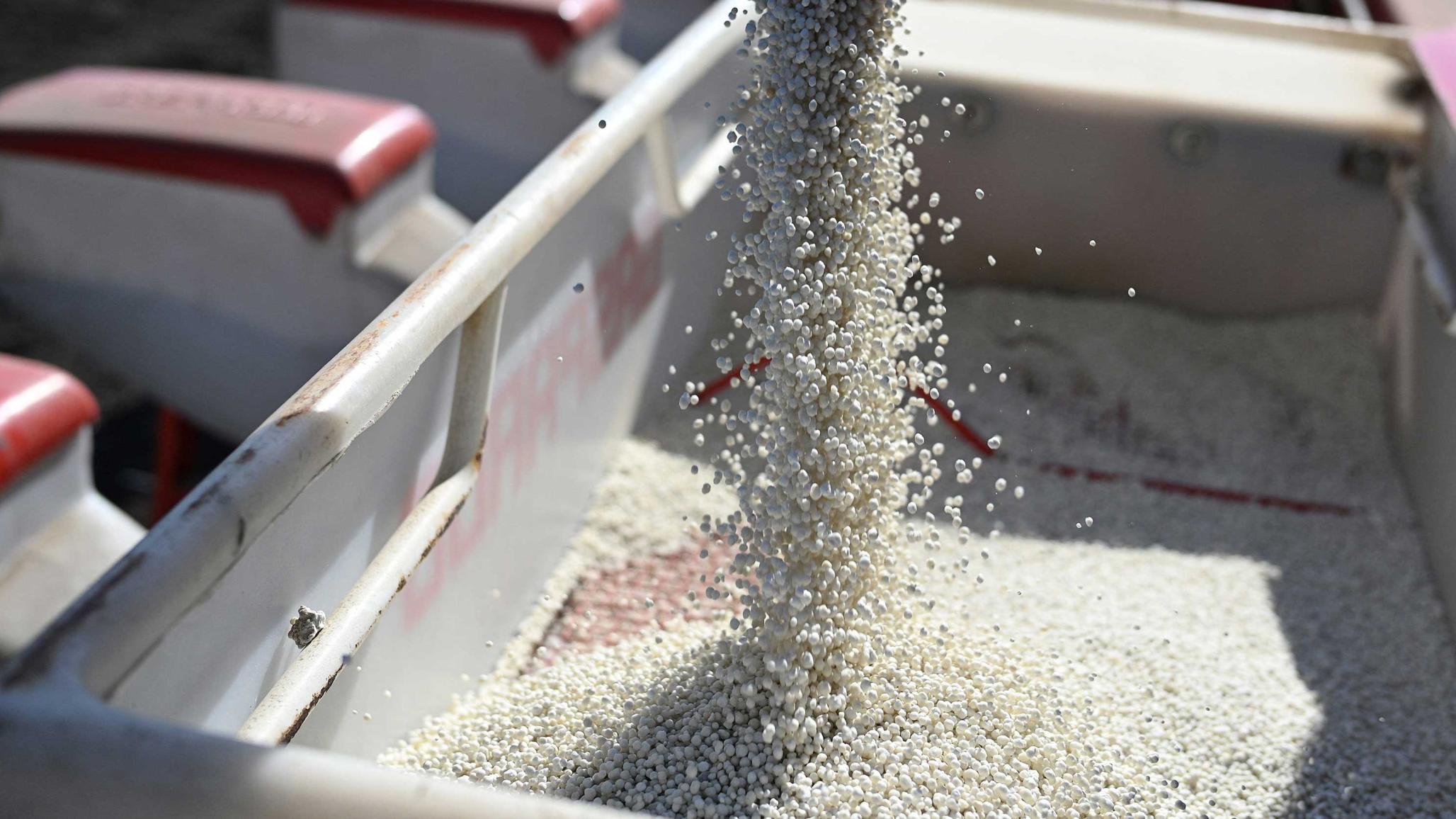
The war in Iran has seriously disrupted the global supply of fertilizer, causing prices to jump and raising fears of potential food shortages. What should trade policy officials do collectively right now? Use the World Trade Organization (WTO) as a platform for economies to jointly examine and address the issues involved.
WTO director-general Ngozi Okonjo-Iweala highlighted the global concern over fertilizer supply in remarks in Washington during the spring meetings of the World Bank and the International Monetary Fund. Others expressing similar views include the International Food Policy Research Institute (IFPRI), an agricultural think tank, and the SOAS Middle East Institute.
Up to 30 percent of global trade in fertilizer is from production in countries affected by the war and is shipped on vessels that usually transit the Strait of Hormuz (based on 2024 data). The Global Trade Alert is tracking developments: At the time of writing, governments around the world have taken 286 policy measures linked to the Gulf conflict, including 6 related to fertilizer. Evidence is mounting that China, Russia, and Turkey have either restricted or banned exports of fertilizer or the commodities used to manufacture it. Indian officials are contemplating joining their number. Fortunately, as of this writing, the UN Food and Agriculture Organization (FAO) reckons no country outside the Gulf region has banned or curbed food exports since the conflict began on February 28. However, this situation is volatile and the likelihood of more export curbs on fertilizer and food rises with every passing day that the war continues and the Strait of Hormuz is effectively closed.
How serious the impact will be on the 166 economies represented at the WTO depends on military and diplomatic factors, the duration of the strait's closure, the threat of destruction of production facilities, and political decisions to adopt trade measures in reaction to scarcity and price increases.
The WTO facilitated getting vital information to members during other recent crises
Governments need information immediately. This was also the case during the Global Financial Crisis of 2008–09, when the question was whether trade restrictions would be widely adopted in reaction to the world economic setback. The then-WTO director-general Pascal Lamy instituted enhanced reporting to the G-20. The WTO's recent experience with the COVID-19 pandemic is also instructive. Reporting at the WTO during COVID-19 was extensive and detailed, with monitoring of over 450 goods measures and 150 services measures. The WTO Secretariat provided regular, detailed updates on restrictions (e.g., export bans), particularly focusing on medical products such as pharmaceuticals and essential goods, including personal protective equipment, medical devices, and pharmaceuticals, as well as tracking trade facilitation (e.g., tariff reductions). The services-related policy measures that were tracked included those facilitating cross-border transportation, logistics, and telecommunications. The WTO Secretariat verified information from official and non-official sources, included trade facilitation measures, and followed up with reporting on the removal of restrictions.
COVID-19 concentrated the attention of policymakers everywhere. Sequestered during the pandemic, they had the time and necessity to focus on dealing with issues related to the calamity that had befallen the world economy and the well-being of peoples. The new WTO director-general brought on board in the midst of the pandemic, Ngozi Okonjo-Iweala, having served as the chair of the Board of Gavi, the Vaccine Alliance, had already played a critical role in strengthening immunization programs in developing countries, particularly during the pandemic. Using the WTO as a platform enabled her to press for removal of export restrictions on vaccines, raw materials, and medical supplies, and for reducing trade impediments and speeding up global distribution of critical goods through personal diplomacy.
The WTO has tools that can provide important information needed for policymakers' decision-making about the Iran war's impact on fertilizer and food
If the Iran war's impact on fertilizer and therefore food is seen as a serious problem that is not transient, particularly for the least developed members, then the WTO's tools should be deployed to ensure members have an opportunity for a deep examination of what is occurring and what can be done about it. A Trade Policy Review can be initiated focused on this single subject. The WTO also has existing structures that can get involved: the Committee on Agriculture, the Council on Goods, and the Council on Services.
To assist in the discussion, governments taking crisis-related trade measures should be prepared to give full information on the demand and supply of fertilizer in their countries, available stocks, and the measures they have implemented to enhance supplies. This approach should not be adversarial. It should emulate the notification of product standards in the WTO Technical Barriers to Trade Committee. In addition, specific trade concerns regarding applied measures can be raised by other WTO members. There would be an opportunity for a government imposing a crisis measure to provide complete information on the measure it is taking, including the need it saw for the measure, why it chose this policy instrument and not alternatives, why the product coverage is no wider than necessary, the expected duration, and, if open-ended, the factors that will determine its retention or removal. The government imposing the measure should be open to listening to the concerns of others. And it should do this voluntarily.
Another similar approach is contained in a recent proposal from four supporters of the WTO that has circulated to WTO members. That proposal included voluntary transparency and suggested coordinated action by a critical mass of members to agree on principles to guide emergency measures. For widespread adoption, that proposal would require time for deliberation. In contrast, the approach advocated in this essay could be put into place immediately, requires no formal approval by any WTO member, and does not need a new formal agreement among members for managing crises.
The WTO is a potentially vital platform for collective action to deal with trade crises
On many fronts, the clear way to proceed at the WTO is through pragmatism, advancing the common good in whatever form it can be achieved. The WTO as a platform for collective action should be understood more clearly and taken advantage of. The Greek mathematician and scientist Archimedes is famously quoted as saying, "Give me a place to stand, and a long enough lever, and I shall move the earth." He was celebrating the power of a lever and fulcrum to amplify physical force. It is very common to focus on the lever, forgetting entirely about the platform. Ameliorating the harmful impact on global trade from immediate threats requires a platform to deal with them. This is a role the WTO is well suited to fulfill. The WTO is a gathering of economies to deliberate trade concerns and forge a consensus to the extent possible on how they can be dealt with collectively. It proceeds in meetings of highly experienced trade representatives, ministers when needed, and ambassadors and their staffs, charged by their governments to participate in this effort. The WTO Secretariat is experienced and ready to support the members, including through analyses and reports.
Undervaluing the WTO is easy to do, given the gap between what it could do and what it does in terms of governance of the world trading system. But the platform is vital. As a senior trade official and critic of the WTO said in turbulent times for trade, "If the WTO did not exist, we would have to invent it." It should be made use of now.
Simon J. Evenett is professor of geopolitics and strategy at IMD Business School, Lausanne, and founder of the St. Gallen Endowment for Prosperity Through Trade.
Bernard M. Hoekman is part-time professor and director of global economics at the Robert Schuman Centre for Advanced Studies.
Petros C. Mavroidis is the Edwin B. Parker Professor of Law at Columbia Law School and nonresident fellow at Bruegel (Brussels).
Alan Wm. Wolff is senior fellow at the Peterson Institute for International Economics.
Data Disclosure
This publication does not include a replication package.
