When the Trump administration imposed so-called "reciprocal," country-specific tariff rates in April 2025, it made clear that the measures were intended not only to protect US industry but also as negotiating leverage to extract bilateral concessions.[1] The president's team subsequently negotiated several deals—called Agreements on Reciprocal Trade, or ARTs—with other countries to adjust US tariff rates and product coverage in return for a variety of concessions. As of May 22, 2026, nine ARTs have been signed and several more are under active negotiation.
The ARTs' fine print reveals, however, that they are far more significant than simple bilateral trade deals: They construct a legal architecture to pull US trade partners away from China and to constrain China economically. They push partners to keep supplying the US market, but on terms that reduce space in other countries for Chinese firms, capital, and technology, as well as China-linked transshipment. The United States is not simply reducing direct imports from China. It is setting a framework to mold global value chains around US strategic preferences.
Before the 2018–19 US-China trade war, 22 percent of US goods imports came from China. By the end of 2025, China's share had fallen to 9 percent.[2] But US imports overall have not declined, as sourcing has shifted to other countries in Asia and the Americas. These other economies have intensified their trade and investment flows with China, suggesting that further US efforts to decouple from China must now be directed at the Chinese value-added content of these third-country exports to the United States.
The ARTs deals do not name China explicitly as the target of these efforts, referring instead to a "third country," "covered nation," or "country of concern"—but it is obvious which nation is in the crosshairs. The deals require partners not only to buy more from the United States but also to help police third-country trade, investment, and technology flows. The nine ART partners with signed agreements to date are Argentina, Cambodia, Bangladesh, Ecuador, El Salvador, Guatemala, Indonesia, Malaysia, and Taiwan.
This approach may strengthen US leverage, but it also raises the question of how much policy autonomy partner countries are giving up in exchange. China could retaliate against them in many ways. Given the deep integration of many middle-income ART partners with China, especially those located in Asia, the agreements place them in a difficult bind: meet US demands and risk Chinese punitive measures or defy the United States and endure a snapback of the "reciprocal" tariff rates.
The Trump administration celebrates commitments made by ART partners to remove behind-the-border measures that the United States has long claimed negatively affect American exports. But ARTs do more than exchange relief from punitive US tariffs for unilateral trade concessions. They are part of the Trump administration's abrupt departure from World Trade Organization–based constraints on discriminatory tariff rates (tariff rates that differ among partners or are conditional on partner actions outside the scope of the agreements). Indeed, although the United States has long provided certain benefits to its strategic partners, ARTs mark the first large-scale use of US tariffs to enforce alignment with American policy choices since the end of the Cold War.
The ARTs deploy recurring legal devices to shape how America's trading partners deal with third countries, sensitive technology, foreign investment, and supply-chain enforcement.[3] A careful reading of the ARTs shows how the administration is building the framework for indirect decoupling from China and other foreign entities of concern. In addition to forcing reduced commercial interaction through unilateral US tariffs and export restrictions, Washington is requiring trade partners to reproduce parts of those efforts inside their own commercial policies.[4] Across the different ARTs, we find seven mechanisms that the United States may use to control supply chains beyond its borders. These mechanisms are described in table 1, and we explain the possible use of each as an instrument of further decoupling from China.
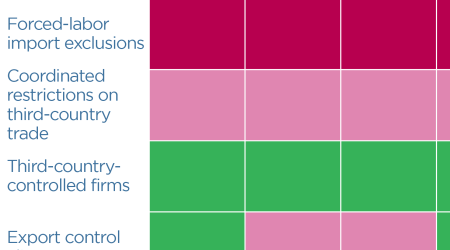
| Table 1 Core exclusionary mechanisms in the ARTs | ||
| Mechanism | Typical legal terms used | Possible China-related effect |
| 1. Forced-labor import exclusions | 19 U.S.C. § 1307; presumptively prohibit importation | Extends US forced-labor enforcement logic, especially against Xinjiang-linked supply chains |
| 2. Coordinated restrictions on third-country trade | Equivalent restrictive effect; third-country non-market practices | Pushes partners to mirror US restrictions aimed at non-market practices associated with China |
| 3. Third-country-controlled firms | Unfair trade practices by firms owned or controlled by third countries | Targets China-linked firms using offshore production or local affiliates |
| 4. Export control alignment | Restrict transactions with entities on US sanctions lists; align with US Foreign Direct Product Rule (FDPR); catch-all controls | Restricts China-linked access to sensitive technologies and research channels |
| 5. Investment security | Reviewing inbound and outbound investment based on national security risks | Screens Chinese capital and technology acquisition routes |
| 6. Rules of origin | Prevent benefits from accruing substantially to third countries; combat transshipment | Limits rerouting of Chinese goods through third countries |
| 7. Penalty clauses | Terminate this agreement; reimpose reciprocal tariff rate | Discourages partners from deeper economic alignment with China |
1. Forced-labor import exclusions
The prohibition of imports produced by forced labor is a significant aspect of US trade policy, reflecting commitment to human rights, ethical labor practices, and fair competition. Chinese labor practices have been spotlighted since 2021, when the Uyghur Forced Labor Protection Act (UFLPA) was passed to ban imports made with forced labor in the Xinjiang Uyghur Autonomous Region of China.
Commitments contained in ARTs extend the US forced-labor trade regime outward. ART partners agree to prohibit imports of goods made with forced or compulsory labor, a commitment many of them have already made in their domestic law. While the ARTs reference obligations of International Labor Organization members, most agreements link partner-country enforcement to US determinations under Section 307 of the Tariff Act of 1930, 19 U.S.C. § 1307, the legal foundation for the UFLPA.[5] If a partner country agrees to recognize or act on US determinations under that framework, part of the US forced-labor enforcement perimeter is effectively extended into another market.
2. Coordinated restrictions on third-country trade
A second mechanism for indirect decoupling requires partners to adopt measures with "equivalent restrictive effect" when the United States imposes import restrictions on a third country for economic or national security reasons.
When Washington restricts trade with a third country on security grounds, the partner is expected to adopt comparable restrictions of its own. Because US trade enforcement against "non-market practices" has overwhelmingly targeted China—through Section 301 tariffs, antidumping and countervailing duties, forced-labor import bans, and prohibitions on transactions related to the Specially Designated Nationals and Blocked Persons (SDN) List—this mechanism gives ARTs a built-in China-facing effect even when China is not named in the text.
3. Third-country-controlled firms
Several ARTs address firms operating inside partner countries but owned or controlled by third-country actors. These provisions require partner governments to act against unfair practices by such firms, often in coordination with the United States. The wording of the text is ambiguous, as some refer to unfair practices taking place within the jurisdiction of the US partner.
This clause is aimed at a familiar problem in the US-China trade war: China-linked firms relocating production, expanding offshore capacity, or embedding themselves deeper into third-country supply chains to preserve access to the US market.[6] ART language on third-country-controlled firms is designed to blunt that strategy. Despite the salience of such trade diversion, the text is unclear and perhaps deliberately so. It leaves open questions that may plague bilateral relations in the years ahead. For example, can the importation from China by Chinese-owned firms of intermediate goods believed to be state subsidized be the basis for activation of this clause if the resulting third-country exports are viewed as problematic by the United States?
4. Export control alignment
Export control alignment is the most forceful national security mechanism in the ARTs. Some agreements require partners to cooperate with the United States to restrict transactions with entities on the Entity List, Specially Designated Nationals and Blocked Persons (SDN) List, or Non-SDN sanctions lists. Taiwan's agreement goes much further, requiring alignment with the US Foreign Direct Product Rule (FDPR), anti-circumvention enforcement, catch-all controls, and restrictions on research cooperation with "covered nations"[7] or "countries of concern."[8]
Chinese firms and research institutions in sensitive sectors are already heavily targeted by US export-control and sanctions tools, including the Entity List, SDN List, Chinese Military-Industrial Complex Companies (CMIC) List, and Military End-User (MEU) List. ART commitments extend that logic beyond the United States by asking partner countries to restrict transactions with listed entities. In Taiwan's case, alignment with the US FDPR would require a domestic legal framework capable of keeping advanced chips and related technologies from reaching China. Catch-all controls would widen that net to cover even unlisted items when diversion risks arise, while restrictions on research cooperation would further limit collaboration between Taiwanese and Chinese universities and laboratories. Taken together, these obligations reflect both Taiwan's deep economic and technological ties with China and its pivotal role in the US effort to prevent Chinese access to advanced semiconductors.
5. Investment security
ARTs commonly require partner countries to establish mechanisms for screening inbound investment for national security risks and in some cases outbound investment as well. This provision draws on the logic of the US Foreign Investment Risk Review Modernization Act (FIRRMA).[9] The target is strategically sensitive investment, including investment linked to Chinese firms, state-backed actors, or technology acquisition strategies.
6. Rules of origin
ARTs allow parties to tighten rules of origin if agreement benefits are flowing substantially to third countries or third-country nationals. Some agreements with Southeast Asian nations go further by requiring action against transshipment and other forms of duty evasion.
These provisions reflect the extent and persistence of the rerouting of trade through third countries in response to the US-China tariffs. Chinese goods can be lightly processed, relabeled, or reassembled elsewhere to avoid US tariffs and other restrictions.[10] ART rules of origin are a frontline anti-circumvention device.
These provisions, however, also serve as the basis for a more invasive challenge from the United States to the composition of third-country supply chains. China remains an important source of many higher-value components used in countries intensifying their participation on global value chains (GVCs).[11] Importing parts from China and substantially transforming them into a finished good is not a violation of US tariff laws, even if the intermediate good itself would be subject to a tariff if exported directly to the United States.[12] One major exception to this convention occurs when rules of origin are negotiated in the context of a preferential trading agreement, when both parties liberalize substantially all bilateral trade. Embedding new "rules of origin" inside ARTs deviates from this general rule, which permits third-country sourcing discretion.
7. Penalty clauses
Finally, some ARTs allow the United States to terminate the agreement and reimpose reciprocal tariffs if the partner signs a new trade or preferential agreement with a third country that undermines essential US interests.
The phrase "third country that undermines US interests" is best understood as aimed primarily at China, which is the most plausible "covered nation" or "country of concern" with both the economic weight and strategic relevance to conclude meaningful bilateral trade arrangements with US trade partners.
Although these seven mechanisms form the common architecture of the nine ART agreements, the depth and stringency of commitments vary across partner countries. Some agreements impose broader or more demanding obligations in specific areas, while others contain narrower or more limited language. Taiwan, for example, faces especially extensive commitments on export control alignment; Argentina and El Salvador do not appear to include penalty clauses; and Indonesia, Cambodia, and Malaysia are specifically required to combat transshipment through rules-of-origin enforcement. To capture these differences, table 2 below provides a comparative assessment of ART commitments across partner countries, using commitment intensity (●) to indicate the relative stringency of obligations within each policy mechanism (see note in table 2).
| Table 2 Variation in the stringency of ART commitments across partner countries | |||||||||||||||||
| Mechanism | Argentina | Bangladesh | Cambodia | Ecuador | El Salvador | Guatemala | Indonesia | Malaysia | Taiwan | ||||||||
| Forced-labor import exclusions | ●●●●● | ●●●●● | ●●●●● | ●●●●● | ●●●●● | ●●●●● | ●●●●● | ●●●●● | ●●●●● | ||||||||
| Coordinated restrictions on third-country trade | ●●●● | ●●●● | ●●●● | ●●●● | ●●●● | ●●●● | ●●●● | ●●●● | ●●●● | ||||||||
| Third-country-controlled firms | ●●● | ●●● | ●●● | ●●● | ●●● | ●●● | ●●● | ●●● | ●●● | ||||||||
| Export control alignment | ●●● | ●●●● | ●●●● | ●●● | ●●● | ●●●● | ●●●● | ●●●● | ●●●●● | ||||||||
| Investment security | ●● | ●● | ●● | ●● | ●● | ●● | ●● | ●● | ●● | ||||||||
| Rules of origin | ●●● | ●●● | ●●●● | ●●● | ●●● | ●●● | ●●●● | ●●●● | ●●● | ||||||||
| Penalty clauses | ●● | ●●●●● | ●●●●● | ●●●●● | ●● | ●●●●● | ●●●●● | ●●●●● | ●●●●● | ||||||||
|
Note: The assessment is based on three factors: 1. Legal wording. The choice of verbs reflects the degree of obligation and enforcement. Stronger, more prescriptive language indicates higher stringency, while softer language suggests greater discretion for partner countries.
2. Cross-country comparison. Stringency is assessed relative to other partner countries. Where a country undertakes fewer or less demanding commitments within a given mechanism, it is coded as less stringent. 3. Level of specificity and scope. Greater detail and broader coverage indicate stronger commitments. This includes: ● explicit identification of targeted countries (e.g., "covered nation" or "countries of concern") ● the breadth of policy areas covered |
|||||||||||||||||
How will the United States enforce these provisions?
ARTs define the actions that must be taken by partners to maintain their negotiated US market access. For all nine countries that have signed agreements, negotiated tariffs are below the "reciprocal" rates originally announced by President Donald Trump on April, 2, 2025—which he dubbed "Liberation Day"—making the threats of non-compliance penalties real. The US Supreme Court earlier this year struck down the administration's reliance on the International Economic Emergency Powers Act as the domestic authority enabling those tariffs. Trump replaced those tariffs with temporary across-the-board tariffs, invoking an obscure balance-of-payments authority, and these have been struck down by the US Court of International Trade.[13] What does this shaky basis in law mean for the enforcement of ARTs, which threaten the reimposition of the Liberation Day tariffs if signatories do not fulfill their obligations according to the United States?
Wording of the administration's newly announced Section 301 investigations suggest that it will rely on the outcomes of these cases as the basis for tariff rates negotiated through the ARTs and as the basis for any tariff rates imposed if the need for penalties should arise. On March 11, 2026, the US Trade Representative (USTR) initiated Section 301 investigations into 16 economies' acts, policies, and practices relating to structural excess capacity and production in manufacturing sectors.[14] The 16 countries include China and all five ART signatories outside Central and South America. The scope of the investigations is both broad and vague and may be used as the basis for tariffs on ART signatories.
The following day, March 12, the USTR initiated investigations of 60 economies that "will determine whether acts, policies, and practices of each of these economies related to the failure to impose and effectively enforce a ban on the importation of goods produced with forced labor are unreasonable or discriminatory and burden or restrict US commerce."[15] The set of countries under investigation includes China and all nine ART signatories.
The investigations also target other partners such as the European Union, for which forced labor allegations are surprising. Notification of the investigation acknowledges this reality but points to inputs imported from third countries as possible sources of unfair competition. [16] The Federal Register notice states, "Although a majority of countries prohibit forced labor as a matter of law within their jurisdiction, such prohibitions are insufficient to prevent firms from profiting from forced labor. In the absence of a forced labor import prohibition that is effectively enforced, firms can continue to source, use, and profit from imported products produced with forced labor, even if the use of forced labor is prohibited domestically" (emphasis added). The explicit extension of the investigation's scope to include supply chain partners sets up the use of Section 301 tariffs as enforcement for the forced labor provisions of the ARTs.
Notes
1. Executive Order 14346, "Modifying the Scope of Reciprocal Tariffs and Establishing Procedures for Implementing Trade and Security Agreements," 90 Fed. Reg. 43737, September 10, 2025. The deals were formalized in Executive Order 14346, which also created a mechanism for negotiating these concessions with individual countries. The order states that the president's willingness to reduce reciprocal tariffs to zero or modify Section 232 tariffs depends in part on "the scope and economic value of a trading partner's commitments to the United States in its agreement on reciprocal trade," as well as US national interests and national security considerations.
2. Chad P. Bown provides a detailed breakdown of shifts in US import sourcing. See "The Trump-China trade wars: Five takeaways from US imports in 2025", RealTime Economics, Peterson Institute for International Economics, March 16, 2026.
3. The White House, "America First Trade Policy," presidential memorandum, January 20, 2025,
4. In its implementation of export controls, the US government uses the foreign direct product rule to extend its jurisdiction over foreign-produced goods that are deemed to have been produced directly or indirectly by US technology. ARTs seek to extend US control to the content of its partners exports regardless of whether they contain American technology or inputs.
5. US Customs and Border Protection, "Uyghur Forced Labor Prevention Act," accessed May 22, 2026.
6. US-China Economic and Security Review Commission, 2025 Report to Congress: Executive Summary and Recommendations, November 2025.
7. 10 U.S.C. § 4872(f)(2), defining "covered nation" to include the Democratic People's Republic of North Korea, the People's Republic of China, the Russian Federation, and the Islamic Republic of Iran.
8. 28 C.F.R. § 202.601, defining "countries of concern" to include China, Cuba, Iran, North Korea, Russia, and Venezuela.
9. US Department of the Treasury, The Foreign Investment Risk Review Modernization Act of 2018 (FIRRMA).
10. House Select Committee on the Chinese Communist Party, letter to the Department of Justice, Department of Homeland Security, and Office of the US Trade Representative regarding transshipment, March 5, 2025.
11. Abigail Dahlman and Mary E. Lovely use detailed trade data to show that Indo-Pacific countries became more reliant on China as an import source between 2010 and 2021, including imports of intermediate goods. See "US-led effort to diversify Indo-Pacific supply chains away from China runs counter to trends," RealTime Economics, Peterson Institute for International Economics, September 6, 2023.
12. There are exceptions to this general rule in US trade law, as there are in most cases. The general rule is clearly described on the Department of Commerce website.
13. Alan Wm. Wolf addresses the staying power of Trump tariffs and the basis for legal challenges in "Why do Trump's tariffs have such staying power?" RealTime Economics, Peterson Institute for International Economics, May 7, 2026.
14. Office of the US Trade Representative, Initiation of Section 301 Investigations: Acts, Policies, and Practices of Certain Economies Relating to Structural Excess Capacity and Production in Manufacturing Sectors, March 17, 2026. 91 FR 12886.
15. Office of the US Trade Representative, Initiation of Section 301 Investigations of Acts, Policies, and Practices of Various Economies Related to the Failure to Impose and Effectively Enforce a Prohibition on the Importation of Goods Produced with Forced Labor, March 17, 2026. 91 FR 12884.
16. US trade agreements have long maintained that partner countries must enforce labor standards as well as enact them into law. For example, the United States-Mexico-Canada Agreement contains a Rapid Response Mechanism, which is a labor enforcement tool between the United States and Mexico that allows the US government to act quickly to investigate complaints and potentially suspend preferential tariffs if workers' rights to freedom of association or collective bargaining are deemed to have been violated. The key innovation in the ARTs is its conditioning of US tariffs on labor conditions in third countries supplying intermediates imported by partners for production of exports for the United States.
Data Disclosure
This publication does not include a replication package.