
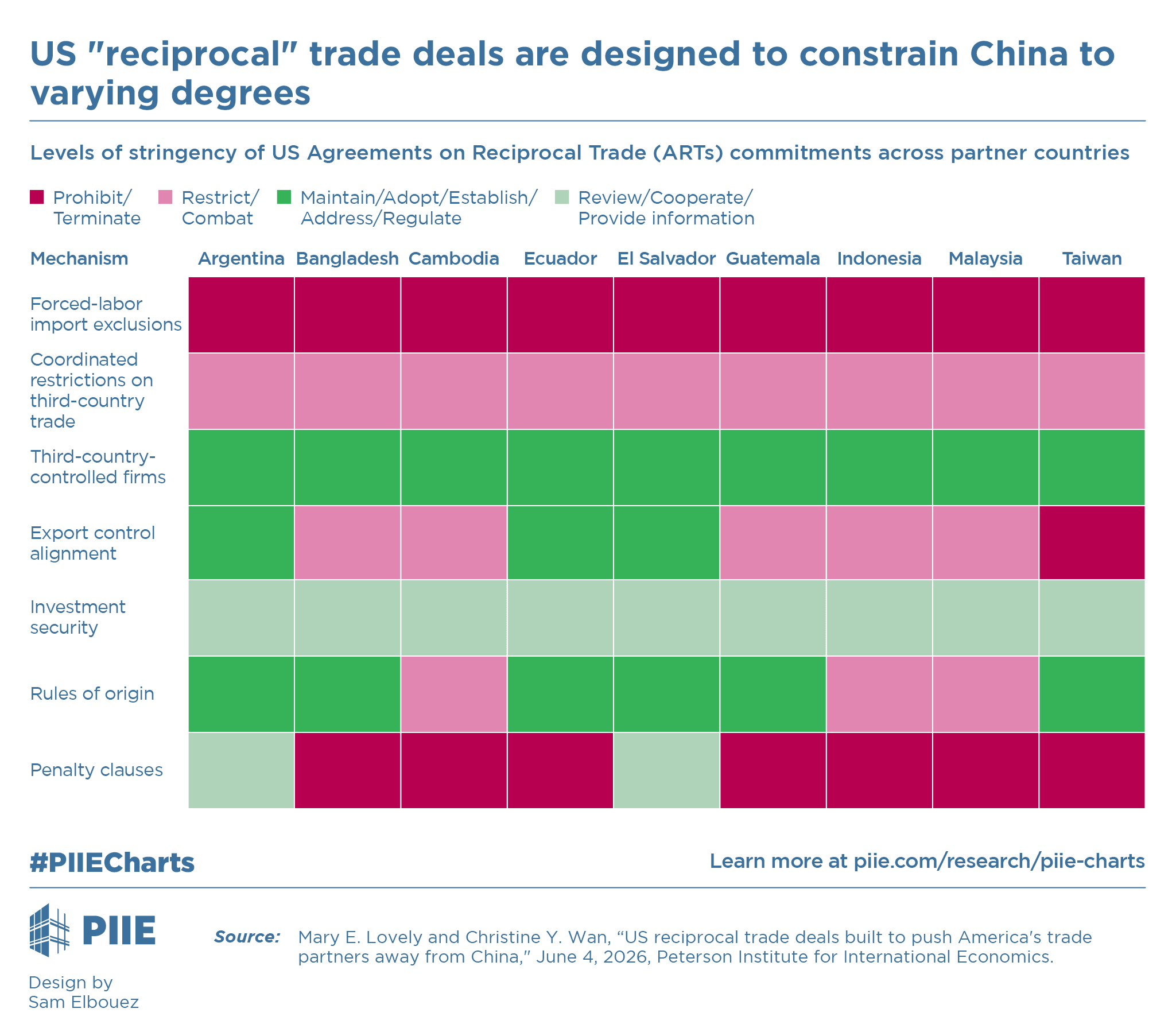
The Trump administration has negotiated several deals called Agreements on Reciprocal Trade (ARTs) with trading partners to adjust US tariff rates and product coverage in return for a variety of concessions. As of May 2026, Argentina, Cambodia, Bangladesh, Ecuador, El Salvador, Guatemala, Indonesia, Malaysia, and Taiwan have signed ARTs with the United States, and several more are under negotiation.
The ARTs include seven mechanisms the United States may use to control supply chains beyond US borders:
- forced-labor exclusion
- third-country trade restrictions
- third-country-controlled firms
- export control alignment
- investment security
- rules of origin
- penalty clauses
The agreements do not name China explicitly as the target, referring instead to a "third country," "covered nation," or "country of concern." But it is obvious that the United States is constructing a legal architecture to pull US trade partners away from China and constrain China economically. These agreements push partners to keep supplying the US market, but on terms that reduce space in other countries for Chinese firms, capital, and technology, as well as China-linked transshipment.
Although all nine ARTs include these seven mechanisms, the depth and stringency of commitments vary across partner countries. Some agreements impose broader or more demanding obligations in specific areas, while others contain narrower or more limited language. Taiwan, for example, faces especially extensive commitments on export control alignment. ARTs for Argentina and El Salvador do not appear to include penalty clauses. Indonesia, Cambodia, and Malaysia are specifically required to combat transshipment through rules-of-origin enforcement.
This PIIE Chart is adapted from Mary E. Lovely and Christine Y. Wan's blog post, "US reciprocal trade deals built to push America's trade partners away from China."
Data Disclosure
This publication does not include a replication package.

