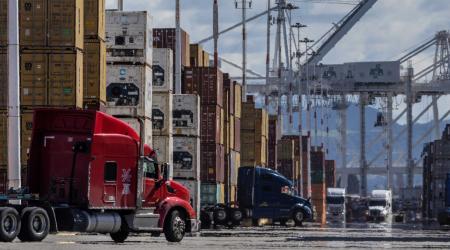
Soon after the Supreme Court struck down one set of President Donald Trump's tariffs in February, he imposed a second set that now faces legal challenges. The Court of International Trade (CIT) recently heard oral arguments in two cases on plaintiffs' requests for an injunction preventing the United States from collecting the new duties. During that three-hour window into the judges' thinking, their questions indicated they were unlikely to grant the request. So the cases will probably go to the next round for further argument.
The legal story so far
It's helpful to think of the confusing chain of Trump tariffs as a three-act play in the courts. First, on April 2, 2025, Trump announced "reciprocal" tariffs under the International Emergency Economic Powers Act (IEEPA); these were struck down by the Supreme Court on February 20, 2026. Second, he imposed temporary tariffs under balance of payments (BOP) authority in Section 122 of the Trade Act of 1974; these are the tariffs now in effect and before the CIT, and the judges' questions indicated that they have serious questions about when it is appropriate to use this authority. Third, the US Trade Representative has launched scores of so-called Section 301 trade investigations that could provide a basis for imposing new tariffs on a more durable legal basis after the BOP tariffs expire on July 24.
Trump announced the BOP tariffs at a rate of 10 percent on the day the Supreme Court acted against his emergency tariffs under IEEPA but said that they could be raised to 15 percent. These tariffs were quickly challenged by a group of states and a number of small businesses—the plaintiffs in the cases before the CIT now. To obtain an injunction blocking the government from collecting the BOP tariffs, the plaintiffs have the burden of proving to the court that: (1) they are likely to prevail on the merits, (2) there are no questions of fact, and (3) there will be irremediable harm if the injunction is not granted. The judges appear to have more questions than answers about whether the president acted within the law when he imposed the additional tariffs.
The fact that the Supreme Court found that the IEEPA tariffs exceeded the president's authority has no bearing on this case. That case was decided on narrow technical grounds that IEEPA did not authorize the imposition of tariffs.
The CIT has been presented with a $35 billion to $50 billion question—the amount that will be collected during the duration of the BOP tariffs. Even though use of the BOP authority is an interim measure, since it expires in a few months, it is what several Supreme Court justices would call a "major question." A lot of money is at stake, from a large swath of business and ultimately consumers, and affects the country's trade relations with practically all other countries. This should require clear authorization from Congress.
Is the balance of payment authority relevant in an era of floating exchange rates?
The judges spent three hours questioning counsel for those challenging the use of the statute and the government's lawyers defending it. The judges are trying to find out to the extent possible what Section 122 meant when it was enacted in 1974 and what it should mean today. This is no easy task. The statute was drafted in the shadow of the Nixon 10 percent import surcharge in 1971. At that time, the Treasury was defending the value of the dollar against a run on gold, when the United States had a fixed exchange rate that could no longer be maintained. President Richard Nixon's apparent use of wartime emergency authority, the Trading with the Enemy Act (TWEA) of 1917, to impose an import surcharge for four months, was the single dominant fact before the House and Senate during 1973–74 when they drafted the BOP authority in the 1974 act. They saw the 1917 statute as a virtually unlimited grant of authority to the president.
Section 122 was designed to rein in presidential authority. It gave explicit authority to act on an interim basis, as it allows the imposition of import restrictions only for up to 150 days and up to 15 percent. It was part of a suite of tariff-limiting enactments. While IEEPA, enacted in 1977, retained the presidential authority to act in emergencies, it was limited by the National Emergency Act, passed in 1976, which gave the Congress the means by joint resolution to cancel emergencies, and was recently found to contain no tariff authority at all.
The BOP authority appears on its face straightforward: "(a) Whenever fundamental international payments problems require special import measures to restrict imports—(1) to deal with large and serious United States balance-of-payments deficits." However, those few words gave rise to a number of very difficult questions that the judges probed tirelessly during oral argument.
The chief complication is that during 1973–74, while Congress considered the provision, the international monetary system, which had been based on fixed exchange rates, was in a state of flux. It was migrating, permanently we now know, from a fixed to a floating exchange rate system. The practice of fixed exchange rates was effectively ended at the economic summit at Rambouillet, France, in 1975, and the change was formalized through amendments to the International Monetary Fund Articles of Agreement in 1976.
Plaintiffs in the BOP tariffs cases argued that the legal authority used by Trump is suitable only for a fixed exchange rate world and that the statute is inapplicable to current circumstances. The government argued that the large and serious deficits in several accounts that make up the balance of payments, or in a series, are enough to trigger use of this tariff authority.
Much in the BOP tariff cases rests on supposition. The fact that at the time Section 122 was enacted, the United States had just been allowed to be set by market forces, to float, was a major change in circumstances, but that is not mentioned in the legislative history of the statute. Nor is there a record that shows the drafters intended the BOP authority to be used only on a standby measure in case the United States went back to a fixed rate system. A further complication for deciding what was meant by the statute, the judges said, is the fact that in 1999 the Bureau of Economic Affairs (BEA) stopped publishing the liquidity balance and official settlements balance, measures of great concern to the drafters when considering Section 122. These measures were dropped because they were tied to the Bretton Woods fixed exchange rate system and became conceptually obsolete in a world of floating exchange rates and large private capital flows, but they were considered critically important to the drafters of the BOP authority in 1974.
The plaintiffs and over 50 leading economists maintain in their amicus filing that there could not be a BOP "problem" "due to large and serious deficits" under a floating rate system. Some accounts always balance the others. The judges clearly showed a reluctance to conclude that a US statute had no current meaning. Weren't there circumstances when BOP deficits would necessitate action? Why, if floating exchange rates were a cure-all, was the 1985 Plaza Accord necessary? Why did the Congress add words to what Treasury had drafted, referring to a BOP "problem"? What sort of "deficits" met the test for use of the statute: repeated deficits over time, current account and trade deficits occurring at the same time?
Is there a balance of payments problem?
The facts are not in dispute that the United States has both a large US trade deficit ($1.2 trillion for goods) and a large current account deficit (roughly $1.0 trillion –$1.2 trillion annually). The Trump administration, citing its most senior economists, argue that these deficits allow this statute to be used as authority for imposing tariffs currently. The plaintiffs counter that these deficits are not a balance of payments problem, as foreigners are willing to buy US Treasuries in adequate amounts to offset the current account deficit. The signs of a problem are missing: The exchange rate has not plummeted. Foreign persons and institutions still purchase US debt instruments. The judges understood that the accounts always therefore come close to balancing, because the inflows and outflows are nearly equal as a bookkeeping matter. Does that mean that a problem cannot exist?
The judges also addressed legal matters that are not subject to economic arcana: Action by the president under this statute is mandatory, not discretionary. If the BOP problem existed before the afternoon of February 20, the president was obligated to have acted under the BOP statute but did not do so then and instead chose to use IEEPA. In fact, the president's lawyers rejected use of Section 122.
In what may be key to the case, the judges observed that the tests are objective, not a matter for the president's sole determination. This makes the president's decision reviewable. The judges are free to exercise their own judgment as to whether a BOP "problem" exists due to deficits.
What could be most important: If there is a balance of payments crisis that justifies having a tariff in place until the problem is solved, why hasn't the president asked the Congress for authority to deal with the serious BOP problem, as Section 122 is only a temporary measure, expiring at the end of July? Trump and his senior economic advisors have made clear that there will be additional US tariffs. The legal justification has shifted as necessary, and it is likely to do so again. He appears poised to impose the next set of tariffs under Section 301, after finding that other countries failed to enforce or have sufficient trade rules against forced labor in the making of traded goods and they engage in the build-up of excess production capacity—rationales that have nothing to do with BOP deficits.
What happens next? The CIT will likely rule in the BOP tariffs cases that the plaintiffs failed to meet their burden of proof to obtain an injunction—for example, because the harm is not irremediable since the tariffs can be refunded if the government loses. So the court is unlikely to grant an injunction. At that point the plaintiffs can either appeal or the cases go on to full trial. That legal stage will be set for Trump tariffs, Act II, Scene 2.
Ultimately, the question for the courts will be "Can the president exercise the full authority of the Congress over tariffs?" In the IEEPA case, admittedly as dicta (an unbinding statement), Supreme Court Justice Neil Gorsuch gave the answer: Under the Constitution, the tariff power rests solely with the Congress. If the president wants leverage to maintain his 19 negotiated trade deals and to seek additional deals with other countries, as well as using tariffs as a major source of revenue, a specific grant of authority is needed from the Congress, as has always been the case since the founding of the republic. The bottom line: The president cannot set America's tariffs as a general matter on his own. Congress has the power over American commerce.
Data Disclosure
This publication does not include a replication package.