
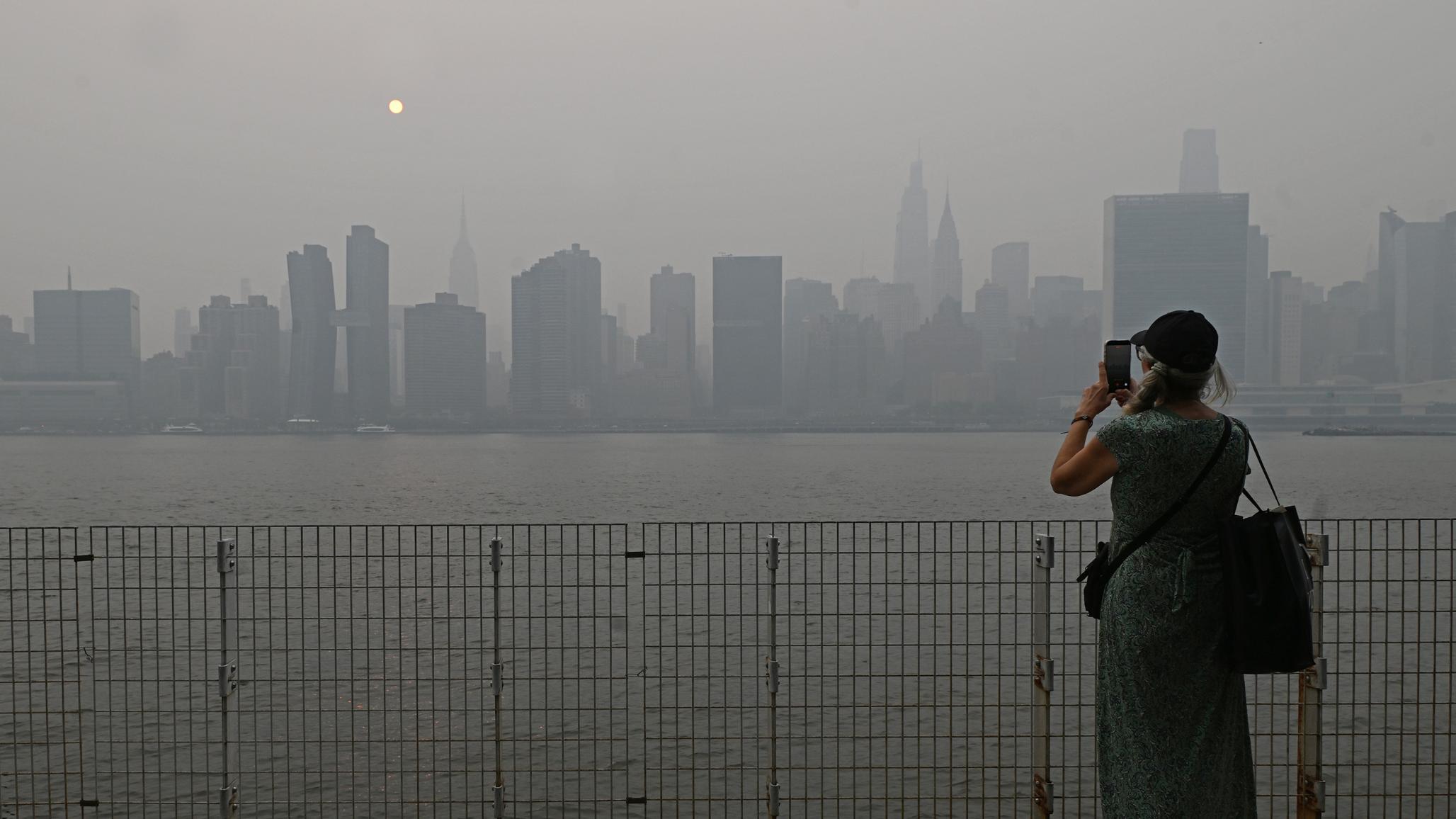
President Donald Trump's tariff threats over Canadian wildfires blanketing the northeastern US with smoke have been folded into his broader US-Canada trade war. The president's bullying over Canada's alleged failure to manage the fires came on the same day the US implemented a new 10 percent tariff on Canadian goods stemming from a Section 301 investigation on forced labor, and just days after it announced 50 percent tariffs on select Canadian exports.
This is not a novel problem in international affairs or Canada-US relations. History demonstrates what works—and what doesn't—to address transboundary pollution problems. Typically, cooperative resolution comes from multilateral agreements to change economic incentives regarding pollution, as shown by European cooperation over rehabilitation of the Rhine. In the disputes over haze from palm oil and pulpwood deforestation in Southeast Asia, however, the underlying economic incentives augured against cooperation, because the offending fires are part of the core business model of palm oil and pulpwood producers.
The Canadian wildfires are different. They have consumed almost 28,000 square kilometers of Canadian forest and displaced thousands from their homes. While air quality has improved markedly across the Eastern Seaboard in the past weeks, the problem is likely to endure for months—but return next fire season. The fires are not unfortunate externalities or central elements of any single core business model. They are a natural, persistent feature of the landscape that active management can only partially address. The only hope for adapting to the problem—one that is likely to get worse as the world warms—lies in continued cooperation. A punitive, tariff-based approach will not only fail but also undermine cooperation across a host of other domains.
Decades of Canada-US cooperation over transboundary challenges
Before this fire season, US-Canada forest fire comanagement efforts were operating under a model of bilateral cooperation to address shared environmental problems. For nearly 60 years, beginning with Quebec's entry into the Northeastern Interstate Forest Fire Protection Compact in 1969, Canada and the US have shared resources, personnel, and aircraft across the border to combat recurrent wildfires, as well as sharing scientific data and comonitoring of weather conditions along their 4,000-mile, often heavily forested, border.
For example, Canadian firefighting crews and aircraft played a role in containing the 2025 southern California wildfires.[1] In 2023, during Canada's then-worst fire season on record, the US sent over 2,000 firefighters and support personnel to combat fires from Nova Scotia to British Columbia. Critics on both sides of the border have periodically decried what they view as inadequate forest management policies that prioritize fire suppression—trying to mitigate the frequency of fires—over routine debris-cleaning that would reduce fire intensity and scale. In spite of these disagreements, mutual aid has been the norm.
Upstream/downstream conflicts are not new
Frictions between upstream polluters and those affected downstream have been the subject of intensive study for decades. These studies reveal a consistent pattern: Transboundary pollution issues are resolved—or best mitigated—when economic incentives are realigned through multilateral frameworks but tend to fail when they are not.
The most instructive success case is European management of Rhine pollution. Salt pollution from the Alsatian potassium mines threatened drinking water and agriculture in downstream countries for over a century. Efforts to address it through treaties (1976) stalled for a decade until the 1986 Sandoz chemical spill generated political pressure to act. The breakthrough came not through punishment but through cost-sharing: Downstream countries—the Netherlands, Switzerland, Germany, and Luxembourg—jointly financed injection wells and storage facilities for waste disposal. This arrangement gave France the resources and the incentive to comply, since the mines remained economically viable and France avoided isolation from increasing European integration.
The clearest parallel to the US-Canada problem is the Indonesia-Southeast Asia haze dispute. Massive peatland fires in 1997-98 burned an area in Indonesia the size of Virginia, spreading smoke across Southeast Asia and causing $9 billion in economic losses. The Association of Southeast Asian Nations (ASEAN) responded by adopting the Agreement on Transboundary Haze Pollution in 2002, but Indonesia delayed ratification for over a decade. The agreement failed because it lacked an incentive realignment mechanism. Unlike the countries involved in cost-sharing compliance to protect the Rhine, Indonesia's neighbors had no way to compensate Indonesia for abandoning palm oil production. The reality was that the fires were the mechanism by which the industry cleared land, i.e., a key component of the business model, not an unfortunate externality. Without incentive restructuring, enforcement was toothless. The fires resurfaced in 2006, 2015, and 2019.
The Canada-US problem is different
By contrast, there are no domestic economic interests benefitting from uncontrolled wildfires in Canada's vast boreal forests. Toronto's skyline is just as invisible as New York City's. The fires result from a natural process driven by higher temperatures and more frequent and persistent droughts due to climate change in areas with virtually no infrastructure. These fires come with real costs. Recent estimates by economists Kimberly Clausing, Christopher Nittel, and Catherine Wolfram suggest that somewhere between 50 and 80 percent of the economic costs associated with recent wildfires are attributable to climate change over the past three decades.
The problem is compounded by the remoteness and scale of Canada's forests, limiting well-intentioned fire suppression activities. Indonesia's sins are of commission; Canada's sins—if they even can be called that—are sins of omission. But it is reasonable to ask if any forestry policy could reasonably be expected to solve the problem in a country where there are roughly nine hectares of forest per person—ten times the US value. This situation is fundamentally different from the political-economic interests at play in both the Rhine and Southeast Asian disputes.
Tariffs almost guarantee failure
Threatening or imposing tariffs is not likely to generate better outcomes. First, it treats the problem as one of political will, rather than capacity. No amount of trade-related punishment is likely to spur fixes to remote boreal forest fire suppression, because no such fixes readily exist.
In fact, tariffs would only poison the goodwill necessary to create collaborative solutions. Prime Minister Mark Carney, the target of sharp criticism from Trump, already cannot go to the Canadian public to promote the virtues of data sharing and comonitoring under these circumstances, especially given Trump's recurrent threats to make Canada the 51st US state. Tariffs and saber-rattling worsen this relationship.
What would help—and what it would require
The brutal truth is that the fires result not from industrial policies or avarice but from a changing climate to which all countries must adapt.
There are four paths forward—three productive and one mutually hurting. The first would be to return to the status quo: coinvest in fire detection infrastructure, coordinate emergency response, increase the stock of and preposition aerial fire suppression equipment, and perhaps fund more forest clearance activities in areas closest to population centers. These interventions can reduce severity of the fires.
The second path is for both Canada and the US to increase investment in adaptation and resilience, which does not solve the problem but does make affected populations more resilient to it.
The third would be for Canada and the US to work together on climate mitigation. Here, Canada is doing strong work, but the US is actively undermining global cooperation, despite both being leading fossil fuel producers. In any event, the problem will still be there. There are no silver bullets; however, the US and Canada can collaborate to put shock absorbers in place and address underlying causes.
The fourth, of course, is to escalate tensions, which will do nothing to address the fires themselves but will sap both countries of the neighborly help that has been so important recently. That is a recipe for higher economic and human costs.
Punitive approaches, moreover, will threaten cooperation across a host of other domains, including environmental issues like shared freshwater resources (the Great Lakes and many rivers) and transboundary coastal fisheries. The US is threatening trade-related punishment over a nontrade issue. It should not expect Canadian responses to remain purely in the trade domain. This problem needs climate scientists, public health and infrastructure experts, and forest management officials on the case—not trade lawyers.
Note
1. Mexican firefighting crews were also deployed in Los Angeles.
Data Disclosure
This publication does not include a replication package.
