
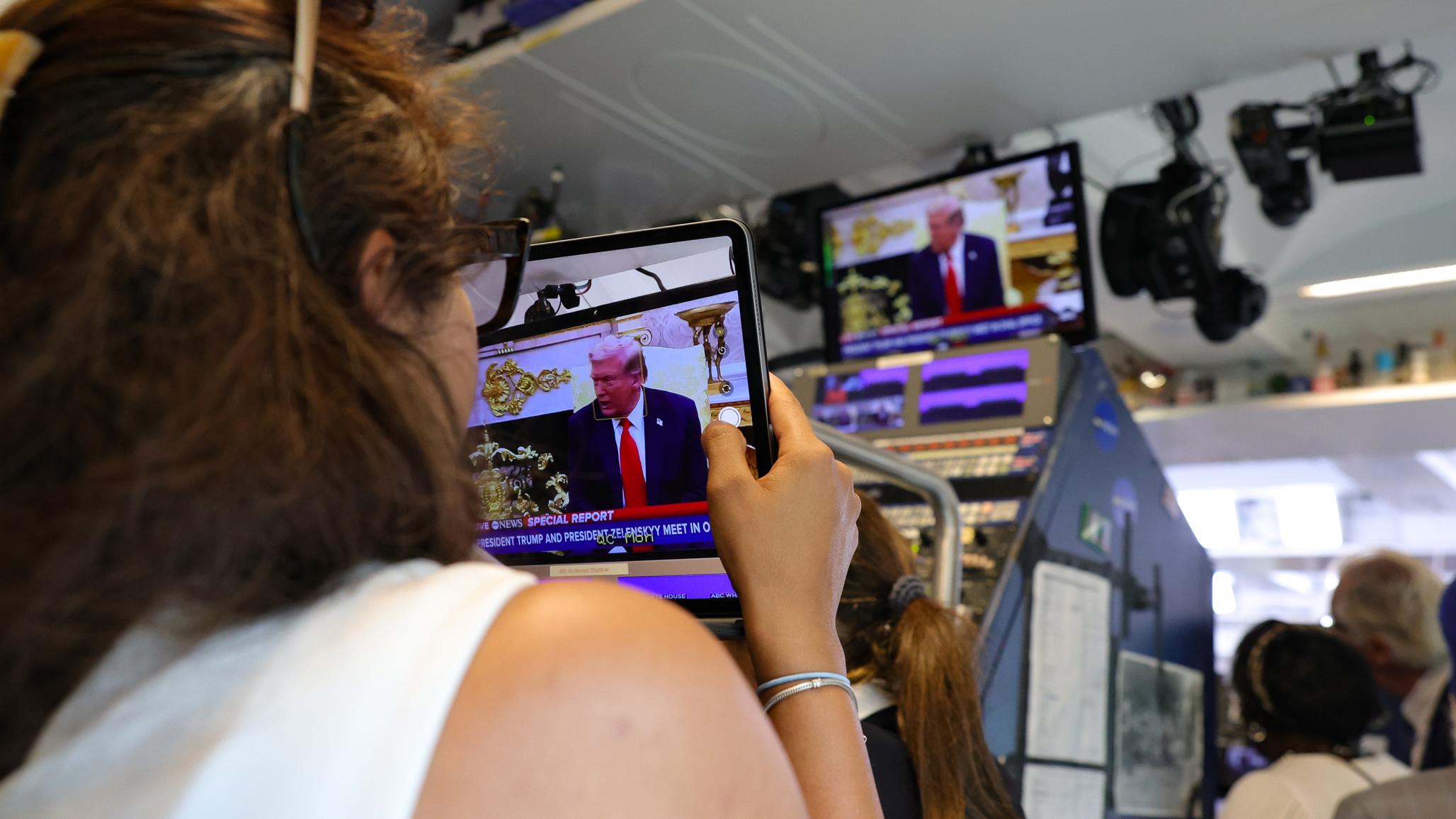
Ukrainian president Volodymyr Zelensky and US president Donald Trump met August 18 in the White House to discuss how to end Russia's war in Ukraine, just days after Trump’s talks with Russian president Vladimir Putin. Among the issues considered were the possibility of the US and European governments providing Ukraine with some sort of future security guarantee—but not membership in the North Atlantic Treaty Organization (NATO). Russia on August 20 ruled out any Ukrainian security guarantee without its consent, a stance that could function as a poison pill or hardline bargaining position.
Public proclamations aside, any negotiated end to the fighting will eventually require either active third-party peacekeeping or security guarantees from Western powers—none more powerful than the United States. But for any such guarantee to work, both Ukraine and Russia would have to believe the US commitment. But how can other countries believe the United States will follow through on any security agreement after the Trump administration has abrogated numerous trade agreements and adopted a more skeptical posture toward NATO? These administration actions have expanded its bargaining latitude significantly but at the cost of making future commitments less credible.
Credible commitment problems are a favorite topic of economists and international relations scholars because they highlight a dilemma at the heart of virtually every promise: A promise binds the maker to a future action they may no longer want to take once the moment arrives. A US promise to secure Ukraine against future invasion may sound good in the Oval Office in front of reporters, but the test of that commitment might not come for years, not until after the Ukraine-Russia conflict has been superseded by the latest international crisis of the day and the spotlight is elsewhere. Calls for help rarely come at convenient times, and the promise itself—to spend US resources to secure Ukraine’s post-settlement borders against a nuclear-armed, much larger adversary—could be a costly one to keep.
The problem is ubiquitous. New Year’s resolutions, romantic relationships, and non-cash economic transactions are all examples of situations in which the promise itself can be easy, but the follow-through can be hard.
Thankfully, there are a variety of solutions—or at least partial solutions—to this problem. There’s a reason weddings—promises to love one another forever—generally take place in the light of day, surrounded by friends and family and not in the dimly-lit backseats of cars where the promise may have been first uttered. A wedding is what’s known as a costly signal, or an action an entity takes to demonstrate its intentions in a way that is too expensive, risky, or reputationally costly to take lightly.[1]
Stepping back into the realm of diplomacy, there are a variety of well-known ways countries can costly signal intent to honor their security commitments. The first is through public, formal treaty commitments. NATO’s Article V pre-commits its members to treat an attack on one as an attack on all. The credibility of that promise has been enhanced over time by joint exercises and functional specialization, which renders NATO members somewhat dependent on other members’ capabilities and industrial bases. The public nature of these treaties establishes a shared understanding, not just between alliance members but also countries that might seek to do them harm, of where the line is and what the consequences will be for stepping over it.[2]
A second mechanism, explored and explained best by the late economist Thomas Schelling, is to station guarantor troops directly in harm’s way, a strategy known as tripwire deployment. The 28,500 US troops stationed in the Republic of Korea could not hope to repel a full-scale, million-soldier-strong North Korean invasion. Indeed, in that event they would likely fight valiantly and die in significant numbers. But the United States would have to respond—domestic public opinion would not stand for anything else.
A third, related mechanism would be to anchor US economic interests to the region. The US-Ukraine critical minerals deal could do just that by developing US-owned mineral deposits across central Ukraine. If those assets come online (and that’s a significant “if”), a new Russian invasion would imperil not only Ukraine’s sovereignty but also US mineral security, raising the cost of US inaction.
In theory, the Trump administration could use any combination of these mechanisms to make US commitments credible. Treaty-based alliance commitments, forward deployment of US assets, and economic interdependence with allied countries have been the bedrock of US grand strategy since the end of World War II. If US-Ukraine economic interdependence takes years to materialize and we take Putin at his word that deployments of NATO troops along the Ukraine-Russia border would be a nonstarter, then any negotiated settlement would fundamentally rest on the security guarantor’s willingness to meet its publicly created obligations. The Trump administration’s lukewarm posture towards NATO and other treaty allies and the weakened checks and balances in US political institutions augur against that promise being credible.
The Trump administration has signaled ambiguity about the strength of its commitment to NATO’s Article V obligations. Trump openly questioned whether the United States should defend countries that don’t “pay their bills”[3] and meet the now 5 percent of GDP defense spending target. He has discussed leaving the alliance entirely and been cagey about his interpretation of Article V, both during his first term and in 2025. As a negotiating tactic on the administration’s part, this approach appears to have paid dividends in the form of increased NATO spending and a US-EU deal that commits Europe to significant purchases of US military hardware and fuel exports. But it has also created strategic ambiguity—not just in NATO capitals but in Kyiv and Moscow as well. Ambiguity may be useful in negotiations, but deterrence depends on strategic clarity.
Then there is the issue of domestic institutional constraints. Historically, US treaty commitments—which encompass both military alliances like NATO, bilateral security treaties with countries like Japan and the Republic of Korea, and the US network of free trade agreements—have been considered solid because of the institutional path toward their creation. Under the US Constitution, the executive negotiates treaties, but they only become binding once the Senate ratifies them with a two-thirds vote.
Most trade agreements, however, are not treaties but congressional-executive agreements: Through Trade Promotion Authority (“fast track”), Congress authorizes the president to negotiate trade deals with specified countries during a set period, following certain policy guidelines, and promises to consider the final agreement under expedited procedures—limited debate, no amendments, and a straight up-or-down vote. Both processes set high bars, and clearing them signals a strong domestic consensus behind the agreement. By the same logic, a formal treaty between the United States and Ukraine would make a US security guarantee far more credible.
Foreign policy under the second Trump administration has not followed this institutional path. Instead, the Trump administration has made unprecedented use of executive orders and delegated emergency powers—including court-challenged use of tariffs—to negotiate and implement trade deals. This approach allows the Trump administration maximum latitude in these negotiations, which have resulted in a program of tariffs that are noncompliant with US treaty obligations under the Uruguay Round Agreements Act[4]—to say nothing of existing free trade agreements, including the US-Mexico-Canada Agreement (USMCA), which was negotiated during Trump’s first term in office. But this latitude comes at a cost: Bypassing established institutional processes renders these deals more brittle and subject to reversal or post-hoc modification.
In the realm of international affairs, formal dealmaking is hard—and that’s by design. It makes the resulting deals that much more robust. In bypassing established institutional channels for making trade and security deals credible, and publicly wavering about the NATO alliance, the Trump administration is undermining the mechanisms that would make a US-brokered deal to end the Ukraine war credible. And credibility is the foundation of stability.
Notes
1. Engagement rings operate according to the same logic.
2. Strong emphasis on the necessity of these commitments being public. The perils of secret treaties were laid bare by the outbreak of World War I.
3. In point of fact, he said “I would encourage them [Russia] to do whatever the hell they want. You got to pay. You got to pay your bills.” Notably, the North Atlantic Treaty (1949) does not mention spending targets, which were unofficially established in 2006 at the NATO summit in Riga, Latvia, affirmed in Wales in 2014, and then upped to 5 percent in The Hague in 2025. Not meeting the spending target is not an abrogation of NATO obligations.
4. The Uruguay Round Agreements Act, which created the World Trade Organization, was signed into law in 1994.
Data Disclosure
This publication does not include a replication package.
