
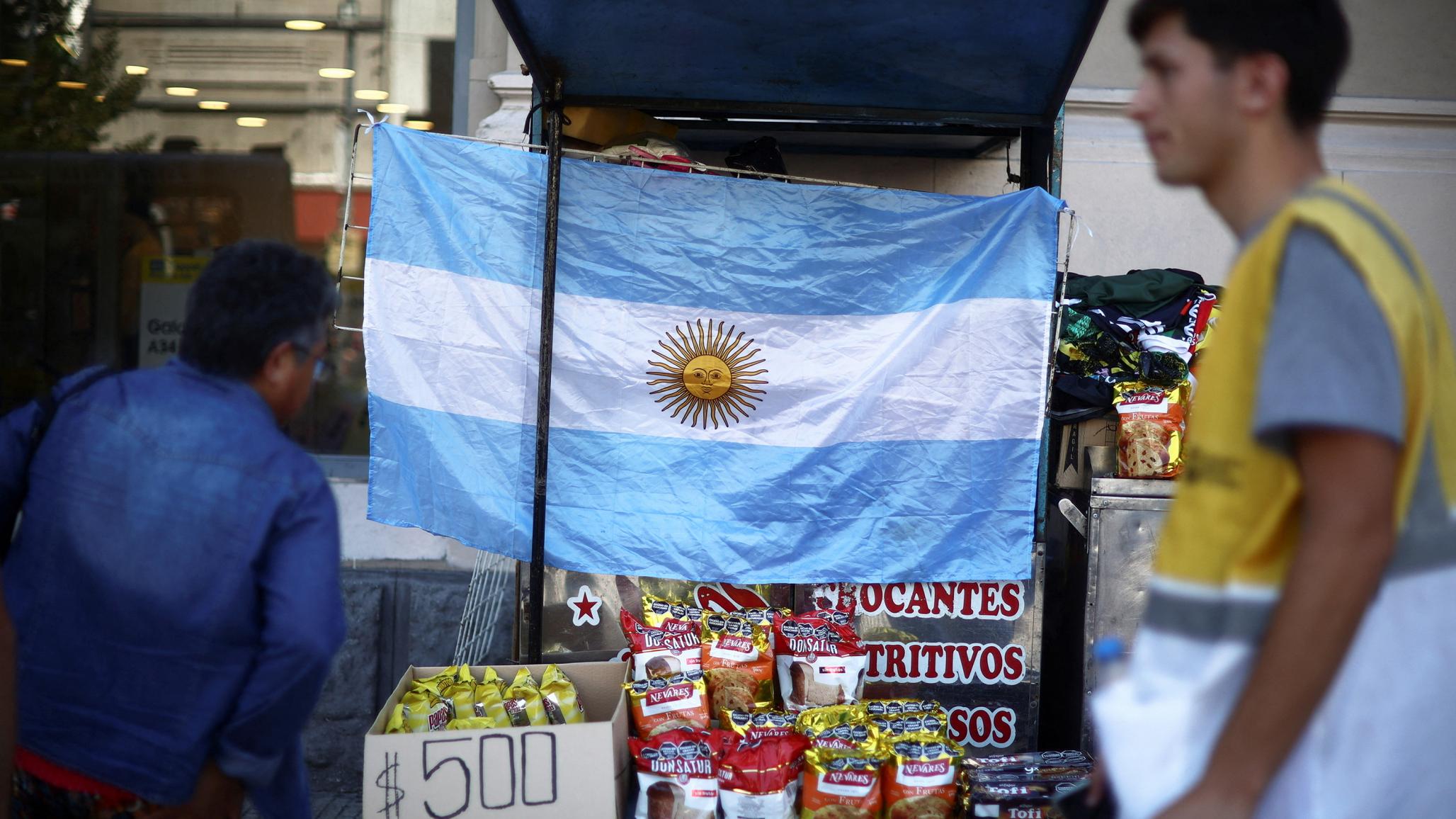
US Treasury Secretary Scott Bessent’s unusual use of taxpayer dollars to support Argentina’s currency is central to President Javier Milei’s hopes in the October 26 legislative elections. Treasury has spent hundreds of millions of dollars directly buying Argentine pesos in Buenos Aires, provided a $20 billion currency swap line, and is trying to arrange $20 billion in private loans to the country.
Before this month, Treasury last bought foreign currency 25 years ago: the euro, in an intervention coordinated with the European Central Bank and the Bank of Japan. More novel even than the fact of US intervention in an emerging-market economy’s currency markets is Bessent’s pledge to do “whatever it takes,” without any publicly announced conditions on Milei’s government, to prevent a disorderly peso devaluation.
Bessent has characterized Argentina’s travails as “a moment of acute illiquidity” caused in part by politically motivated speculators, one that can be surmounted by US lending at no cost to the United States. However, Argentina’s problems run deeper. While there may have been a narrow path for Milei’s reform plans to succeed, that moment has likely passed. At a minimum, Argentina will need a new monetary framework and more multilateral conditional support, accompanied by domestic consensus-building.
Background to the crisis
One of the world’s richest countries a century ago, Argentina has had a troubled history punctuated by soaring inflation, currency crises, and economic reform plans that have always ended in tears. A failed reform effort under former President Mauricio Macri preceded an International Monetary Fund (IMF) program and a $50 billion loan in July 2018 (which the Fund expanded to $57 billion only months later, in October 2018). The IMF refinanced its previous loan with a new program in March 2022, and in April 2025 approved yet another program, along with an additional $20 billion of which the IMF had disbursed $14 billion by August 2025. In total, Argentina now owes the Fund about $57 billion—more than a third of the IMF’s total current lending.
The latest IMF program followed Milei’s election on an economic platform of radical reforms. Argentina’s inflation rate hit a recent peak of 25.5 percent per month—equivalent to 1,427 percent on an annualized basis—in December 2023, the month Milei was inaugurated. Milei’s achievements in bringing down inflation (which was “only” 2.1 percent for September 2025), attaining a federal budget surplus, and easing regulations have been impressive; before the current crisis, the IMF projected Argentina’s GDP to grow 5.5 percent in 2025, after contracting 1.3 percent in 2024. The IMF’s first review of its April 2025 program therefore judged that key goals were being met, with one exception: The country’s net international foreign exchange reserves (which it holds mostly in dollars) were substantially below their target level.1
This Achilles’ heel has placed Milei’s entire program in peril and motivates the US intervention, which aims to reverse his sagging political fortunes and boost his party’s vote in the critical October 26 elections.
Desperately seeking dollars
Argentina needs dollar reserves so badly for two primary reasons. First, Argentina is due to pay foreign creditors (including the IMF) about $45 billion by the end of 2027, with around $8 billion already due through January 2026. Insufficient reserves would make repayment less likely.
Second, and at the root of the recent currency instability, Argentina needs dollars to maintain the monetary framework it put in place last April following the new IMF program and loan. Hoping to allow more exchange rate flexibility while still limiting peso volatility, Argentina announced a band system for the peso/dollar exchange rate, with an allowed fluctuation range that would expand slowly over time at a predetermined pace, as illustrated in figure 1. Milei’s economic team agreed with the IMF that Argentina would sell dollars only if the peso/dollar rate reached its maximum (weakest peso) level, intervening within the band only to purchase (but never to sell) dollars. Had Argentina observed these rules, it might have accumulated more reserves and even dampened the currency speculation that emerged around mid-year—but it did not, and now it has fewer dollars that it can sell in the foreign exchange market to keep the peso from exiting the band.
Dollar purchases within the currency band would have been greatest had the peso been under appreciation pressure due to financial inflows—perhaps from Argentinians repatriating some of their copious offshore dollars and buying pesos. The IMF program had a provision to encourage this development: It required Argentina’s central bank to strictly limit purchases of peso-denominated assets, one of the ways it can raise the money supply. To be sure, the domestic demand for pesos was expected to rise over time as inflation stabilized and interest rates came down, but if the central bank refrained from creating much money through domestic asset purchases, the money would have to come from purchases of returning dollars, which would raise the central bank's dollar reserves along with the money supply. The IMF’s first program review in June 2025 found that Argentina’s central bank had also breached the agreed limits on its domestic asset purchases.
Another potential source of foreign exchange is through trade surpluses rather than capital inflows. However, the improvement in Argentina’s current account balance in 2024 as the economy went into recession proved fleeting. The current account moved back into deficit in the first half of this year, creating further downward pressure on the peso (see figure 2).
Milei’s credibility trap
Soon after starting up the band system, the Milei government also eased most of the controls on cross-border capital movements that had been in place since the Macri administration. History shows, however, that trying to control an exchange rate can be hard once international capital outflows are freed. Exchange rate pegs are inherently fragile because their stability requires the pegger to demonstrate a high degree of commitment and credibility. If markets, for whatever reason, come to doubt the credibility of the exchange rate band and massively sell pesos, the central bank could exhaust its foreign exchange reserves in a vain attempt to prevent the currency from crashing through the top of the band. Right now, markets see a good chance that Milei will adjust his exchange rate band after October 26.
The central bank might try to raise interest rates to draw in foreign funds, but the magnitude of an interest rate hike sufficient to quell the crisis would likely throw the economy into deep recession.
A less risky monetary strategy would have been to free the exchange rate to float rather than using it to suppress inflation, while retaining controls on resident capital outflows. When the exchange rate is used to control inflation rather than being allowed to float, inflation generally takes time to come down, making exports more expensive for foreign buyers and imports cheaper for domestic residents. In turn, home demand falls and the trade balance worsens. However, Argentina likely will need an ongoing current account surplus to earn dollars to repay its debts. Relative to that benchmark, the peso is currently overvalued, which is one reason markets are betting on a currency devaluation after the October 26 election.
Overvaluation is a common phenomenon in exchange rate–based stabilization programs and usually has fatal effects. Unusually for would-be stabilizers, Milei pushed Argentina’s government budget into surplus, mitigating a key potential driver of continuing inflation. Inflation persists nonetheless because of fears that the stabilization program will be abandoned if Milei’s political clout wanes further, as well as the private sector’s attempts to offset income losses by raising prices. And indeed, Milei’s measures have inflicted collateral damage on many Argentine businesses and households, draining political support. This and other factors have brought his ability to govern effectively into question and raised the chances of a Peronist victory in the 2027 presidential election. That outcome would surely bring a return to macroeconomic instability. Market actors understand this.
The result is a credibility trap. Political weakness brings fears of peso devaluation and further inflation, which in turn bring further political weakness. The US Treasury’s intervention in Argentina’s markets is an attempt to break this cycle.
The results of the October 26 election will show if Milei’s problem is one of political “illiquidity” (which he might overcome with enough good luck) or political insolvency. Even if he attains a big enough legislative vote to avoid disaster, continuing illiquidity is a good bet. The US would like to counter China’s regional influence and gain preferential access to Argentina’s wealth of energy, lithium, and copper. Those motives may elicit ongoing Treasury support, but it will be an expensive investment, potentially costly in terms of US domestic backlash and with an uncertain ultimate payoff if Argentine political polarization continues.
Note
1. Argentina’s net international reserves, equal to reserve assets available to and controlled by the central bank less its short-term reserve-related liabilities to nonresidents, stood at minus $4.7 billion in mid-June 2025, according to the IMF.
Data Disclosure
This publication does not include a replication package.

Author's note: I thank Gianluca Benigno, Olivier Blanchard, Monica de Bolle, José De Gregorio, Gene Frieda, Paul Krugman, Andrés Velasco, and Alejandro Werner for helpful discussions. Nell Henderson provided expert editorial assistance and Nishtha Agrawal delivered sterling research support. All opinions are mine alone.