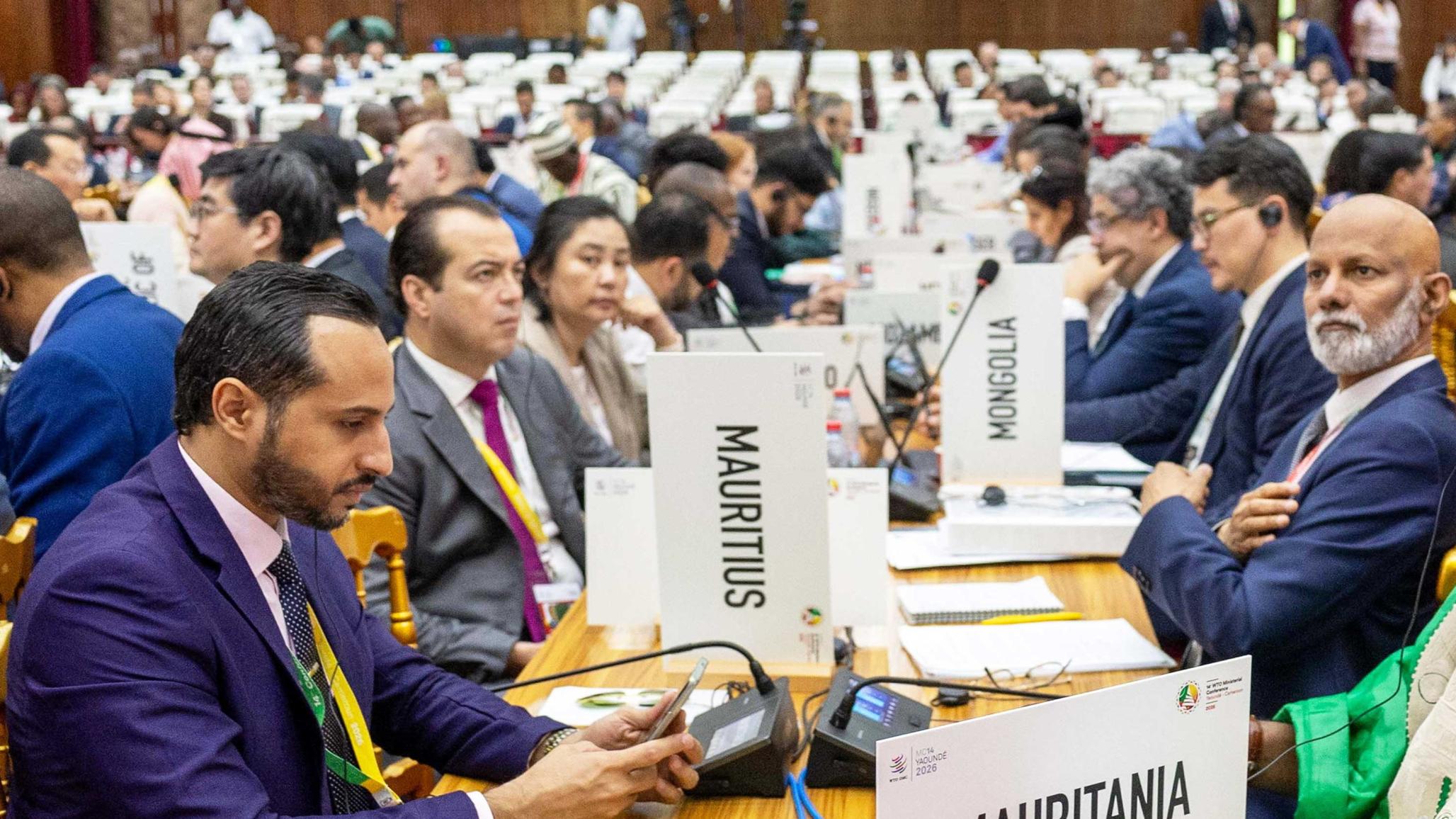
The only significant success of the World Trade Organization's (WTO) 14th Ministerial Conference held in Cameroon on March 26-29, 2026, was to adopt a pathway toward implementing an agreement on electronic commerce, as laid out in a Joint Statement Initiative reached at the 2024 WTO ministerial. The JSI is not a formal WTO agreement but rather a statement of intentions by 66 WTO members (out of the total 166) as to their domestic regulation of ecommerce.[1] While the JSI membership accounts for 70 percent of world trade, it does not at present include large developing countries such as Brazil, India, and South Africa, nor does it include the United States. More on that peculiar absence below. Given its current aspirational nature, and its missing members, why is the ecommerce agreement important?
The ecommerce agreement recognizes a shift in the WTO's role
Its greatest importance lies in its recognition that the WTO no longer solely serves as an organization for crafting binding rules of universal application. Instead, for the foreseeable future, the WTO will mainly provide a forum where groups of members can reach commercial agreements among themselves. The forum has great value to small countries that have neither the economic heft nor the diplomatic resources to negotiate multiple bilateral agreements.
If they wish to make such agreements binding, the parties to such commercial agreements can invoke an arbitration mechanism (such as the WTO's Dispute Settlement Understanding or the Multi-Party Interim Appeal Arbitration Arrangement), but that is not essential. The WTO can thereby serve the world economy well as a forum and repository for plurilateral agreements on emerging issues, illustrated by ecommerce, and perhaps even for old-fashioned trade liberalization on products such as environmental goods and services.
Although the moratorium on ecommerce duties was not extended, the 66 ecommerce agreement countries agreed not to impose any
The second importance of the ecommerce agreement resides in its substance, summarized in the fact sheet. Contrary to the insistence of the United States and other countries, extension of the WTO moratorium on ecommerce duties—which expired during the ministerial—was blocked by Brazil and Turkey.[2] However, members of the ecommerce agreement agreed among themselves not to impose duties. This feature gave the United States a welcome free ride against potential ecommerce duties from the 66 countries. Further, the agreement essentially replaces paper authorization, documentation, and payment with their electronic equivalents. It calls for national measures against fraudulent commercial practices and unsolicited electronic messages, and positive protection of personal data. The agreement also commends an assortment of capacity-building and institutional actions.
Why didn't the United States sign up? Work on the ecommerce agreement started during the first Trump administration in 2017. Drafting proceeded slowly, and when the Biden administration took charge, progressive Democrats feared that the agreement would benefit "Big Tech" and hamper domestic regulation. In 2023, the Biden administration dropped out of the drafting group.
When Trump returned to the White House, he brought different concerns. Whereas the Biden administration thought the agreement would do too much, the second Trump administration thought it did too little. Specifically, as explained by the Information Technology & Innovation Foundation (ITIF), it does not ban data localization rules nor ensure free cross-border data flows, and it does not protect source code from forced disclosure.[3] Such provisions are part of the United States-Mexico-Canada Agreement (USMCA), but they are missing, even as aspirations, in the WTO Agreement on Electronic Commerce.
With the moratorium on ecommerce duties now at an end, more countries may sign up to the next iteration of the WTO ecommerce agreement
In aftermath of the 14th ministerial, some countries that are not members of the new agreement may enact duties on ecommerce, as they reserved the right to do so with the expiration of the moratorium. Other countries may activate their proposed digital service taxes. Based on past declarations, it seems likely that the Trump administration will retaliate if duties or taxes impact US tech firms. Out of this looming confrontation, the next iteration of the WTO ecommerce agreement could find more countries signing up. In exchange for duty and tax limits, one can speculate that the United States might shelve its demands on data localization, since the practice is now widespread. That outcome would represent a signal achievement of the ecommerce agreement.
Notes
1. The signatories have agreed to work towards a "stabilized text" that potentially could include commitments stronger than mere intentions.
2. Brazil reportedly insisted on an extension no longer than two years, while the United States insisted on at least four or five years after an initial demand to make the moratorium permanent.
3. Because of these shortcomings, the ITIF did not endorse the WTO Agreement on Electronic Commerce, but neither did it denounce the agreement.
Data Disclosure
This publication does not include a replication package.