
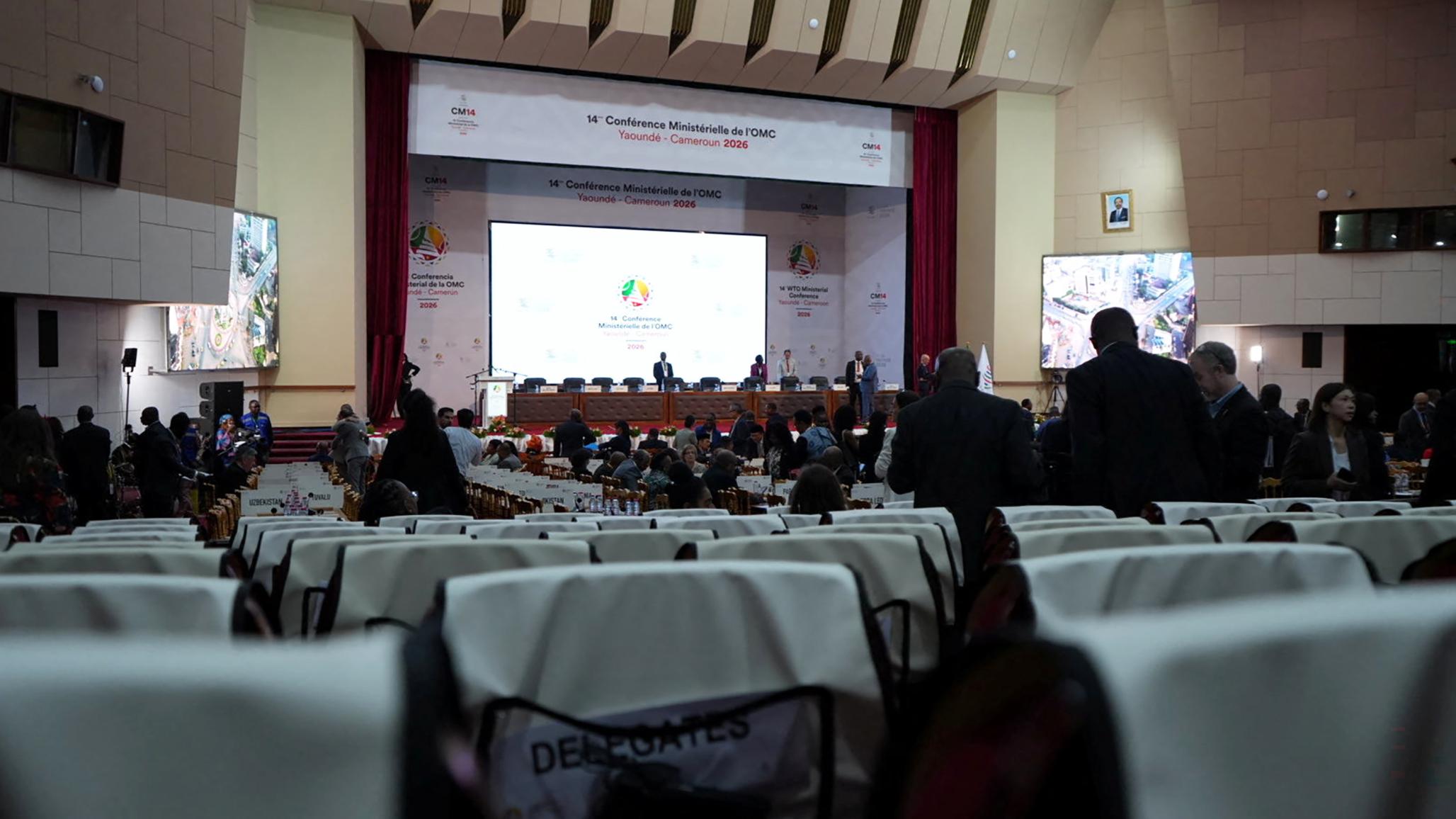
By several obvious measures, the 14th Ministerial Conference (MC14) of the World Trade Organization (WTO) was a failure. It did not end with an overall ministerial declaration, not even a chair’s summary capturing a conference-wide consensus. It did not achieve any of its headline goals, including an extension of the moratorium on placing duties on ecommerce—which expired on March 26, the first day of the conference. It also did not adopt the Investment Facilitation for Development Agreement (IFDA), which had been concluded in July 2023 and presented at MC13 in Abu Dhabi. Nor did it agree on a work program for WTO reform. And yet, by another measure, the world trading system is better off today than it was before the weekend in Yaoundé, Cameroon. Sixty-six members (with the European Union of 27 countries counting as 27 although it acts as one, covering 70 percent of world trade) announced that a formal electronic ecommerce (or ecommerce) agreement was open for signature by participating members, who will now proceed with their domestic procedures and deposit instruments of acceptance with the WTO director-general. The coverage ranges from the very largest WTO members, the European Union and China, to very small economies, such as the Gambia.
The plurilateral (multi-party) ecommerce agreement is not formally part of the WTO rulebook. If the signatories had tried to achieve formal adoption (they say they will try in the future), they would likely have been blocked by India, the primary opponent of plurilateral agreements. Although not a participant in the IFDA, India would not have approved adoption of that agreement at this meeting, preventing a consensus from being formed. Nevertheless, getting this far is an achievement for the WTO.
The Agreement on Electronic Commerce was the result one of four Joint Statement Initiatives (JSIs) created at MC11 held in Buenos Aires in 2017. Groups of like-minded countries decided to join together in discussions, taking the form of Joint Statement Initiatives, to consider how they would approach attaining global rules on four subjects—ecommerce; domestic regulation of services; investment facilitation for development; and micro, small, and medium-sized enterprises (MSMEs). The first three of these became formal agreements among the participants; the MSME exercise resulted in a reference paper. Despite setting up these venues, MC11 too was declared at the time to be a failure.
To say that these JSIs could have been launched outside the WTO is technically accurate but unsupported by any evidence. These were WTO activities, with early discussions through to formal negotiations taking place on the premises of the WTO, supported by the WTO secretariat, and with the resulting agreement on ecommerce announced at a WTO ministerial conference. The agreement is real and will be legally binding, if not formally acknowledged as a WTO plurilateral agreement, such as the Government Procurement Agreement or the Information Technology Agreement.
Although the US did not join the interim ecommerce agreement, it may well apply much of it
Standing back from the wreckage of four days of round-the-clock meetings in search of agreed outcomes at MC14, what is visible is that what Canadian prime minister Mark Carney famously gave voice to at the World Economic Forum in Davos earlier this year exists: Medium-sized countries, middle powers, have agency. When they act together, they can shape the future of trade relations, at least among themselves. Credit for this agreement lies with three co-convenors, Australia, Japan, and Singapore. The United States ultimately did not join this interim agreement in order to preserve its domestic regulatory freedom.[1] Ecommerce is, however, a vitally important market for the United States, and its finding a way to apply much of the agreement should not be precluded. It is a leader in innovation in the sector. Interest in the WTO in the US private sector is likely to remain very strong with respect to rules affecting ecommerce.
While all WTO members, including the United States, would say (or at least acknowledge by their behavior) that the WTO is of great value, and well worth being a part of, none would say that its functions do not need major improvement. All favor reform, although they do not agree on what should be changed or how the WTO should operate. Almost all, if not all, would say that rule by consensus should be retained, but they have not found an answer to consensus being withheld, when the reason for doing so is not because a national interest would have been compromised but apparently in order to take a hostage to seek to advance a pet policy of one’s own. Likewise, almost all would say that they want a uniform means of having full enforcement of obligations but cannot agree on how to achieve it or, in the case of one major actor (the United States), whether it is desirable at all. Those are two of the largest institutional issues. There are also a host of substantive issues that should be addressed but are not yet the subject of serious negotiation: the trade rules needed to address climate-related policies, pandemics, and food insecurity, to name a few.
The failure to find agreement on the WTO conference agenda items should not obscure the incremental progress made
This conference, MC14, is not the end of the debate. The issues on which the ministers meeting in Yaoundé failed to find common ground are to be addressed very soon back in Geneva. It should not be surprising that 166 trade sovereigns cannot find agreement readily at hand on issues where there are differences in interests among them. It is important, however, that they try. Reportedly, they came close to an agreement on these points in several respects in this meeting. But that they failed should not obscure the progress that is being made incrementally. The WTO is a member-driven organization, an over-used expression in that the members are not always seen to be active. Inclusiveness is required and it is slow and frustrating, especially in the absence of positive, strong leadership. At present, the absence of greater cooperation reflects the current state of world affairs more broadly, which although troubled has occasional bright moments. One of them is the creation of the new widely supported Agreement on Electronic Commerce being created at the WTO.
Note
1. It is a separate issue whether this agreement was everything it could have been. The Biden administration backed away from strong commitments regarding freedom of cross-border data flow, a ban on data localization, and protection of source code against forced disclosure. None of these core elements are part of the final agreement.
Data Disclosure
This publication does not include a replication package.
