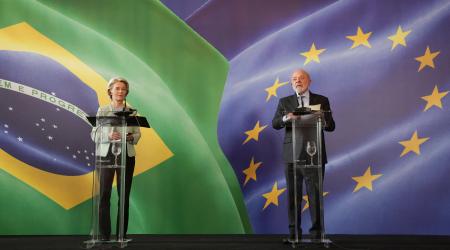
The EU-Mercosur trade agreement between the European Union and the South American bloc of Argentina, Brazil, Paraguay, and Uruguay is, on a generous reading, the most important piece of economic news to come out of Brazil over the past 20 years. Europe's ratification seems on track, but a recent dramatic turn of events may have improved its chances of ratification in Brazil.
That occurred with the disclosure of a potential financial scandal involving Senator Flávio Bolsonaro, former president Jair Bolsonaro's son and a presidential candidate himself, who would be in a position to block the deal if he is elected later this year. Earlier this month, Intercept Brasil, a new independent nonprofit journalism organization, reported links between the younger Bolsonaro and Daniel Vorcaro, the jailed owner of Banco Master, which recently collapsed amid accusations of financial fraud.
Surfaced audio recordings appeared to capture Flávio personally pressuring Vorcaro about overdue payments for the production of "Dark Horse," a film about Jair Bolsonaro. The accompanying bank transfer records published by Intercept Brasil show that substantial funds were transferred to the Bolsonaro family, directly implicating Flávio Bolsonaro in yet another major, still-unfolding corruption scandal.
As a result, within a few days, new polls showed President Luiz Inácio Lula da Silva opening a 7-point lead against Flávio. Meanwhile, two opposition parties filed to strip Bolsonaro's son of his Senate mandate. It is too early to say that Flávio Bolsonaro's candidacy is finished, but the possibility that the Bolsonaro name may be absent from the ballot in October reduces the likelihood that the EU-Mercosur agreement will be rejected.
The EU-Mercosur partnership agreement was signed in Asunción, Paraguay, on January 17 and has been applied provisionally since May 1. On January 21, the European Parliament voted 334 to 324 to refer the agreement to the Court of Justice of the European Union (CJEU) for a ruling on whether it can be applied before all member states ratify it and whether it constrains the European Union's environmental and consumer protection powers. That referral could delay full ratification by up to two years.
Years of negotiations on the trade deal ran into a major obstacle in the form of former president Bolsonaro's appalling record on environmental policies, including Amazon deforestation. Lula reversed these policies, which helped to bring the deal back from the dead. Jair Bolsonaro's direct heir, Flávio, is seen as likely to follow in his father's footsteps and block the deal.
There has been a temptation to read Flávio Bolsonaro as a more tractable, less ideological version of his father, that is, a politician who would govern with less climate denialism and more institutional restraint. That reading does not survive contact with anything Flávio has said about foreign policy. His pitch to Brazilian voters is that only a Bolsonaro can work with President Donald Trump. He has telegraphed, mostly through his brother Eduardo Bolsonaro, currently living in the United States, concessions to Washington on rare earth elements, narcoterrorism designations for domestic groups, and bilateral trade terms, all of which would undermine the multilateral approach Lula has been rebuilding over the past four years.
Lula managed to defuse some of these arguments through his successful visit to the White House earlier this month. But a Flávio presidency would make the Brazilian government again the principal political obstacle to EU-Mercosur ratification on the European side. Every European agriculture minister whose farmers are nervous about Brazilian beef and Argentine grains would, overnight, regain the political cover to vote "no." The CJEU referral, which currently appears to be a procedural delay, would deal a potential fatal blow, a risk that markets have not priced.
The trade, growth, and investment implications for Brazil would be massive. Locking in preferential access for the bulk of Brazilian agricultural exports to the European Union and exposing Brazil's manufacturing to a productivity shock that decades of protectionism had prevented is worth more to Brazil's development potential than any other policy discussion the current candidates could present.
The route by which Flávio's candidacy may now be derailed—the leaked audios, ongoing investigations by Brazil's Federal Police, and a Supreme Court whose impartiality the Brazilian right has spent three years disputing—is not what anyone would opt for. The Banco Master investigation has already cost the Supreme Court a justice and forced the Central Bank to defend its supervisory record in court. The institutional damage is real and will not undo itself.
The comparison, however, is not between this and a clean election, but rather between the scandal and a Flávio Bolsonaro presidency credible enough to negotiate Brazil's posture through the entire 2027–29 ratification window. The scandal has shifted the runoff probability enough that the EU-Mercosur ratification window is now likelier to close with a Brazilian government able to sit across the table from European parliaments without instantly making the deal untenable.
There are at least two things to watch. First, whether the European Parliament's CJEU referral is resolved fast enough that ratification happens before the elections in October. The Brazilian government has every incentive to push for the procedural acceleration that French and Polish opposition will try to slow down. Second, whether the Lula administration uses the political opening to sign the side letters on enforcement, deforestation monitoring, and agricultural safeguards that European parliaments will need to vote "yes."
Ironically, a major financial fraud scandal is opening the door to long-term economic gains. While this is a route no one wanted to take, it provides an opportunity for the country to lock in an international agreement that would pave the way for Brazil's development. Whether Brazil seizes the opening, however, will depend less on the courts and the headlines than on whether the Lula administration finally treats EU-Mercosur as the economic priority it has long deserved.
Data Disclosure
This publication does not include a replication package.