

China's large current account surpluses, reflecting its large trade surpluses, remain a concern around the world. Countries that absorb large quantities of Chinese exports without the ability to sell similar quantities of goods to China fear that China's export orientation threatens their industrial sectors. Weak Chinese domestic demand exacerbates the trade imbalance. Private consumption in China is only 40 percent of GDP, far lower than in most countries.[1]
International imbalances have long been understood by economists to be macroeconomic phenomena. When a country (e.g., the United States) persistently spends more than it earns, it obtains the additional consumption from abroad, running a current account deficit that is financed through international borrowing. When a country (e.g., China) persistently earns more than it spends, it accumulates international assets and runs a current account surplus, shipping excess production abroad.
To address this imbalance and achieve other policy goals described below, China can reform its tax system to encourage more consumption at home. As the country with the world's largest absolute current account surplus, China should rely more on a progressive personal income tax instead of leaning so heavily on consumption taxes. This would be in keeping with its avowed socialist principles while incentivizing domestic spending.
For its part, the United States should expect its trade wars to be ineffective in remedying its trade imbalance, since international imbalances are driven by macroeconomic factors. In recent decades, the United States has emerged as the world's largest debtor. Since 2020, it has accounted for more than half of the world's net current account deficits. Yet the massive US tariffs of 2025–26 have only had modest effects on the US current account. For the United States, reducing fiscal deficits (averaging about 6 percent of GDP of late) would be far more effective in reducing US national dissaving, although there appears to be little political appetite for fiscal restraint at present.
Unlike the United States, China does not have a fiscal situation responsible for its international imbalances. The Chinese government does not run a budget surplus. Instead, it has run large and growing on-budget deficits of more than 5 percent of GDP in recent years, reducing Chinese national savings (figure 1).[2] The Chinese government deficits have not been enough to offset a large excess of private savings over private investment or to lift China's economy convincingly out of deflationary pressures, however. While a larger fiscal deficit isn't called for, China should consider reforming its tax structure, including an expansion of its income tax, to discourage excess private saving.
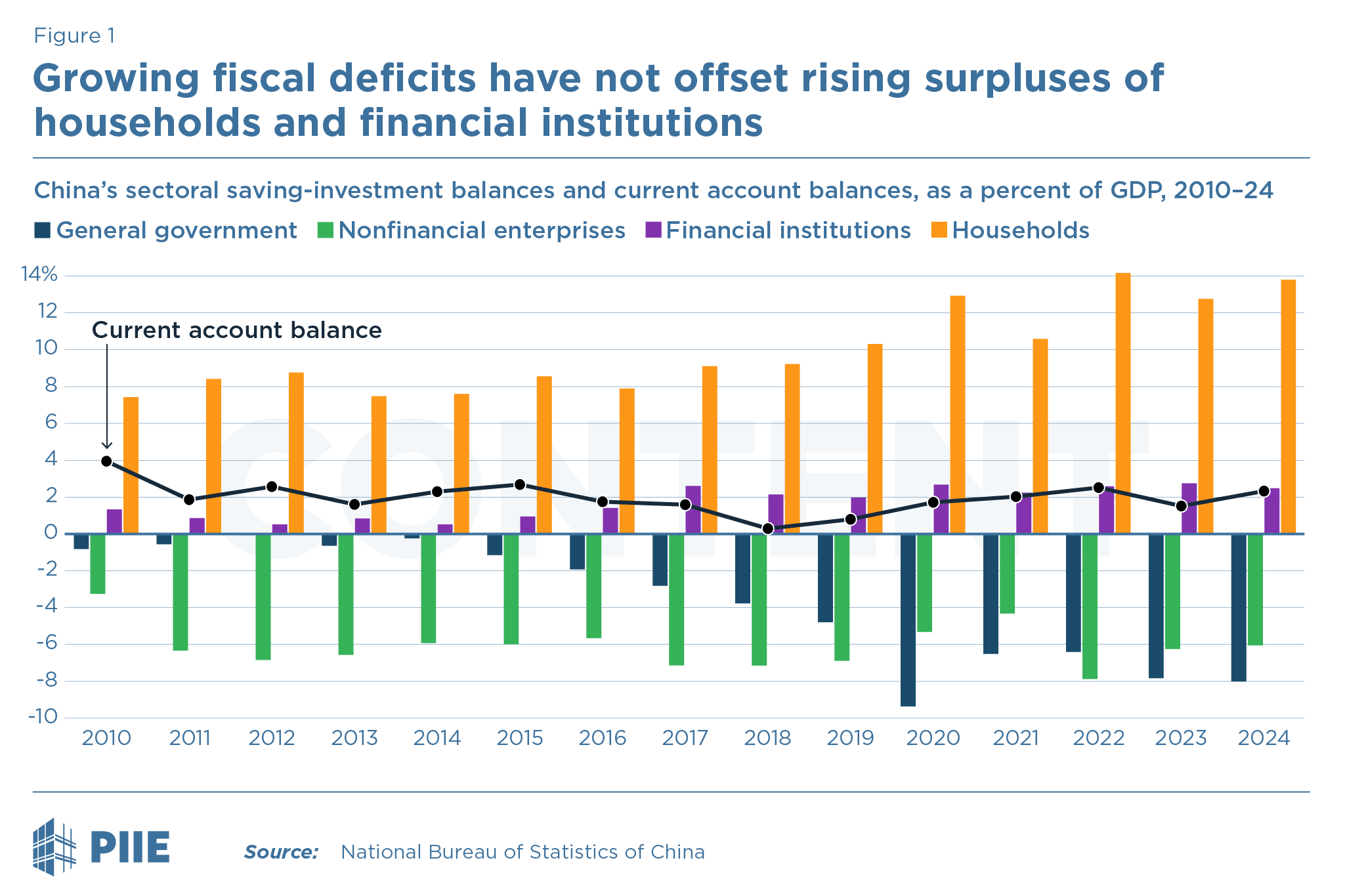
What accounts for the excess of Chinese savings?
It has roots in the Chinese housing bust, which has sharply curtailed private investment without diminishing China's high private saving rate (Huang 2026). Lower house values—especially without the availability of alternative savings options including international investments—may encourage higher saving, as the housing sector becomes a less reliable source of value and households pursue alternative savings goals.
China's government understandably argues that they have no more room to deficit finance aggregate demand in China. By the end of 2025, general government debt had reached nearly 70 percent of GDP, or nearly 130 percent of GDP when off-budget debt is included (International Monetary Fund [IMF] 2026). Total tax revenue as a share of GDP peaked in 2012 and has fallen steeply since then (figure 2). Beijing's tax and government fee cuts to support the economy since 2018 accelerated this decline. The housing bust that began in 2021 has further prolonged and deepened that trend. If anything, the Chinese government needs to raise taxes, as the population is aging and the principal non-tax source of revenue—land sales by local governments—is unlikely to rebound following the housing sector bust.
Indeed, China has often declared its interest in spurring domestic consumption, but it seems to throw up its hands when it comes to taking steps to reach that goal. But while fiscal balances are limited in their ability to help drive macroeconomic aggregates, the design of China's fiscal policy has an important role to play.
In particular, China should look to reforming its tax structure. Its very weak personal income tax was only about 1.2 percent of GDP in 2025, the lowest share among G20 countries other than Saudi Arabia, which does not impose a personal income tax. By contrast, China's consumption tax burden totaled about 6 percent of GDP in 2025 (including VAT, excise tax, and tariffs). Overall, tax revenue in China is very low for an economy on the cusp of advanced economy status, at only 12.6 percent of GDP in 2025. Including social security contributions, which China classifies as fees rather than taxes, the total tax burden amounted to 20.4 percent of GDP in 2023—higher than only India, Indonesia, Mexico, and Saudi Arabia among G20 countries (figure 3).
Tax reform that more heavily taxes incomes, instead of consumption, could achieve five important aims in China.
First, it could strengthen and modernize China's tax system, making it more suited to the fiscal challenges ahead. There are ample fiscal needs in China, including supporting China's elderly population, responding to disruptions, and pursuing countercyclical fiscal policy when needed. At present, China's fiscal capacity is quite low relative to that of other G20 countries.
Second, by taxing income instead of consumption, China could rectify the tilt in its fiscal system toward consumption over savings. China's biggest tax levers exempt savings from taxation; a broad income tax does not. Chinese government officials often say they want to spur consumption, but the structure of their tax system does the opposite, by leaning on consumption taxes rather than income taxes.
Third, these changes would make China's tax system more progressive, a suitable aim for an economy that is avowedly socialist. When we raised these issues with Chinese government officials in a recent trip to Beijing, we were often told that the Chinese population cannot afford tax increases. We agree that this is the case for many in the population, particularly rural residents and/or those with lower incomes. But the ability to make well-off households pay a higher share of their income in tax is a key attribute of a progressive income tax. An income tax can also easily shelter lower-income citizens from high tax burdens. A well-designed income tax system may even provide negative tax rates (i.e. a tax refund) for households with lower incomes—through earned income tax credits (EITCs)—providing both means tested income support and incentives to work outside the informal sectors of the economy.
In the United States, about 40 percent of households pay no federal income tax, mostly because of their lower incomes. And in China more than 70 percent of the individuals who file income tax declarations end up not paying personal income tax. The 1 percent of tax filers earning more than 1 million RMB (about $150,000) annually account for over half of the total personal income tax collected.[3] As such, China's current personal income tax system is progressive in taxing the highest earners. The challenge for the Chinese government is to maintain that progressivity while expanding the personal income tax base.
A broader, but still progressive, income tax can also help tackle China's regional income disparities. Such a tax would fall more heavily on richer regions, allowing the central government to redistribute fiscal resources to lower income regions. China's recent move to enforce personal income tax on wealthy individuals' offshore trust income is a first step in the right direction, targeting tax evasion and capital flight.
Alleviating overall tax collection burdens on lower-income Chinese could be carried out in a revenue-neutral manner, addressing China's weak consumption from two directions. First, income taxation would bring income that is saved into the tax base, shifting the national tax burden toward richer households, who tend to save a larger share of their income. Second, to achieve near-term revenue neutrality, steeper income taxes could be accompanied by lighter consumption taxes, although China may need to raise the overall tax burden over the long run. Since the poor consume a higher share of their income, the tax system would become more progressive overall, enabling lower-income Chinese households to consume more. Negative income tax rates for lower-income citizens through refundable tax credits would also boost consumption by families of lesser means. Such steps would also encourage tax filing and compliance throughout China, building up China's administrative capacity.
Fourth, a more meaningful income tax would also prepare China's tax system for the artificial intelligence (AI) revolution. Consumption and labor taxes are both subject to tax base erosion if labor is displaced by AI and robots. (Both the consumption tax and a labor income tax exempt savings—from taxation. These two taxes target the same tax base.) AI, however, is bound to create large productivity gains, some of which may show up as higher incomes and productivity for some lucky workers. But AI is also likely to yield higher levels of capital gains income and corporate profits. A strong income tax—including business income taxes—can reach all of these "winners" from the AI revolution while simultaneously cushioning those lower in the income distribution.
Fifth, and finally, China faces the long-term impact of aging on its pension system and the associated risks of underfunding in the coming decades. The system already relies on growing subsidies from the general public budget, which is funded primarily by tax revenue, to meet its obligations. This reliance will almost certainly increase without further pension system reforms.[4] To finance these growing subsidies, China must develop new government (e.g. tax) revenue sources. Redesigning and expanding China's income tax code may be the most feasible source of additional revenue of the magnitude likely required to sustainably address China's coming pension system needs.
In the 2024 Third Plenary Session of the Communist Party Central Committee (Third Plenum), the Chinese leadership did propose an income tax reform, but action has been slow, and the measures suggested so far are relatively incremental. In the midst of a deep structural housing market slump, China is also unlikely to institute a meaningful real estate property tax, as doing so would accelerate price declines. But government revenue must come from somewhere. Ideally, it should minimize behavior distortions while providing incentives for a much-needed macroeconomic rebalancing of the Chinese economy toward greater private consumption.
For all these reasons. the time is right for China to consider a broader, more holistic income tax system. Such a step would modernize China's fiscal regime while making it better suited to address international imbalances, ameliorate income inequalities, support an aging population, and readying the fiscal system for the looming disruptions of AI. If not now, when, Beijing?
Notes
1. Even when social transfers in kind (i.e., goods and services the government provides to households), which have reached around 7 percent of GDP in recent years, are included, private consumption in China still lags behind that of most major economies (see Lardy 2025 and the Organization for Economic Cooperation and Development).
2. The deficit measure we use here includes all four government budgets and is calculated by one of us (Huang). If the government's off-budget activity is included, the fiscal deficit would have reached more than 12 percent of GDP in recent years, according to the IMF's "augmented" measure (IMF 2026).
3. See Zichen Wang, "Taxman against further cutting personal income tax in China," The East is Read, April 1, 2025.
4. Such reforms include raising statutory contribution rates, lowering replacement rates by cutting benefits, and increasing retirement ages. Yet none appears feasible in the near term. China's statutory pension contribution rates are already among the highest internationally, leaving limited scope for further increases, while the replacement rate has declined for years and is now below levels generally considered adequate. China already announced (modest) increases in statutory retirement ages in 2024, making further increases unlikely anytime soon.
Data Disclosure
This publication does not include a replication package.


Authors' note: We thank Zhuowen Li for research assistance.