
China's rising reliance on exports to power its economy has fueled fears of a "second China shock" threatening producers of manufactured goods in Asia, the US, and Europe.[1] China's current account surplus rose from 0.7 percent of GDP in 2019 to 3.7 percent in 2025. Customs data show a much larger export surplus in tradable goods.[2] Although these shares remain below the extraordinary levels seen around the 2007-09 global financial crisis, the absolute amounts are enormous. The combination of surging Chinese exports and sluggish imports into China has sent ripples through developed and developing economies, prompting many countries to impose new trade barriers to protect domestic industries.
Much of the recent criticism of China has focused on the role of government subsidies and industrial policy in driving the trade surplus.[3] Those policies matter, but they are only part of the explanation. A deeper force is the aftermath of the bursting of China's housing bubble since 2021. When Chinese households stopped buying homes and developers sharply curtailed new construction, domestic investment fell sharply. Household saving did not decline by nearly as much. The resulting gap between domestic saving and investment has helped to generate a larger current account surplus.
This pattern is not unique to China. Housing busts often lead to rising current account balances globally because investment tends to collapse more quickly than saving.[4] But because China is the world's second-largest economy and a dominant force in global manufacturing, its domestic imbalances are transmitted abroad on an unusually large scale, inflicting pain on some exporting countries and their industries.
The housing bust widened China's saving-investment gap
At the national level, a country's current account balance reflects the difference between its domestic saving and investment. When saving exceeds investment, the excess saving is ultimately invested abroad. The housing crisis has been a major contributor to China's widening saving-investment imbalance in recent years.
The table shows the average sectoral saving and investment balances by component for two periods, 2010-20 and 2021-24, respectively.[5] Between the two periods, the household sector became a much larger net saver, while the general government became a much larger net borrower, leaving China's overall saving-investment balance and thus its current account surplus slightly higher. Specifically, the following patterns can be observed for each sector:
- Households. Their gross capital formation fell by 4.1 percentage points of GDP between the two periods, while saving dropped by a tenth of a percentage point. As a result, the household saving-investment balance widened by as much as 3.9 percentage points. Because household gross capital formation consists largely of residential investment, the growing household imbalance in recent years is likely driven primarily by the sharp declines in household homebuying.[6] This point is important because it shows China's external surplus did not rise because Chinese households suddenly became more frugal. Household saving remained broadly stable. What changed was that households stopped channeling as much of their saving into housing.
- Corporations. Financial institutions experienced a similar, though smaller, increase in their surplus. Their saving increased by 0.9 percentage point, while their capital formation dropped by a fifth of a percentage point. Their saving-investment balance therefore widened by 1.1 percentage points.[7] Meanwhile, the balance of nonfinancial enterprises remained essentially unchanged. Their saving and investment rose by roughly equal amounts.
- Government. The government moved sharply in the opposite direction. While the general government's gross capital formation rose by 1.1 percentage points, indicating higher public investment, its saving fell sharply by 3.7 percentage points, reflecting growing fiscal pressures during and after the COVID-19 pandemic and the collapse of land-related revenue following the housing bust. The government's saving-investment balance declined by 4.8 percentage points as a result. In effect, government borrowing absorbed much of the additional surplus generated by households and financial institutions. Without this fiscal expansion, China's current account surplus would have risen much more dramatically.
| China's saving and investment balance by component, 2010-20 and 2021-24 (percent of GDP) | |||
| Sector and component |
2010-20 |
2021-24 |
Change |
| Gross capital formation |
44.1 |
41.7 |
-2.5 |
| Households |
13 |
8.9 |
-4.1 |
| Nonfinancial enterprises |
25 |
25.7 |
0.6 |
| Financial institutions |
0.5 |
0.4 |
-0.2 |
| General government |
5.6 |
6.7 |
1.1 |
| Gross domestic savings |
46 |
43.7 |
-2.3 |
| Households |
21.9 |
21.8 |
-0.1 |
| Nonfinancial enterprises |
18.9 |
19.5 |
0.6 |
| Financial institutions |
2 |
2.9 |
0.9 |
| General government |
3.2 |
-0.5 |
-3.7 |
| Saving-investment balance |
1.9 |
2 |
0.2 |
| Households |
8.9 |
12.8 |
3.9 |
| Nonfinancial enterprises |
-6.1 |
-6.1 |
0 |
| Financial institutions |
1.4 |
2.5 |
1.1 |
| General government |
-2.4 |
-7.2 |
-4.8 |
| Source: National Bureau of Statistics of China. | |||
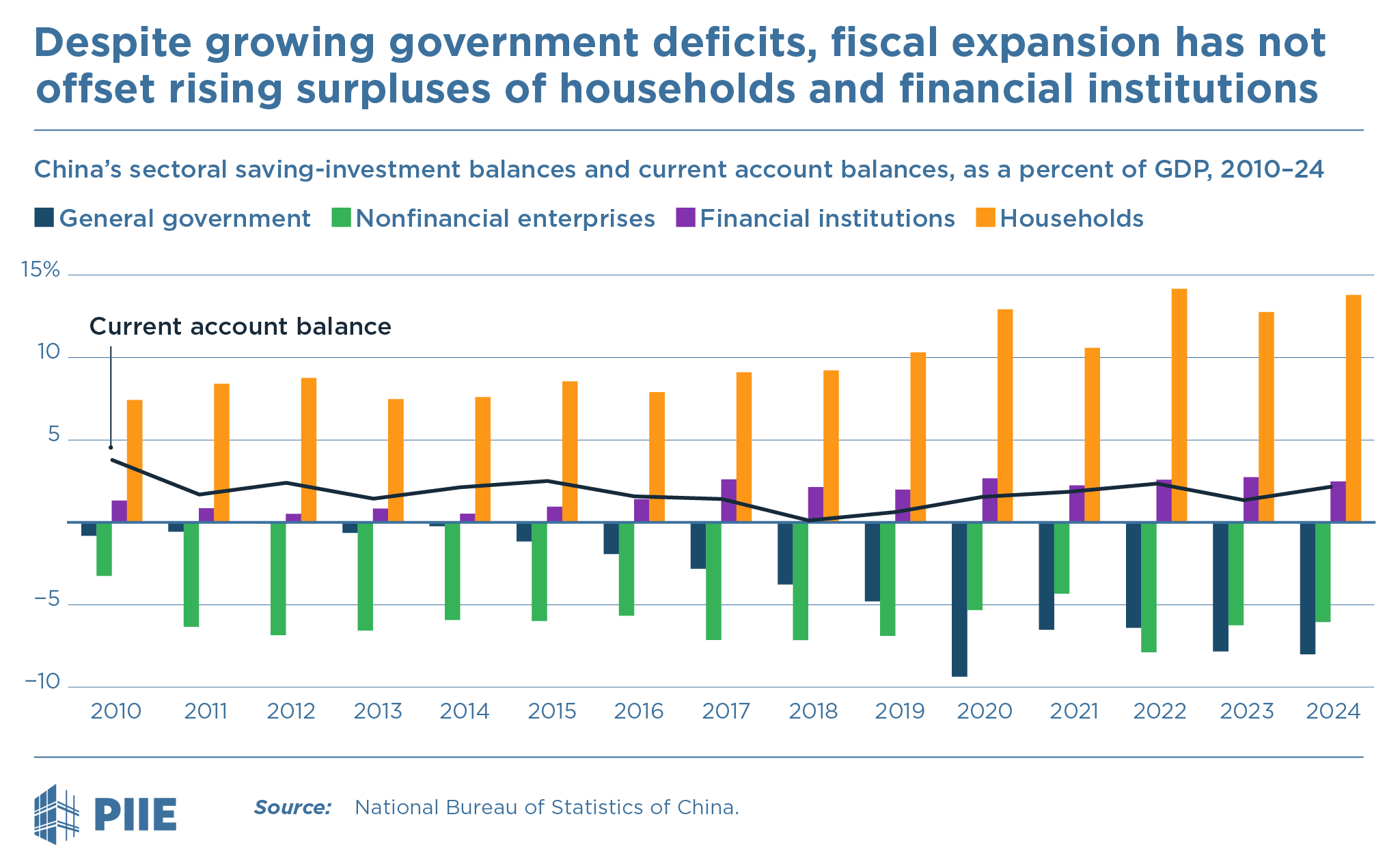
Despite the sharp widening of the government deficit, fiscal expansion was still not large enough to fully offset the rising surpluses of households and financial institutions. As a result, the national saving-investment balance still increased by 0.2 percentage point and reached 2 percent of GDP on average in 2021-24, which was reflected in higher current account surpluses. The figure plots China's sectoral saving-investment balances and overall current account balances from 2010 to 2024. It clearly shows the rising household surplus and a widening government deficit over time.
The imbalance may worsen before it improves
China's external imbalance may get worse before it gets better. As long as households remain reluctant to purchase homes, household investment is likely to remain depressed. Unless household consumption rises (or household saving drop), business investment expands, or the government runs an even larger deficit, the excess saving will continue to flow abroad.
One possible, though far from assured, path toward rebalancing would be for equities to replace housing as a more important destination for household investment. Higher equity valuations could encourage companies to issue shares and use the proceeds to finance new investment. But a rising stock market alone would not guarantee an investment revival, particularly if companies remain pessimistic about future demand.
A more direct response to these imbalances would be for the government to undertake a larger and better targeted fiscal expansion. Greater public spending, particularly on household transfers and the social safety net, could support domestic consumption and reduce precautionary saving. This action would be more effective in addressing the underlying imbalance than providing additional support to manufacturing production.
China's trading partners are right to pay attention to subsidies and industrial policy. But tariffs directed at Chinese products address only the symptoms of the problem. The deeper imbalance originates inside China: Households have stopped investing in housing, private domestic demand remains weak, and the government has not done enough to fill the gap. Until that changes, China's housing bust will continue to cast a long shadow over China's economy and the global economy as well.
Notes
1. See, for example, Shoumitro Chatterjee and Arvind Subramanian, "China is Pulling Up the Ladder Behind It," Foreign Affairs, June 18, 2026; and François de Soyres, Ece Fisgin, Ana Maria Santacreu, Eva Van Leemput and Kevin Vega, "China shock 2.0: How China's ongoing export surge differs from the early 2000s," FEDS Notes, Board of Governors of the Federal Reserve System, May 29, 2026.
2. The trade surplus figures reported by China's customs authorities and those recorded in the balance of payments are not meant to match, given various methodological differences (see an explanation of these differences in Appendix VIII of the IMF's 2025 Article IV Consultation Staff Report for China). However, the widening gap between the two series has still sparked considerable debate among economists about the accuracy of China's official balance of payments data. One leading voice in this discussion is Brad W. Setser of the Council on Foreign Relations. See, for example, "China's Stealth Trade Surplus," Follow the Money, Council on Foreign Relations, July 7, 2025.
3. See, for example, "OECD MAGIC Database of Industrial Subsidies," OECD, June 1, 2026; and François de Soyres, Ece Fisgin, Mike Liu, and Eva Van Leemput, "China's Trade Dominance and the Role of Industrial Policies," FEDS Notes, Board of Governors of the Federal Reserve System, March 23, 2026.
4. Zhao and Guo (2026) find that across 11 housing crises globally since 1985 (including those in the US and Japan but excluding China's ongoing crisis), current account balances increased by an average of 4 percentage points of GDP within five years of the bubble bursting. See "Real Estate Cycles and Global Imbalances," Policy Brief, China Finance 40 Forum, May 17, 2026 (available by subscription only).
5. The data are drawn from China's flow of funds, which is published by China's National Bureau of Statistics with a two-year lag. The latest data available are as of 2024.
6. Also see Adam Wolfe, "China Isn't Suffering from 'Japanification'," LinkedIn, November 29, 2024; and Jonathan Anderson, "It's the Housing Market, Stupid!" Emerging Advisors Group, November 2, 2025 (available by subscription only). Another important component of household capital formation is the building of structures in rural areas by rural households. However, because China's flow of funds data do not provide a breakdown of household gross capital formation, we cannot determine the exact shares of residential investment versus rural construction. That said, China's National Bureau of Statistics used to publish data on fixed asset investment (a measure of investment in China that differs somewhat in coverage from the SNA measure of gross fixed capital formation) in rural areas by rural households prior to 2017. When these data were still available, rural household fixed asset investment, which should closely approximate their actual capital formation, accounted for less than 10 percent of total household gross capital formation in the flow of funds. The share is likely even smaller after 2017. Therefore, the bulk of household gross capital formation is likely attributable to households' residential investment.
7. As The Economist suggested in a September 2023 article, part of this larger surplus run by financial institutions could be a result of Beijing's earlier crackdown on shadow banking. See "Does China face a lost decade?" The Economist, September 10, 2023.
Data Disclosure
Related Documents
- Document2026-08-07-huang.zip (25.48 KB)
