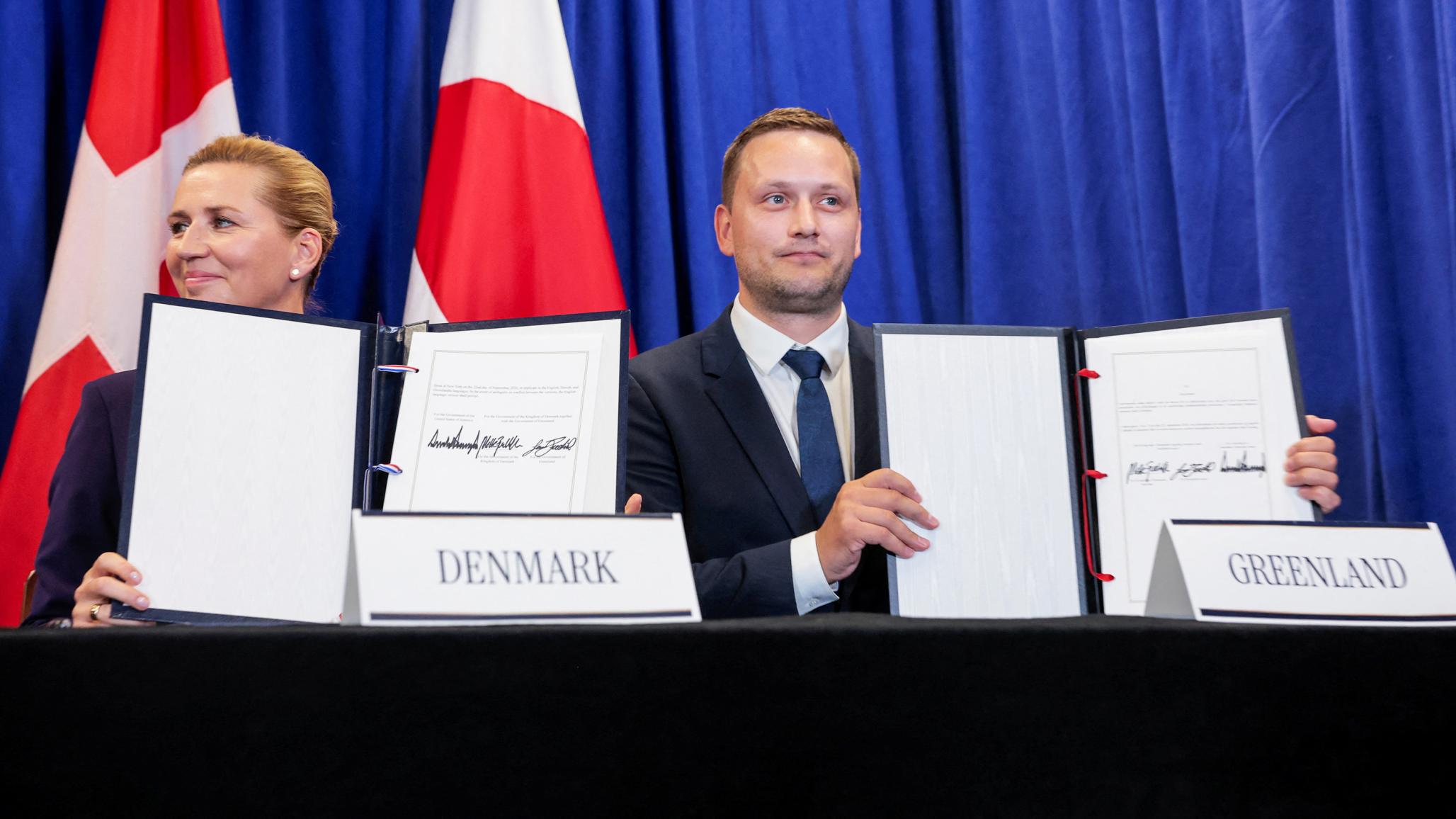
President Donald Trump and the prime ministers of Denmark and Greenland this week signed an agreement allowing the US military's continued presence on the Arctic island, which should help avoid future confrontations over sovereignty.
The new treaty amends and supplements the existing 1951 US-Denmark agreement concerning US bases in and the defense of Greenland, an autonomous territory within the Kingdom of Denmark. Substantively, the new deal entrenches the existing status quo, making it a significant accomplishment for Danish and Greenlandic diplomacy, while affording Trump just enough changes to also claim victory.
The United States is now explicitly permitted to modernize and expand its existing base at Pituffik Space Base (the old Thule Air Base) and establish two new additional bases in Greenland at Narsarsuaq and Mestersvig. The United States also may further establish new bases elsewhere in Greenland, subject to mutual agreement.
As such, the Trump administration is correct in stating that it can now expand its presence in Greenland. However, this option was already available in the 1951 bilateral defense treaty, so this amounts to diplomatic old wine in a new bottle.
The new agreement also explicitly forbids the establishment of manned or unmanned military installations in Greenland by any country not a member of the North Atlantic Treaty Organization (NATO). Again, this was already enshrined in the 1951 treaty and there is virtually no chance that Denmark and Greenland would ever allow such bases to be established. Again, this new agreement maintains the status quo.
Article X of the new agreement makes clear that "states or investors from a state that is not a member of NATO, a NATO partner, or an EU member state shall not be allowed to have (i) control, (ii) significant influence, or (iii) access to non-public information that may constitute a threat to national security or public order within Particularly Sensitive Sectors or Activities in the territory of Greenland (including the Territorial Waters), unless agreed between the Parties that the activities of such states or investors would not constitute a threat to national security or public order." According to the NATO website, the organization retains "partner relations" with 35 nonmember countries and international organizations. In addition to existing EU and NATO members, the these include Algeria, Armenia, Australia, Azerbaijan, Bahrain, Bosnia-Herzegovina, Colombia, Egypt, Georgia, Iraq, Israel, Japan, Jordan, Kazakhstan, Kuwait, Kyrgyzstan, Mauritania, Mongolia, Morocco, Moldova, New Zealand, Pakistan, Qatar, Serbia, South Korea, Switzerland, Tajikistan, Tunesia, Turkmenistan, the United Arab Emirates, Ukraine, Uzbekistan, the Organization for Security and Cooperation in Europe, and the United Nations. Crucially, NATO's partnerships with Afghanistan, Belarus, and Russia are suspended.
While Article X clearly excludes China and Russia from making significant foreign direct investment (FDI) in Greenland's economy, the restrictions do not cover all authoritarian states, as "NATO partners" include several dictatorships in the Middle East and former Soviet republics. As such, the new agreement, at minimum from a national security point of view, demands that Denmark and Greenland together continue to police inward FDI restrictions vigilantly.
Lastly, the new agreement has no expiration date and states that if "Greenland exercises its right to self-determination to become independent, the Government of the Kingdom of Denmark and the Government of Greenland shall together ensure that the independent Greenlandic state will (i) agree to remain in NATO, including by applying to become a member if necessary, and (ii) affirmatively assume, as from the date of independence, all of the rights and obligations of the Kingdom of Denmark specified in this Agreement, including any implementation agreements or arrangements between the Parties, as well as the Defense Arrangements."
So, Trump can correctly state that the US base rights in Greenland have now under virtually all plausible scenarios been made permanent, as the previous 1951 treaty merely stated that US base rights existed as long as Denmark and the United States were both members of NATO.
If Greenland someday were to become an independent state, it would therefore be bound by the new treaty to house US military bases. Combined with the similarly perpetual inability of, for instance, China to establish military facilities and make significant economic investments in Greenland, the new agreement directly affects the political options for possible geopolitical realignment available to a future independent Greenland.
This outcome, however, likely politically suits both the Danish and current (very lukewarm on independence) Greenlandic governments very well, as it effectively undermines at least part of the political and economic case for a future Greenlandic independent state. Would-be Greenlandic secessionists can no longer promise to expel the US military presence from Greenland or to invite in large new investments from China or other excluded nations.
This doesn't make it impossible that a future Greenlandic independent state might one day emerge with the blessings of both Denmark and the Greenland populations. But given that more than half of Greenland's public sector income today is still an annual fiscal transfer from Denmark, it seems clear that any permanent restrictions on the political freedom of action of a new independent state may lead some in Greenland to question the wisdom of pursuing independence.
Ironically, therefore it seems most likely that Trump's initial demands for America to "own Greenland" have with the signing of this agreement instead solidified the political union between Denmark and Greenland.
Data Disclosure
This publication does not include a replication package.