
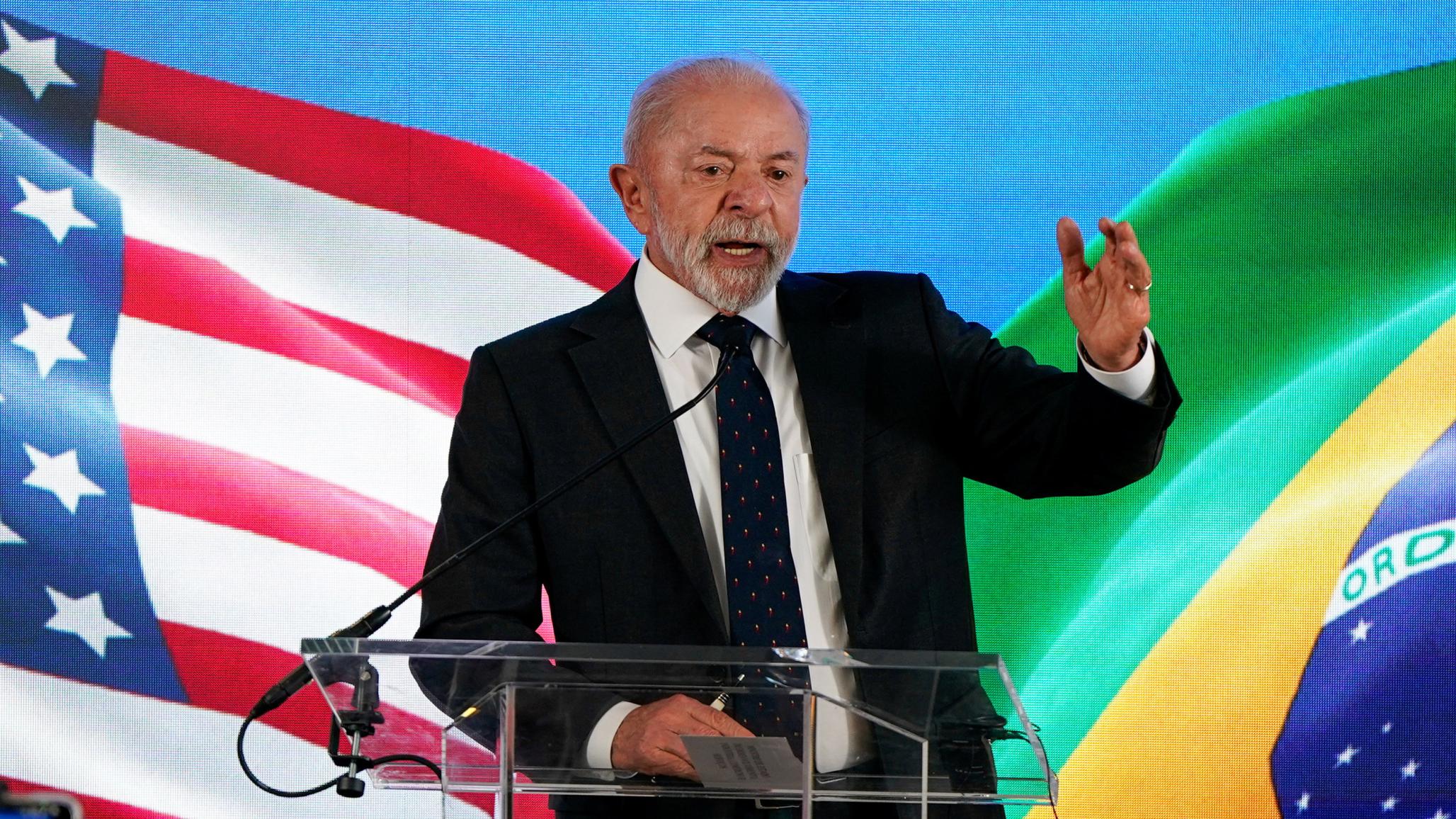
President Luiz Inácio Lula da Silva met with President Donald Trump for nearly three hours on May 7. On paper it was the most substantive US-Brazil engagement in years. Yet there was no joint statement after the session, no tariff rollback, no memorandum on critical minerals, no security framework, and no mention of organized crime. The session served the political purposes for both leaders, however—especially Lula, who can now tell Brazilians that he has at least temporarily stabilized relations with the United States.
The headline deliverable of the session was hardly a showstopper: A working group with a 30-day homework assignment. The leaders of the Western Hemisphere's two largest economies resolved, with appropriate solemnity, to keep meeting. In diplomacy as in bureaucracy, when there is nothing to announce, you announce a deadline.
Presidents Lula and Trump were joined by JD Vance, Scott Bessent, Jamieson Greer, and a Brazilian delegation led by Commerce and Industry Minister Márcio Elias Rosa. Lula had originally planned to come to Washington in March, but the trip was postponed because of the war in Iran.
The two presidents were scheduled to take questions from the press together in the Oval Office. They didn't. Instead, Lula held a press conference at the Brazilian embassy alongside the clutch of Brazilian officials who had accompanied him to DC. The sole concrete deliverable was an agreement that Rosa and Greer would lead a bilateral working group within 30 days to draft a proposal on the tariff dispute and the pending Section 301 investigation into alleged unfair trade practices by Brazil. The most likely result will be yet another piece of paper that could be accepted, modified, rejected, or ignored, the latter being the outcome with the highest probability as of now.
Lula, in his remarks at the Brazilian Embassy, said he was "very, very satisfied." Trump, in a post on Truth Social, wrote that Lula is "very dynamic" and that the meeting "went very well." Most major US media outlets covered the meeting briefly and moved on, while the Brazilian coverage, though heavier, was largely absorbed into the domestic political contest over whether Lula had achieved anything tangible besides a photo-op.
Three things are worthy of mention.
The first is that the absence of substance is the substance. A three-hour meeting with this cast of characters, with no announcements, is a deliberate choice. Both Lula and Trump clearly wanted the ritual of a high-stakes encounter and the optics of a friendly exchange without having to commit to anything that could be politically litigated in the press, in Congress, or in Brazil's Supreme Court. For Lula, this meant he could fly back to Brasília with the narrative that ties between the two countries have been "stabilized" following the tensions at the end of 2025. For Trump, who has spent the past several months oscillating between punitive and conciliatory tariff postures towards Brazil, the meeting allowed him to claim progress without conceding leverage.
Second, the meeting reframed, but did not resolve, the core economic dispute. The tariffs Trump imposed on Brazilian goods last year, and partially walked back as part of the broader push to bring down US consumer prices, remain the elephant in the room. The Section 301 investigation into Brazilian commercial practices remains open, and nothing was lifted, paused, or even publicly narrowed. But the register of the bilateral relationship did change: Instead of being managed through tariff escalation and threats, the dispute is now (temporarily, most likely) being managed through a deadline-bound technical track. Whether that track survives contact with political developments in either country is a different question altogether.
Finally, critical minerals were on the table, but not in a way that committed Brazil to anything—or the United States, for that matter. Shortly before Lula boarded the plane to DC, the Brazilian lower house had passed PL 2780, the bill detailing the country's new framework for critical and strategic minerals, including rare earth elements; the bill will now go to the Senate. During the meeting, Lula reportedly told Trump that Brazil is open to partnerships with the United States, China, the European Union, and Japan, reinforcing the country's tradition of non-alignment in foreign policy and economic matters. The country is therefore signaling that it wants to keep all doors open and has no intention of joining a US-led critical minerals bloc. For an administration that has been trying to corral allies into a Western critical-minerals architecture, Brazil's message signals a non-trivial outcome, dressed up as diplomatic courtesy.
So, what did the May 7 session accomplish? In essence, a working group, a 30-day clock, two carefully phrased social media posts, and a handful of nice pictures. In a different bilateral relationship, that would count as a setback. But as both leaders face challenges to their mandates in this year's elections, it counts as a win.
The next real test is the 30-day mark. If the working group produces a credible proposal on tariffs and the Section 301 investigation, the meeting will look retrospectively useful, a stage-setter for a deal. If it doesn't, the session will confirm that the bilateral relationship is being run on deadline diplomacy and Truth Social posts.
Data Disclosure
This publication does not include a replication package.
