Fentanyl abuse is a first-order public health crisis in the United States. In 2025, President Donald Trump imposed tariffs on China for its role in fentanyl trade, then raised them, lowered them, and in 2026 a Supreme Court decision eliminated them. But variations in tariff rates over 2025–26 cannot explain an epidemic that had already begun to recede when the second Trump administration took office.
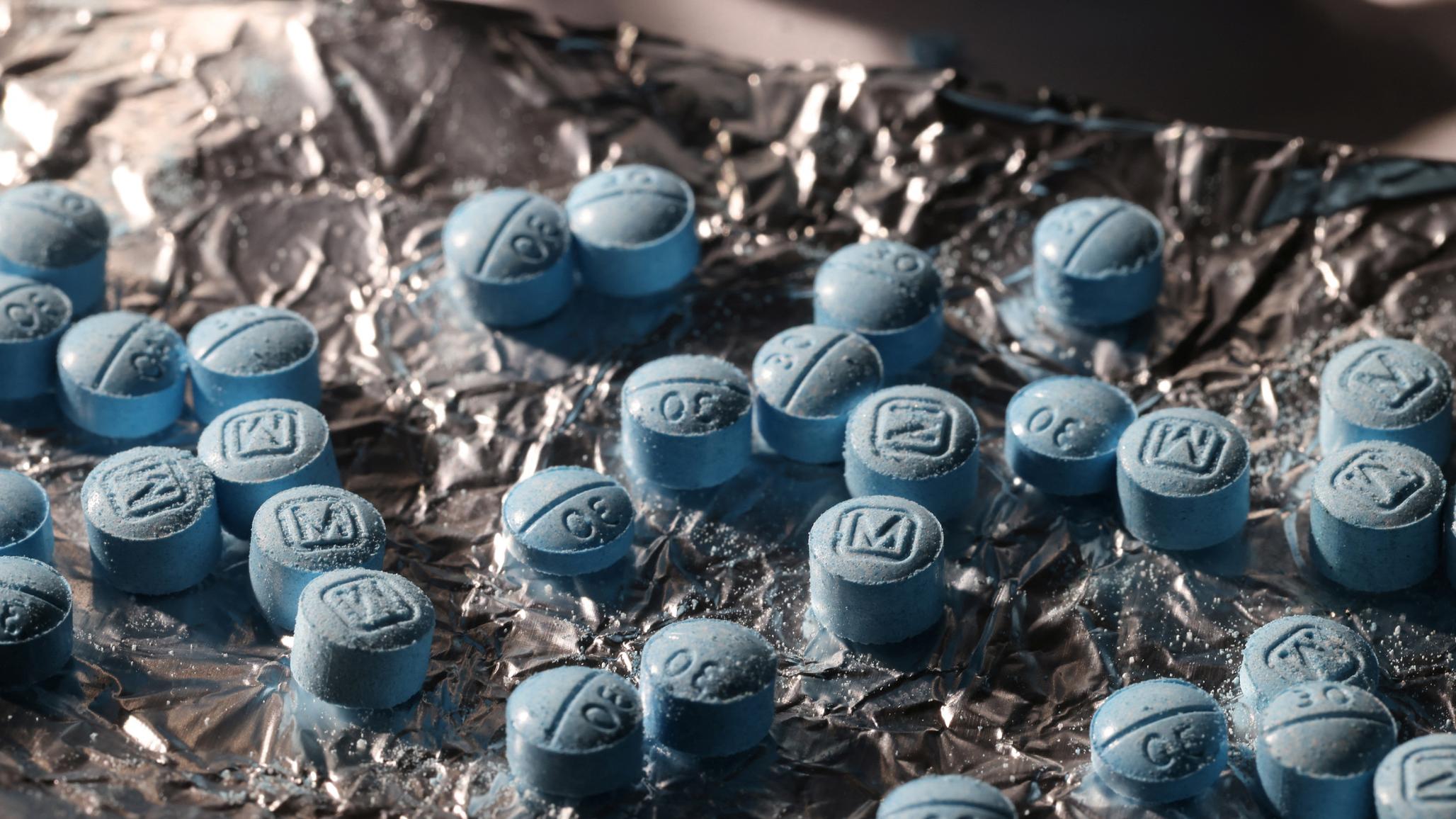
Fentanyl is a synthetic opioid, 50 times stronger than heroin and 100 times stronger than morphine. Drug overdoses—the bulk associated with fentanyl—were the leading cause of death among Americans aged 15–44 years, exceeding heart disease, cancer, suicide, vehicular accidents, and COVID-19 in 2023. At their peak during 2021–23, fentanyl-related deaths exceeded the level of US casualties for the entire Vietnam War.
But as is evident in the figure above, the pattern of declining overdose deaths, after peaking during the Biden administration, calls into question the role of tariffs imposed by the current Trump administration.
Frankly, we do not have a very good grasp of what causes drug epidemics to build and then recede. When I first moved to Washington, the city was in the grip of a crack cocaine epidemic with users congregating in the vicinity of the PIIE office. You don't see that anymore.
There are multiple potential explanations for the decline in fentanyl-related deaths:
- It could be that the drug has basically killed off its user base. Here in DC, fentanyl has completely crowded out heroin, and many of those long-time heroin users are now dead.
- It could be that medications such as Narcan (naloxone) have reduced overdose mortality.
- It could be that interdiction has improved.
- It could be that diplomatic initiatives have helped choke off supply.
For historical reasons, the locus of global fentanyl production is in China, and fentanyl has been the subject of US-China negotiations since the Obama administration.
A paper written with Julieta Contreras and Lucas Rengifo-Keller examined transactions data to determine whether diplomatic developments starting during the Obama administration and running through 2023 had significant impact on street prices. (You might be surprised, but even additive substances exhibit price elasticities. Existing users exhibit some response to price, but the big impact is at the extensive margin, on potential users who may be deterred from initiating use by high prices.)
We found that a May 2019 US-China agreement during the first Trump administration to end direct fentanyl exports to the United States increased prices for a temporary period (before trade and production were rerouted through third countries, principally Mexico) and reduced overdose deaths by around 1,000 cases during this period.
We did not find evidence that other developments had an impact. We did not, for example, find that then-Speaker Nancy Pelosi's visit to Taiwan and a Chinese threat to suspend anti-narcotics cooperation had any impact on prices.
US government data displayed in the figure show that the purity of seized fentanyl powder began to decline in late 2023 with a corresponding decline in pill purity following in 2024. On the street this amounted to shrinkflation, as prices remained steady but the actual amount of the drug declined.
A recent paper in the journal Science conjectures that the Chinese government intensified actions against purveyors of fentanyl precursor chemicals (the chemicals used to manufacture the drug) on online platforms following a meeting between Presidents Joseph R. Biden Jr. and Xi Jinping in November 2023, causing a supply shortage and the subsequent decline in purity. (This meeting came after the sample period in the PIIE paper, and its impact was not examined.)
Which brings us to the Trump tariffs. In February 2025 President Trump imposed a 10 percent tariff on China related to fentanyl. The tariff was later extended to Canada and Mexico, and in March the fentanyl tariff on China was raised to 20 percent. In November 2025 China agreed to tighten controls on 13 fentanyl precursor chemicals, and the United States cut the tariff to 10 percent. In February 2026 the Supreme Court declared these tariffs unconstitutional in the Learning Resources, Inc. v. Trump case, and the tariffs were eliminated.
To be clear, deaths from fentanyl overdoses remain a top-level public health challenge in the United States. In addressing this problem, it is incumbent on us to address the demand side through a variety of outreach and recovery strategies.
Yet at the same time the supply side matters. There is some evidence that interdiction works. Effective interdiction will require at a minimum cooperation with China, Mexico, and India (which has emerged as an alternative source of fentanyl supply chemicals).
We do not yet have data that would allow us to evaluate the Trump fentanyl tariff or its subsequent cut and elimination. What we do have is evidence that diplomatic engagement has had benefits.
It is logically possible that the imposition and subsequent reduction of the tariffs elicited more cooperation from China than would have otherwise occurred and further reduced overdoses, but there is no evidence of this at this time. But by the same token, it is also possible that the imposition of tariffs could have a perverse effect by reducing Chinese cooperation.
But tariffs are clearly not central to the story. Variations in tariff levels in 2025–26 cannot cause a decline in overdose deaths that began in 2023.
Data Disclosure
The data underlying this analysis are proprietary and not available for download.