
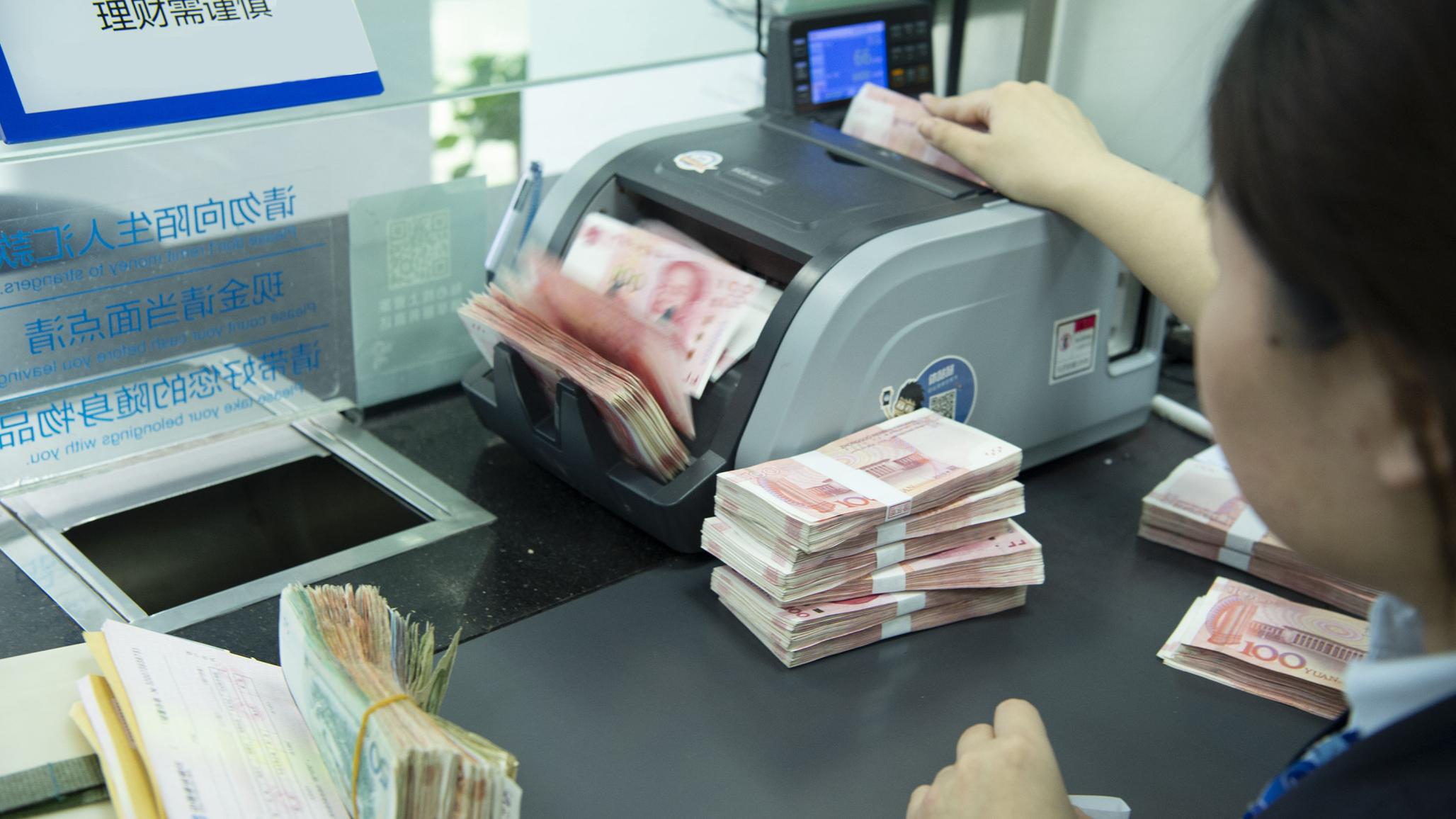
China's Deposit Insurance Fund (DIF), a key pillar of the country's financial safety net, has a remarkably small financial buffer relative to the deposits it protects. At the end of 2025, its reported balance was only RMB130 billion ($18.5 billion), equivalent to an estimated 0.1 percent of insured deposits—far below the fund's 1.5 percent target reported by the International Monetary Fund (IMF) and the funding levels of other major economies.
A low reserve ratio does not necessarily mean that insured depositors will suffer losses: Funds recovered from failed banks' assets and additional financing, including government support, can help meet payout obligations. But the low ratio leaves insufficient prefunded industry resources to absorb losses. The central concern is who ultimately pays. If government support is not subsequently recovered from the banking industry, bank failure costs shift onto the government balance sheet. China should rebuild the DIF toward its reported target. This would require higher bank contributions now, reducing the need to raise them during a future crisis.
Generous coverage backed by a small fund
Established in 2015, China's deposit insurance system has helped resolve distressed regional banks, including Baoshang Bank in 2019, and supported mergers of several troubled smaller lenders in recent years. While the system has helped reinforce public confidence in the banking system, extensive use of the fund—including to support payments to creditors beyond those covered by deposit insurance—has depleted its resources.[1] Bank resolution also remains heavily reliant on public funding and does not force creditors to absorb significant losses.
The system covers nearly 3,000 banks and protects up to RMB500,000 per depositor per bank. According to the People's Bank of China, this limit fully protects more than 99 percent of depositors. At about five times China's GDP per capita, the coverage limit also makes the Chinese deposit insurance among the most generous in the world. By comparison, the International Association of Deposit Insurers reported a median coverage limit of 2.5 times GDP per capita among Group of 20 (G20) economies in 2022.
Yet this relatively generous coverage is backed by limited prefunded resources. Chinese authorities do not publish figures for deposits insured within the payout limit, making the DIF's reserve ratio—the DIF balance as a share of insured deposits—difficult to calculate directly. Using the IMF's reported target fund balance and target reserve ratio to calculate insured deposits, such deposits accounted for approximately 37 percent of China's total bank deposits at end-2023.[2] Applying this calculated share to the People's Bank of China's reported total deposits at the end of 2025 yields approximately RMB124 trillion of insured deposits and a reserve ratio of about 0.1 percent.
By comparison, the figure below shows that the US Deposit Insurance Fund had a reserve ratio of 1.42 percent at the end of 2025, above its statutory minimum of 1.35 percent, while the European Union generally requires national deposit guarantee schemes to maintain a ratio of at least 0.8 percent, a requirement most members have met.[3] Japan maintained a reserve ratio of 0.43 percent at end-March 2026. Brazil and India have much higher reserve ratios than many advanced economies.
Who ultimately pays?
A low reserve ratio alone does not determine whether insured depositors will be protected. The deposit insurance system can recover funds from failed banks' assets and potentially draw on additional financing. Chinese financial regulators established a Financial Stability Guarantee Fund in 2022 that may provide funding support when needed, though little public information is available about its size or functions. The central and local governments could also use other public resources to fill any shortfall. Indeed, expectations of government support may help explain why the DIF's tiny size appears to have done little to undermine depositor confidence.
The greater concern is who ultimately would bear any future losses. A small DIF increases the likelihood that the system would have to raise additional financing during periods of financial stress, either through additional bank contributions or government support. Raising bank contributions during a crisis could increase the strain on banks precisely when they are already under pressure. Government support can bridge a funding gap, but unless its costs can be subsequently recovered from the banking industry through higher assessments, it essentially socializes losses by shifting them onto the public balance sheet, which can encourage banks to take greater risks. Depositors may receive the same protection either way, but the allocation of costs and resulting riskiness of the banking system differs.
China should rebuild the Deposit Insurance Fund
China should reform the system in several ways. Most urgently, regulators should start requiring higher bank contributions now—especially from riskier banks—to boost the DIF's balance toward its reported target while financial conditions remain relatively stable. Replenishing the DIF should be accompanied by stricter limits on its use. Shareholders and uninsured creditors should bear losses in accordance with the legal hierarchy, while protection beyond the statutory coverage limit should be avoided. Any government support should come with a clear mechanism for subsequently recovering its costs from the industry. Officials also should clarify the role of China's Financial Stability Guarantee Fund and its relationship with the deposit insurance system.
Notes
1. For example, when Baoshang Bank failed in 2019, not only were all household deposits protected, other claims of up to RMB50 million also received full protection, far above the statutory limit of RMB500,000. Meanwhile, larger claims received partial protection. In 2020, the Deposit Insurance Fund spent RMB93 billion, roughly three quarters of its reserves, on resolving Baoshang's failure alone. The People's Bank of China provided additional funding support.
2. The IMF's 2025 Financial Sector Assessment Program report (paragraph 76 and footnote 38) reports a target balance for China's Deposit Insurance Fund of approximately US$224 billion (RMB1.6 trillion) and a target reserve ratio of 1.5 percent as of end-2023. Dividing the target balance by the target reserve ratio implies insured deposits of approximately RMB107 trillion. Relative to total deposits of approximately RMB290 trillion reported by the People's Bank of China at end-2023, this implies an insured share of about 37 percent. The end-2025 estimate carries forward this calculated share and applies it to the People's Bank of China's reported total deposits of RMB336 trillion, yielding estimated insured deposits of approximately RMB124 trillion. Dividing the reported end-2025 DIF balance of RMB130 billion by this estimated amount gives a reserve ratio of approximately 0.1 percent.
3. The EU Deposit Guarantee Schemes Directive includes a derogation clause that allows member states with highly concentrated banking sectors to adopt a lower target level of 0.5 percent. France, for example, makes use of this clause and currently meets the lower target.
Data Disclosure
Related Documents
- Document2026-10-13-huang.xlsx (27.34 KB)

Author's note: I thank Zhuowen Li for excellent research assistance; Bert Van Roosebeke and colleagues at the International Association of Deposit Insurers for providing feedback on an earlier version of the figure in this blog post; and Joseph Gagnon, Patrick Honohan, Nick Lardy, Arvind Subramanian, Nicolas Véron, and David Wilcox for helpful comments. All errors remain my own.