
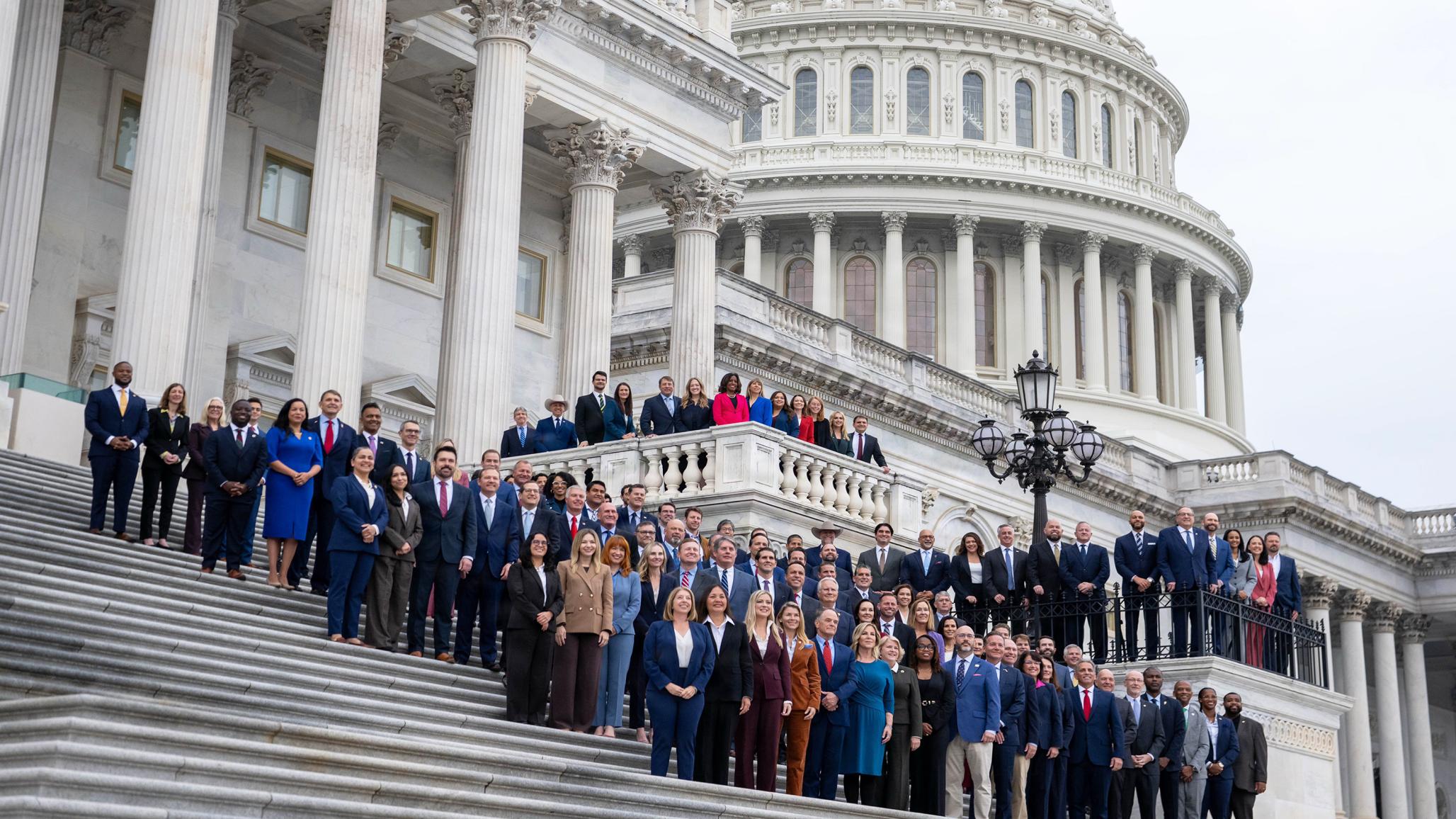
Can we expect the House and Senate Democratic majorities taking office in January to quickly succeed in rolling back very unpopular policies like President Donald Trump's tariffs? It is far from easy, but not impossible. Passing anti-tariff legislation will be difficult because the incoming Congress will need enough votes to override a likely presidential veto. For the next two years, absent a concerted effort, the likely outcome will be a legislative stalemate on most of the tariffs, leaving hopes for removing them pinned on the courts.
Trump, whose term lasts into January 2029, likes tariffs. He believes in the correctness of his tariffs. They are hallmarks of his administration. The likelihood of Trump signing a bill lifting the tariffs is about zero. Overriding his veto requires the votes of at least 290 House members and 67 senators. Though votes are still being counted as of this writing on November 16, the Associated Press reports that Democrats will hold at least 256 House seats and 55 Senate seats (including two independents who caucus with the Democrats)—solid majorities, but not enough to override a veto. Vetoes are hard to override. Congress has overridden only 112 of the 2,599 presidential vetoes made since George Washington took office in 1789.
Options before the incoming Congress
The new congressional majorities have a few tools they can use. They can add a blanket repeal of the tariffs Trump imposed to a must-pass bill like the National Defense Authorization Act (NDAA). Otherwise, they can offer a standalone bill expecting his veto but forcing him and his congressional supporters to own the tariffs' costs to consumers and small businesses. A third possibility for the Democrats is to scale back the level of their ambition and attempt to lift the most recent anti-Canada tariffs by repealing the statute on which they are based (Section 338 of the Tariff Act of 1930) and by supporting North American free trade. This could succeed for a few reasons: The 1930 statute invoked as authority for the tariffs is no longer in force anyway. Moreover, Trump's tariffs against Canada, a close neighbor and ally, are harmful to US businesses and are particularly unpopular. But while canceling those tariffs would be a step in the right direction, they apply to only $20 billion of US imports. Trump's tariffs target a large share of total US imported goods from all sources, on track to be worth $3.8 trillion to $3.9 trillion in 2026.[1] Congress might have a better shot at a veto override on a Canada bill, but even that narrower result is not guaranteed.
From Canada's point of view, the more damaging US tariffs are those imposed on Canadian goods, including steel, aluminum, lumber, copper, auto parts, and other products, for purported national security reasons under Section 232 of the Trade Expansion Act of 1962. These goods were not excused under the United States-Mexico-Canada Agreement (USMCA) from paying Section 232 tariffs and accounted for a large share of the $10 billion in duties the US collected on Canadian imports in 2025.[2] One way to lift those tariffs would be for Congress to legislate that Canada, historically the closest US ally, is to be exempt from Section 232 duties. Trump's animus toward Canada (his 51st US state) is such that his likely veto of this measure would still have to be overridden.
Can a broader anti-tariff bill pass with a veto-proof margin? The new majority could forbid the use of trade statutes for economic coercion against an ally or neutral country, requiring a congressional vote to initiate a trade war or take hostile trade actions against an ally. Such legislation would have at least three problems: First it would require defining an ally and a neutral country, which would likely involve making contentious political judgments. Second, it would mean the end of Section 301 of the Trade Act of 1974, which has been used by this and prior administrations to threaten tariffs in response to foreign trade practices deemed unfair. Third, there are vested interests who welcome protection and would oppose the bill.
During both the Trump and Biden administrations, the largest share of US tariffs has been applied to imports from China. In any general tariff rollback addressing affordability, a bill could include a more rational approach to tariffs on Chinese goods—namely, excluding those goods that clearly are a net benefit to the US economy. The legislation might garner votes from the US farm belt if as a result the Chinese market were fully opened once again to US agricultural exports. The difficulty for proponents is that appearing weak on China could be politically costly. Would a China-focused bill get enough votes to override a veto? Not at all likely, but Congress should test how much bipartisan support might exist for such a measure.
There are numerous legislative proposals to add conditions to the use of tariff authorities. All of these would be Trump veto bait if effective. The White House might accept technical changes with low economic impact, but that would not achieve the goal of rolling back Trump's unpopular tariffs and lowering consumer prices. The AP Voter Poll found that almost 50 percent of respondents said the cost of living was crucial to their vote for Congress. The tariffs fed inflation, making life in this country less affordable.
The incoming Congress must assert its constitutional role of controlling the nation's tariffs. Moreover, the recent midterm elections have created an expectation for change. For example, Congress could legislate a new fast track procedure that would require congressional agreement before the president can impose tariffs for any reason. Once again, however, the bill would need enough bipartisan support to override a veto.
However, Congress does have some leverage. Senate confirmation is required for new appointments to most senior positions in the Trump administration and to the federal judiciary. Appropriations must be passed into law. The Trump administration may even need occasional congressional support or forbearance that can be used as trading stock. As noted above, some bills are considered "must pass" and cannot effectively be vetoed. But these powers are not always readily deployable. Members of the incoming Congress have more than tariff reform on their wish lists of policies and measures, and they will have to use their leverage selectively.
Cooperation between Trump and Congress on tariffs cannot be ruled out entirely. Quick tariff relief for consumers and small businesses over the next two years, cannot be solely at the discretion of the president even if hard for the incoming 120th Congress to achieve.
Working toward a better future
Greater cooperation is needed between the legislative and executive branches. Under the US constitution, only the president can negotiate trade agreements that mutually benefit the signatories while only Congress can implement agreements that require changes in US law. Lawmakers realized this during debates leading to the enactment of the Trade Act of 1974. To facilitate interbranch cooperation, under the 1974 Act's procedures—known as "fast track trade negotiating authority," later renamed Trade Promotion Authority (TPA)—Congress mandates negotiations, transparency, and consultations; in return, it gives up its weapons of delay and amendment to block an international trade agreement. Prior administrations (including the first Trump administration) benefited from this arrangement from 1975 to 2021, but the current president and his immediate predecessor did not ask Congress to renew the TPA when it expired in July 2021.
Even Trump needed Congress to allow him to implement USMCA, which he heralded as "the largest, fairest, most balanced, and modern trade agreement in the history of our country." The next president, whether Democrat or Republican, could discover the merits of working with Congress on trade.
Notes
1. Author's calculations using US Census data for monthly imports and extending it to the full year, as recent months are higher than the average.
2. According to US Census data, in 2025, the US imposed duties on about 15 percent of US imports from Canada by value (about $56 billion total), with a total of $10 billion in calculated duties (compared with $0.4 billion in 2024).
Data Disclosure
This publication does not include a replication package.
