
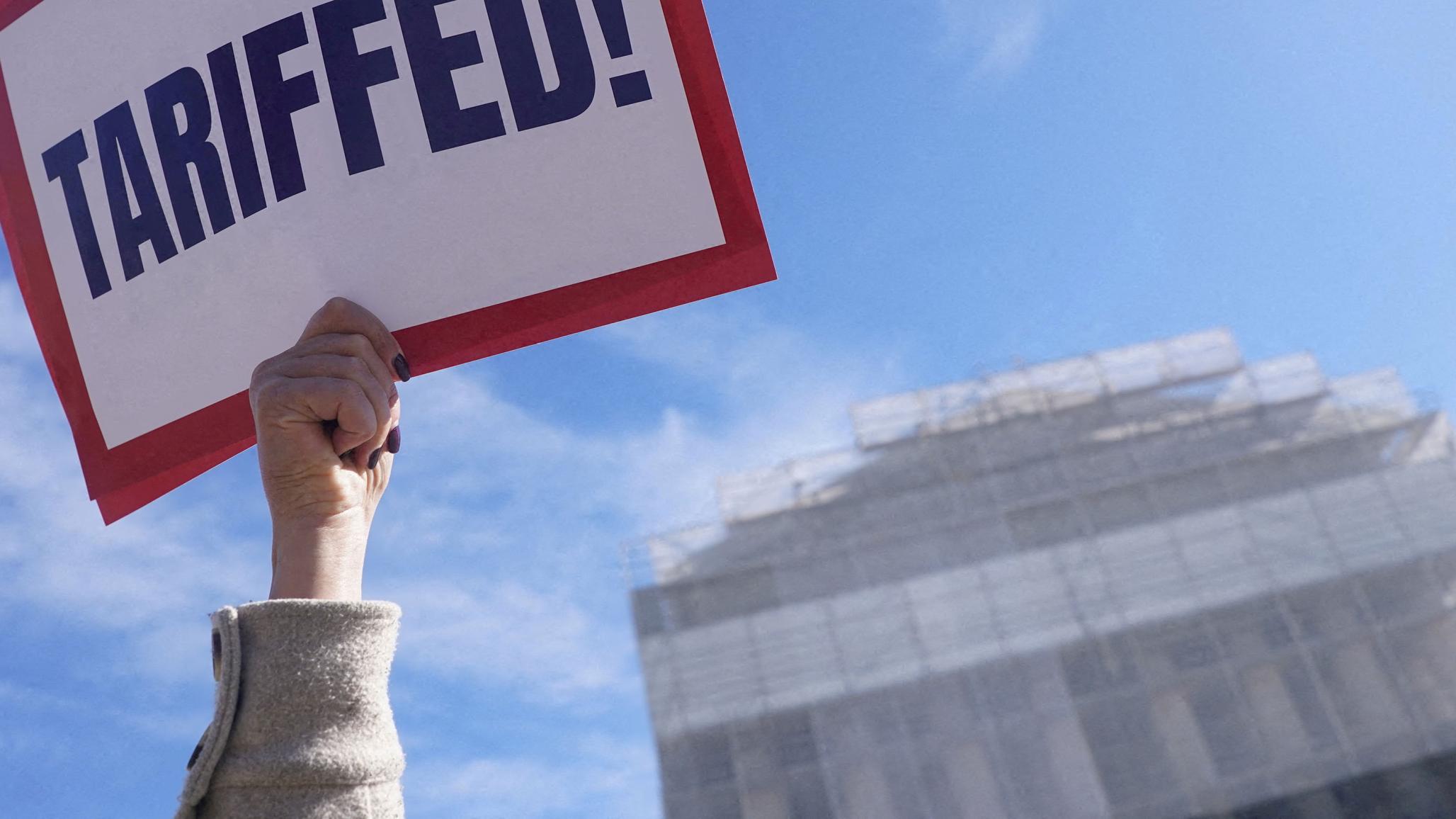
A decision by the Supreme Court on the legality of President Donald Trump’s “reciprocal” tariffs could be delivered any day now. The president has warned that throwing out the tariffs would create an “economic and national security disaster” and that it might cost trillions of dollars to “unwind” the tariffs if they are invalidated, as demanded by the plaintiffs. What is the Court likely to do?
The justices, who heard oral arguments on November 5, are to decide what additional import duties, if any, the president can legally impose by virtue of declaring an emergency under the International Emergency Economic Powers Act (IEEPA) of 1977. What and how the justices decide could have far-reaching consequences for the dividing lines between the powers of the executive branch and Congress. The Supreme Court could, of course, leave Trump’s “reciprocal” tariffs in place, deferring to the executive branch’s invocation of its emergency powers. But here are six alternative possibilities.
1. The Supreme Court curtails the use of the IEEPA
The Court could determine that the circumstances are not unusual and that there is no real emergency, prerequisites for invoking the 1977 statute. To most people, and almost all trained economists, it is self-evident that there is no emergency. This is not an easy call to make for the Court, however.Under the statute, the determination is for the president to make, not a task for unelected players or commentators.The whole idea of an “emergency declaration” is that it can be used when needed, like a nuclear counterstrike, without delay to allow for careful debate. In this view, challenging any emergency undermines the ability to act in a real emergency.
The Court could determine that the IEEPA does not authorize blanket imposition of “reciprocal” tariffs on all countries and all products. The questioning by the justices indicated that they were troubled by an unlimited power to apply tariffs, noting that the power to tax cannot be delegated by Congress without limit. They could (and should) also note that tariff authority is carefully rationed by Congress: For balance of payments emergencies, the tariff can be no more than 15 percent and last only 150 days without further action by Congress. The Court could also note that to implement a trade agreement under statutory procedures, there can be no tariff increases at all, and to help an injured industry, there must first be a finding by an independent commission. In such cases, the law requires that the tariff increase can last only for four years and can be extended only one time.
The Supreme Court, like the courts below, will also turn to the text of the statute to determine if the words to “regulate importation” may include some use of a tariff. The justices could determine that a tariff could be used, for example, to obtain compliance with a sanction. A wholesale use of the tariff authority that was given to Congress by the Constitution could be construed to be a different matter, beyond the scope of a sanctions law.
The Court will also note that IEEPA emergencies can be terminated by joint resolution, but that guardrail is limited as a practical matter. (More on this below.)
Not officially part of the deliberation but within the ambit of judicial notice is that a decision throwing out the tariffs may require overturning much of the current administration’s foreign economic policy.
The 11 judges sitting on the case at the US Court of Appeals for the Federal Circuit, from which this appeal is taken, did not fully agree on whether the “reciprocal tariffs” were a justified use of the emergency statute. They split their vote 7–4. The decision would not appear to be based on politics—none of the four judges siding with President Trump were appointed by him (two were appointed by Barack Obama and two by George W. Bush).
This author’s view: The Court should find that Congress did not delegate authority to the president to impose tariffs without any effective limits. The global tariffs are illegal.
2. Congress ends the emergency
Under the National Emergencies Act of 1976, emergencies can be terminated by joint resolution of the House and the Senate. The Senate has three times voted recently to end an IEEPA tariff-related emergency, each by a narrow majority, with respect to the tariffs on Brazil and Canada and the Global Tariffs (52-48, 51-48, and 51-47, respectively). The House has not taken up ending any of the IEEPA tariff emergencies.
Because the president must sign a joint resolution, it is subject to a presidential veto, and a veto can only be overridden by a two-thirds vote in both chambers. That may prove to be a political impossibility given the current configuration of Congress.
An emergency must expire in one year unless renewed, which the president can do at will.
3. President Trump suspends the global tariffs
If the president senses, as the mid-term elections approach in 2026, that the “reciprocal” tariffs are increasingly unpopular, and that a majority in Congress might vote to end the emergency, he could declare that a large portion of the tariffs have served their purpose and back away from them substantially. He could decide to keep the tariffs that are applied consistently with negotiated agreements in place, and invoke Section 301 of the Trade Act of 1974, imposing tariffs on any large trading partner or trade surplus countries not agreeing to a higher tariff. This action need not affect the tariffs imposed on China under Section 301, which may be subject to a separate deal between the US and China. Such sidestepping would render an override by Congress largely moot.
4. President Trump remains adamant that the reciprocal tariffs must remain in place
Given that gaining a supermajority to override a legislative veto in present circumstances is unlikely, if the president digs in, an anti-blanket tariff majority must be elected in both houses of Congress during the mid-term elections in 2026, or an anti-blanket tariff president must be elected in 2028. The latter scenario depends on the vagaries of whether a strong centrist candidate emerges.
5. The coerced trading partners back away from their deals with the US
If the war in Ukraine settles into an armed ceasefire, the EU may no longer feel the need to implement all the terms of the deal made with the US in July, which called for the EU removing tariffs on US industrial and agricultural goods and the US imposing a 15 percent tariff generally on EU goods. Trading partners continue to harbor resentment over current arrangements, disparate treatment, and the US not fulfilling its prior obligations. The US-EU bilateral agreement and others of this kind could fray, and a renegotiation could take place, or the EU and others may decide to retaliate. Having sown the wind, the US could end up reaping a whirlwind.
6. The Supreme Court rules that these tariffs are not legally permitted under the IEEPA
If the tariffs are invalidated across the board, the president will have to rely on other clearer tariff authorities, such as Section 301 of the Trade Act of 1974, which calls for retaliation against unfair trading practices, and Section 232 of the Trade Expansion Act of 1962, which permits tariffs on national security grounds. The coverage of these statutes must be more selective and would continue barring successful litigation challenging such steps as not an appropriate use of those statutes.
To conclude, if the Court does opt to support the president on his broad tariffs, the trading system can adapt, if slowly—imposing additional economic costs borne at home while US trading partners continue to explore other markets and perhaps diversify away from trade with the US.
Data Disclosure
This publication does not include a replication package.
