Key Takeaways
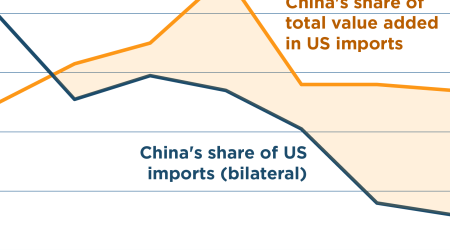
- US tariffs have failed to significantly reduce America's dependence on Chinese goods and services. While China's share of bilateral US imports fell by 7 percentage points from 2017 to 2024, its share of value added in US imports—which also includes Chinese products, parts, and other content shipped from other countries—fell just 2 percentage points.
- US tariffs drove suppliers to reroute supply chains through third countries to avoid shipping directly from China to the US. The top gainers in the share of aggregate US goods imports between 2017 and 2025 were Taiwan (4.1 percentage points), Vietnam (3.7 points), and Mexico (2.3 points).
- The tariffs failed to achieve significant US decoupling from China during this period, leaving America vulnerable to interruptions of key supplies originating in China.
- The second Trump administration's current tariff policies will also likely fail to curb America's reliance on Chinese imports, some of which are essential inputs to important industries.
Body
Using Asian Development Bank multiregional input-output tables for 2007–24, this Policy Brief traces Chinese value added throughout the US import basket. It argues that genuine US economic security requires a more disciplined strategy—identifying actual chokepoints, building competitive alternative suppliers and the infrastructure connecting them to markets, and cooperating with allies rather than forcing them into separate supply chains. The appendix explains the method and databases that the authors used in their analysis.
Data Disclosure:
Related Documents
- Documentpb26-12.zip (2.15 MB)
- DocumentAppendix (254.05 KB)