
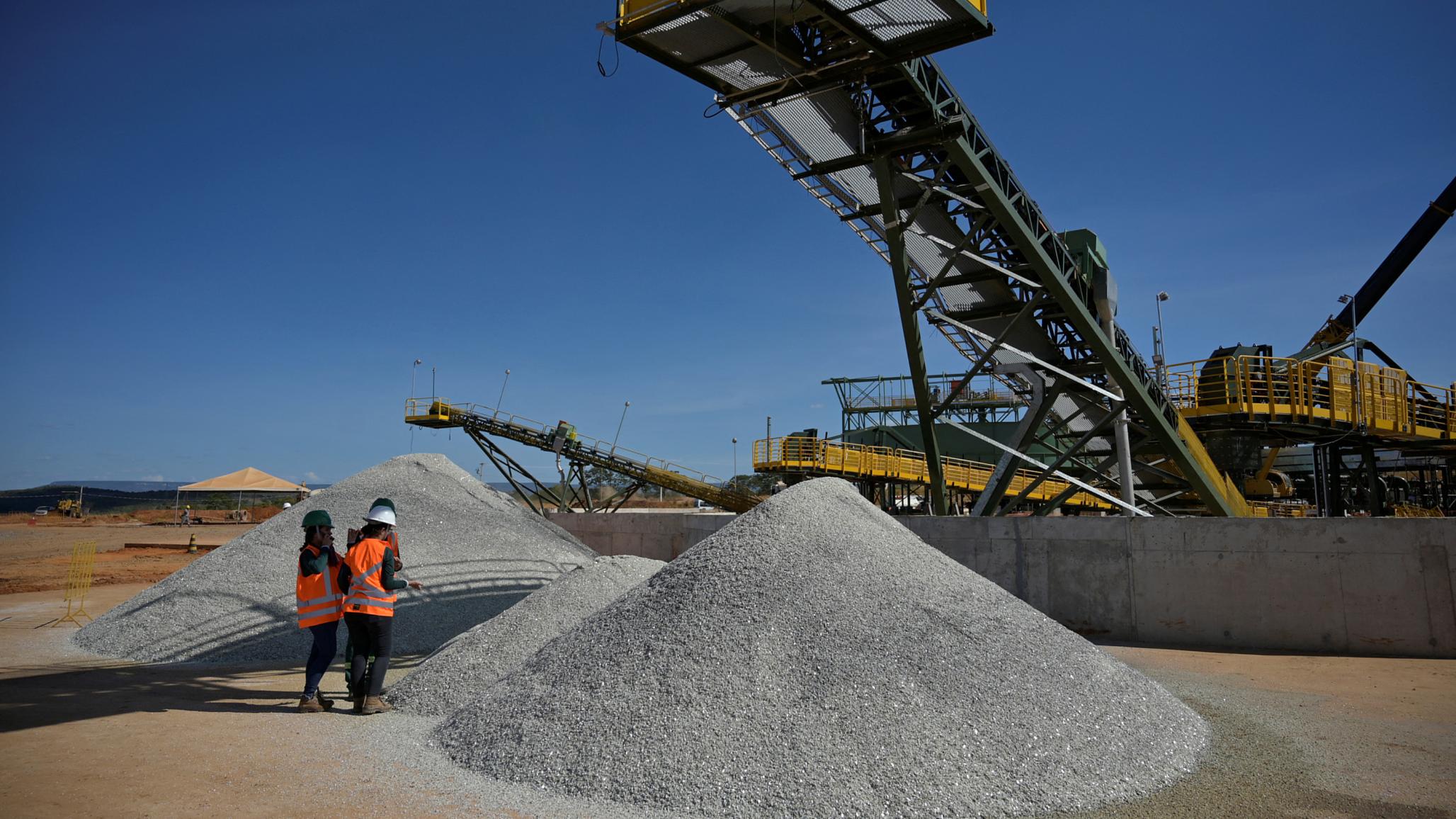
The October election between President Luiz Inácio Lula da Silva, running for a fourth term, and Senator Flávio Bolsonaro, running as a proxy for his father, who was convicted and imprisoned for organizing a coup, is not simply a contest between left and right. It is a contest over whether Brazil controls the terms on which the world accesses its resources or whether those terms are set by others. The outcome matters well beyond Brazil’s borders. It will shape critical mineral supply chains, climate governance, and the balance of power in the Americas for a generation.
For decades, globalization taught a seductive lesson: Geography no longer mattered. That lesson is being unlearned. The world is revaluing land—minerals, clean energy, water, the Amazon—and Brazil holds more of what the global economy now demands than almost any other country.
Lula is a flawed incumbent who has failed to deliver on many of his 2022 campaign promises, notably reducing inequality and addressing affordability issues. But Flávio Bolsonaro’s stated intention to align fully with the Trump administration reprises his father’s bargain: rhetorical sovereignty in exchange for operational surrender—of trade leverage, of the Amazon, of Brazil’s seat at the table where the rules are being rewritten.
Brazil thus faces the most consequential shift in its relationship with the rest of the world in a century. That is because Brazil holds vast territorial assets—the Amazon rainforest, the pre-salt oil reserves, the Cerrado’s agricultural frontier, one of the world’s largest freshwater systems, critical mineral and rare earth deposits—whose relative importance is growing precisely as the international system reorganizes around control of such resources.
Brazilian electoral campaigns have traditionally treated foreign relations as a specialist concern. But voters must now recognize that foreign relations and Brazil’s economic future are more closely tied than before. To cite one example, the price of soybeans received by a Brazilian farmer depends on trade architecture shaped by geopolitical competition between the United States and China. Moreover, whether the Amazon generates revenue through carbon markets or remains an ungoverned liability depends on international environmental frameworks that Brazil either helps design or that are imposed upon it. The industries that will employ the next generation of Brazilian workers—in critical minerals processing, renewable energy, advanced agriculture, and AI—will depend on technology partnerships, trade agreements, and investment regimes negotiated at the international level.
In this context, a candidate who promises jobs, growth, and development without articulating a foreign policy vision is offering a house without a foundation. Leaders of Brazil must confront the reality that the United States, China, and the European Union each have distinct and intensifying interests in Brazil’s resources.
The United States seeks to secure supply chains for critical minerals and reduce Chinese influence in Latin America. China wants continued access to agricultural commodities, energy, and minerals to sustain its industrial base. The European Union conditions market access on environmental governance standards that directly affect how Brazil manages the Amazon and its agricultural frontier.
Each of these actors offers a different package of opportunities and risks. None of them is acting out of altruism. The question for Brazil is not whether to engage with these powers—disengagement is not an option for a middle-income country sitting on assets the world needs—but on what terms.
This is sovereignty in its most material form. Not the rhetorical sovereignty of nationalist speeches but the operational sovereignty of determining who extracts Brazilian niobium, under what conditions foreign capital enters the energy sector, whether carbon credits from the Amazon are priced in São Paulo or London, and whether Brazil captures value from its resources or merely exports them.
The Bolsonaro regime offered a cautionary lesson: It invoked sovereignty rhetorically but surrendered it operationally.
In pursuit of ideological alignment with the Trump administration, Brazil agreed to allow foreign wheat into its market without tariffs, implementing a 750,000 metric ton annual duty-free tariff-rate quota. This action honored a long-deferred 1994 commitment by entering the World Trade Organization (WTO). Before this, US wheat faced a 10 percent tariff, while Argentine wheat entered duty-free through its South American trade agreement, Mercosur.
On ethanol, Brazil circumvented its 20 percent tariff on ethanol and extended a quota allowing imports of 198 million gallons of US ethanol duty-free, a deal that came out of the Trump-Bolsonaro meeting in Washington in March 2019. At the time, Brazil also agreed to stop self-designating as a developing country in WTO negotiations, thereby reducing future negotiating flexibility.
What Brazil got back from these concessions is remarkably opaque. The United States established a “US-Brazil Energy Forum,” but no concrete reciprocal market access appears in the public record. Trump’s tariff threats against nearly every country in the world suggested that Brazil was paying to avoid punishment rather than gaining anything.
Brazil’s competing electoral factions have historically produced dramatic oscillations in foreign policy. This fluctuation was made worse by the Bolsonaro government (2019–22), which abandoned Brazil’s decades-long tradition of pragmatic multilateralism and non-alignment in favor of an explicitly ideological foreign policy modeled on the American right.
For example, Bolsonaro sidelined or overruled the highly regarded and professional Ministry of Foreign Affairs, known as Itamaraty, shifting Brazil from being a leader in climate negotiations to an obstructionist. Once a proponent of multilateral trade governance, Brazil became an uncritical follower of Washington’s bilateral preferences.
The consequences were not abstract. The Mercosur-EU trade agreement, decades in the making and nearing conclusion, became politically unratifiable in European parliaments because of the Bolsonaro government’s anti-environmental Amazon policies. Investment decisions in green infrastructure and critical minerals that might have anchored long-term supply relationships were deferred or redirected. Brazil’s voice in shaping the rules of the emerging green economy was muted at the very moment those rules were being written.
The Lula government’s return to multilateral engagement after 2023 partially repaired the damage, but the deeper problem remains: The whiplash in policy itself is the vulnerability. Partners and investors do not plan on four-year cycles. A country that veers between climate leadership and climate denialism, between pragmatic engagement with China and ideological hostility, between multilateralism and unilateral alignment, cannot build the sustained relationships that the current moment demands.
The fragmentation of the global economy is creating an opportunity for Brazil to lock in long-term supply agreements, technology transfer arrangements, and strategic partnerships. At risk is not simply a loss of diplomatic prestige but also the danger of investment going elsewhere, in supply chains that bypass Brazil and in governance frameworks designed without Brazilian input. Most of all, Brazil cannot afford the growing gap between the country’s resource endowment and its actual economic and geopolitical weight.
The global energy and digital transition must be at the center of the electoral debate. Brazil is well-positioned for this transition. Its energy matrix is already among the cleanest of any major economy. Brazil holds significant reserves of lithium, niobium, rare earths, and other minerals essential to batteries, semiconductors, and renewable energy infrastructure. The Amazon represents the world’s largest terrestrial carbon sink. Brazilian agriculture is moving—unevenly, but moving—toward practices that could anchor global sustainable food systems.
But endowment is not destiny. Converting these assets into development outcomes requires diplomatic infrastructure: trade agreements that ensure market access for Brazilian green products, technology partnerships, environmental governance frameworks that Brazil co-designs rather than merely complies with, and financial architectures that channel climate finance on terms favorable to Brazilian interests.
Neither candidate is confronting these issues, and it’s doubtful whether they will in the run-up to the elections. Lula at least understands that granting concessions to the current Trump administration without clear commitments from the United States that meet Brazilian interests—for example, technological assistance in establishing critical mineral processing capacities—is detrimental to the country. Flávio Bolsonaro, on the other hand, judging by his comments at the most recent Conservative Political Action Conference in Texas, intends to fully align with the US government at the expense of what might be best for Brazil.
The future of the Amazon is at the center of these concerns. Its forest is simultaneously a territorial asset, a sovereignty flashpoint, a focal point of international pressure, a potential source of enormous economic value, and a governance challenge that no single Brazilian administration has resolved. What happens in the Amazon is shaped by international commodity markets, European deforestation regulations, bilateral relationships with Norway and Germany, carbon pricing mechanisms, and the operational capacity of Brazilian federal and state institutions.
The Amazon is also where the Bolsonaro era did its most lasting damage—for example, by effectively dismantling the Amazon Fund, which had channeled over $1.3 billion from Norway and Germany into conservation and sustainable development, causing Norway and Germany to freeze contributions. Deforestation surged to its highest levels in over a decade, driven by the systematic weakening of environmental agencies IBAMA and ICMBio and by political signals from the presidency that enforcement was no longer a priority. Brazil went from hosting the world’s most significant tropical conservation financing mechanism to destroying it—and in doing so, demonstrated to every international partner that commitments made by one Brazilian government could be annihilated by the next.
The Lula government reactivated the Fund and resumed enforcement, and deforestation rates have since declined. But these shifting political priorities have made it impossible for Brazil to build a credible long-term position either as environmental steward or as sovereign manager of its own territory. International actors exploit this inconsistency, alternately pressuring and partnering with Brazil depending on who is in power.
The questions candidates should answer are clear. What is the strategy for negotiating with the European Union on deforestation and other climate regulations? How will Brazil capture value from its critical minerals rather than exporting raw ore? Who will set the price of the Amazon’s environmental services? How will the competing demands of the United States and China be met without sacrificing Brazilian autonomy?
The world is watching whether Brazil’s most important decisions about its place in the world will be made, once again, by others.
Data Disclosure
This publication does not include a replication package.
