Since the widespread introduction of large language models (LLMs), there has been a wave of research and a deluge of predictions about what artificial intelligence (AI) will mean for the labor market, and when. There has also been research—and considerable speculation—about how AI is affecting the labor market right now. None of this research is—nor could be—the last word. In this analysis, I review a selection of recent research and find that the evidence on how AI is affecting the labor market today is inconclusive, and claims about harmful impacts on particular groups of workers are premature.
There are three reasons why the nascent research on AI's impact on the labor market has barely scratched the surface, and why all the important questions about AI's effects on the labor market are still unanswered.
First is that the early research findings, which focus on how AI affects labor demand, are collectively inconclusive. Second is that any research findings based on current data on AI and the labor market are necessarily weak signals about the future. Third is that the existing research on labor demand is only one corner of the vast landscape of urgent AI research questions, and many plausible channels of impact on the labor market have been under-explored relative to labor demand.
There is an enormous opportunity and need for more research on the relationship between AI and the labor market—and better data. This analysis concludes with some principles for maximizing the value and usefulness of research on AI and the labor market.
Why current research on AI and labor demand is inconclusive
Much of the recent research on AI and the labor market has focused on labor demand: that is, how AI will change the jobs, skills, or tasks employers will pay workers to do. This research takes the form of ranking or classifying occupations (or industries) by the extent to which they are likely to be affected by AI, and then analyzing how trends or patterns of occupations more likely to be affected by AI differ from those of occupations less likely to be affected by AI. Most of this research focuses on occupations or industries, rather than skills or tasks, since existing labor-market data is more available for occupations and industries.
To rank or classify occupations, researchers develop or use one or multiple measures of AI exposure or AI usage. AI exposure refers to how likely it is that an occupation (or the tasks that constitute it) will be augmented or replaced by AI, while AI usage refers to how and how much people in that occupation are using AI already.
Importantly and somewhat confusingly, there are now numerous AI exposure and usage measures being used in AI research, and they do not entirely agree. AI exposure and AI usage are different concepts, and many occupations rank differently on exposure than on usage, as shown in Gimbel et al. (2025; figure 1). Some of these rankings or classifications are based on human judgment, and others are generated by LLMs themselves.

For instance, several clerical and office administration occupations rank low on current AI usage but high on potential AI exposure. There is also disagreement even among exposure measures. And, of course, the occupations with the highest usage or exposure might change as the capabilities, costs, and norms of AI evolve.
One way to put these exposure or usage measures to work is to combine them with the descriptive characteristics of occupations—such as their geographic distribution or demographic profile—to anticipate which places or demographic groups might be more affected by AI. Manning and Aguirre (2026) take this approach to understanding which demographic groups and places might be most exposed to AI, and which are more likely to adapt if faced with AI-induced job losses.
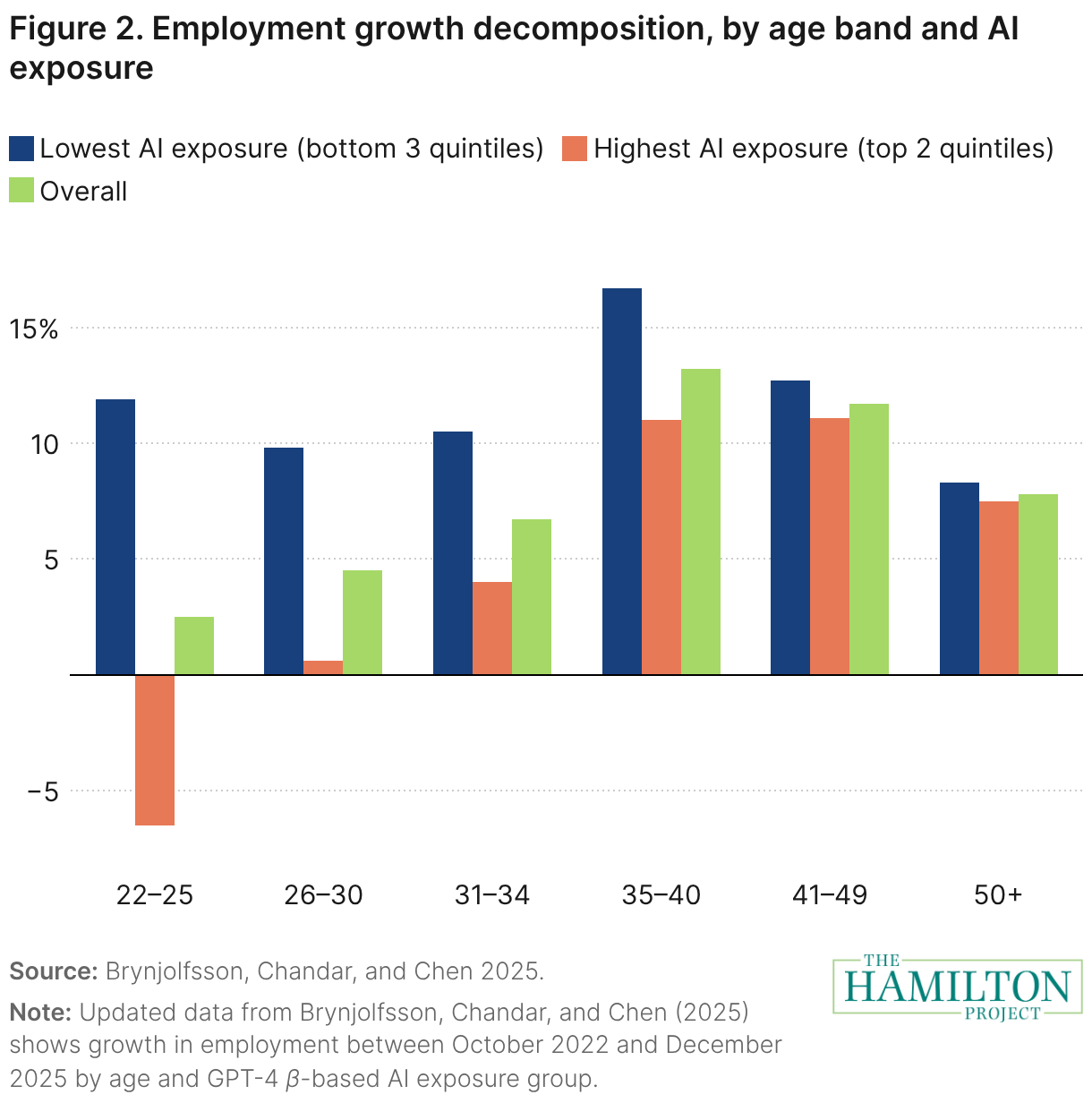
Several high-profile research efforts have combined AI exposure or usage measures with recent occupational employment data in order to analyze how employment trends correlate with an occupation's AI exposure or usage. Brynjolfsson, Chandar, and Chen (2025) merged their preferred AI-exposure measures with detailed employment records from payroll processor ADP, whose data include very specific occupational detail and demographics. They found employment fell more for young workers in occupations with higher AI exposure but not in occupations with lower AI exposure; differences in employment changes by occupational AI exposure for older workers were minimal. They found employment fell more for young workers in occupations with higher AI exposure but not in occupations with lower AI exposure; differences in employment changes by occupational AI exposure for older workers were minimal (figure 2).
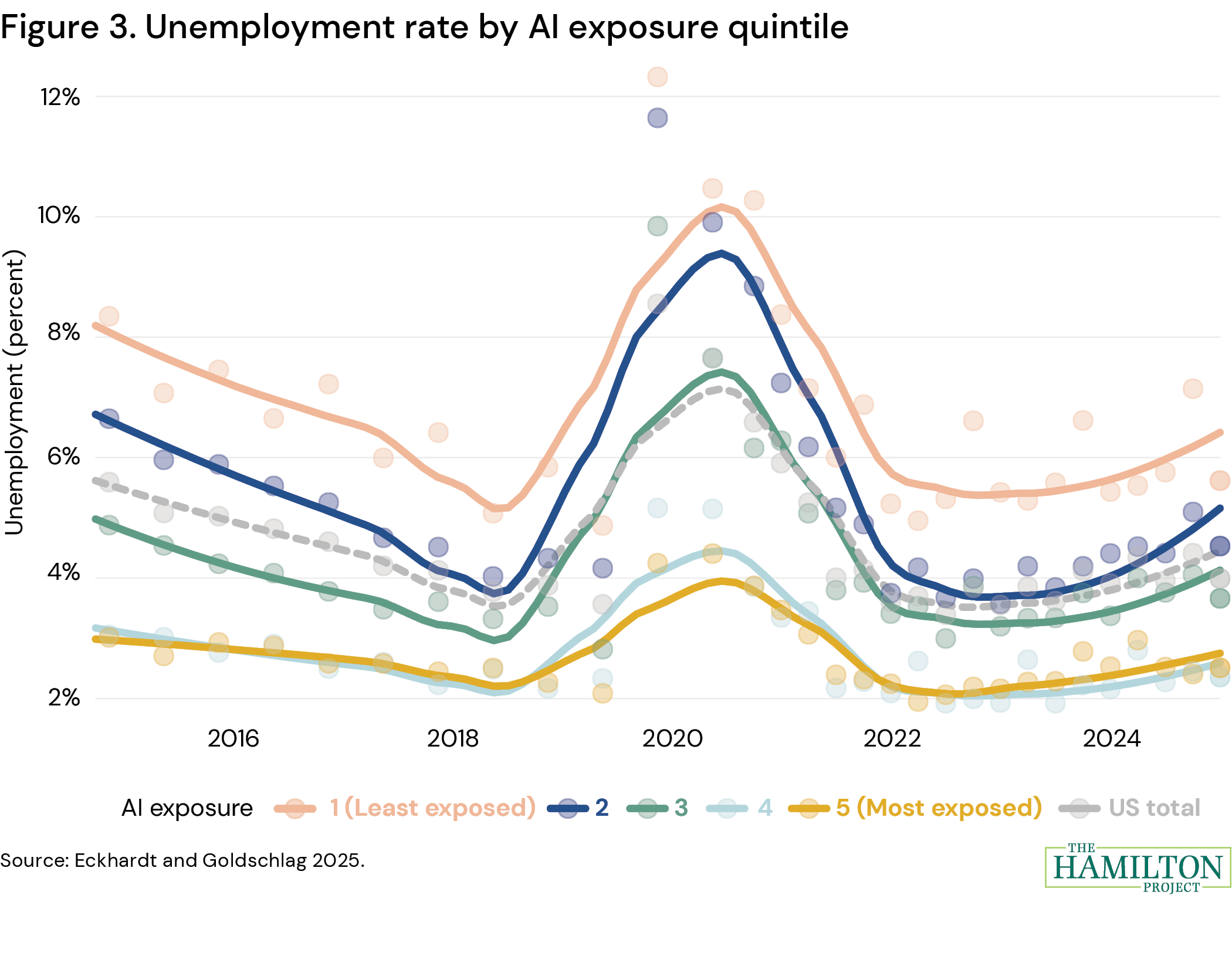
In contrast, Eckhardt and Goldschlag (2025) found that unemployment rose less for workers in occupations with higher AI exposure using publicly available jobs data from the Current Population Survey (CPS) (figure 3). CPS has a much smaller sample than the proprietary ADP data, which limits analysis by AI-exposure quintile for narrow age groups. Helpfully, they repeated their analysis using different AI exposure measures: The broad conclusions were generally robust across measures, with some small differences across measures. Iscenko and Millet (2026) follow a similar approach to Brynjolfsson et al. and find that job postings declined more in AI-exposed occupations, but this trend began in 2022 prior to the public release of ChatGPT. They argue that the timing of the decline in job postings corresponds better to the macroeconomic shift of rising interest rates than to the launch of LLMs. Frank et al. (2026) found similar results.
These papers on AI and labor demand naturally focus on occupations that exist today, for which employment data and AI exposure and usage measures are available. AI might bring forth entirely new occupations, or create new kinds of work within existing occupations, which could be a meaningful source of job growth. Research on previous waves of technological change suggests that newly created occupations do in fact contribute to employment growth, particularly when innovations augment rather than automate work activities (Autor et al. 2024).
Together, these early efforts show the value of combining new measures of AI with existing labor market data, and they also illustrate why interpreting these results only through the lens of AI is challenging if not outright problematic. Results can be sensitive to which AI measure is chosen. AI exposure or usage could be correlated with other ways occupations differ, such as the extent of over-hiring during the pandemic, or suitability for remote work, or exposure to tariffs, or reliance on immigrants for workers—all of which could also explain why employment patterns have differed across occupations in recent years.
Early findings are weak signals
Even the most robust research finding or overwhelming anecdotes about the current effect of AI in the labor market should be read skeptically. The commercial diffusion of the current generation of large language models (LLMs) is so recent that any lasting economic impact would likely take years to show up in employment, output, or productivity data.1 Previous technological revolutions showed up in economic data years or decades later, once business processes adapted to take full economic advantage of new technologies.
In addition, AI is advancing rapidly. Breakthroughs are arriving quickly, and our current sense of AI's capabilities is far ahead of last year and likely far short of next year. As the capabilities of AI change, so does its likely impact on the labor market. Even robust conclusions about how the current generation of LLMs are affecting the labor market or might change the demand for particular tasks or occupations could quickly become obsolete.
Additionally, our research tools and approaches are immature. As the capabilities of AI become clearer and as the research literature matures, researchers and policymakers will align on common definitions for exposure, usage, and adoption, and on standards for measuring economic impact. Until then, research findings might be highly sensitive to differences in definitions and classifications. As discussed above, the newly rich literature that explores employment trends in jobs likely to be more affected by AI than other jobs uses multiple measures of occupation-level AI exposure and usage. There is no consensus among researchers around these measures, nor around how to measure adoption.
Because AI is more likely to affect professional white-collar jobs than past waves of technological innovation, the research and researchers might also be more prone to biases that have yet to be fully realized and accounted for. For example, the current public debate about AI and jobs echoes in some ways the debate a decade ago about automation and jobs. But the people who produce the research, narratives, and stories about AI and the labor market are likely more exposed to today's LLMs than last decade's automation, which was expected to put "routine" jobs in factories and offices at highest risk. Today, when researchers, journalists, consultants, and content producers can easily see how their own jobs are exposed to AI, this "narrator's bias" could color the interpretation and tone of research findings.
We should be concerned about research that draws on companies' own statements about the impact of AI on their businesses. The enthusiasm for, investment in, and genuinely astounding advances in AI create pressure for employers, workers, and policymakers to show how they are harnessing AI. If you are regularly being asked how you plan to use AI to save money, boost productivity, or become more efficient, you have an incentive to over-attribute your investment, hiring, or operational decisions to AI. A CEO can more proudly blame AI for a hiring freeze or layoff round than they can admit that they over-hired in the aftermath of the pandemic.
Finally, beware "streetlamp bias," which could affect our early understanding of AI: Research topics well lit by available data and developing methods could point to different conclusions than research topics that sit in the dark because of unavailable data or undeveloped methods. This bias should also fade over time as relevant data become more available and research methods become more established, but should make us more skeptical about the research on AI and the labor market that emerges early.
AI could affect much more than labor demand
The referenced studies on labor demand and AI are only one part of the AI research landscape. While they have gotten more public attention than research into productivity effects, labor supply, and transition dynamics, three areas deserve more attention—and more research!—to fully understand how AI might affect labor markets.
Productivity: A growing literature has examined how AI has affected business productivity, primarily through in-depth analysis of a team or a firm; Imas (2026) summarizes these studies. Many look at coding or customer service activities. Most find productivity benefits, with notable exceptions: One found AI made developers slower, and another found consultants over-relied on AI for some tasks beyond AI's capabilities, resulting in worse performance. Individual productivity is not the only outcome. Dell'Acqua et al. (2025) found that AI improves team collaboration and overcomes traditional functional silos while Jiang et al. (2025) found that AI exposure increases work hours and decreases employee satisfaction.
As with labor demand, one should not expect these studies on AI and productivity to reach a consensus or uniform conclusion. AI could well have different productivity effects for different occupations, firms, industries, or types of workers, and all of these effects could also shift as AI's capabilities evolve over time.
Furthermore, the effects that these early studies find might not generalize broadly because of which firms are currently using AI. Current data from the Census Bureau's Business Trends and Outlook Survey shows that fewer than one-fifth of firms are using AI in any capacity, and even fewer are using AI directly for producing goods and services. Firms using AI today are still early adopters, and studies of firm productivity being published today are based on firms among these early adopters.
Labor supply: Research has paid relatively little attention to the potential effects of AI on labor supply. Theoretically, AI could affect people's interest and availability to work through many channels. AI could improve the job-search process, making it easier to find job opportunities and to identify good matches; AI could alternatively hamper the job-search process if application, recruitment, and candidate selection all become more automated and require both candidates and hiring managers to establish and adopt a new set of processes and norms. AI could also affect labor supply by making personal chores less burdensome (raising labor supply) or making personal leisure more appealing (lowering labor supply). As with AI and labor demand, the effects of AI on labor supply could vary across people and could change over time as AI evolves.
The effect of technological innovation on labor supply has been underappreciated in economic research. Ask economists which technologies over the past century have had the biggest effect on labor markets, and few are likely to mention the Pill, which completely transformed women's educational and career choices and contributed to a dramatic increase in women's labor force participation in the latter decades of the 20th century (Goldin and Katz 2002). More recently, the technology and norms that supported video communication and remote work supported the labor supply of mothers of young children and people with disabilities.
Transition dynamics: Apart from AI's eventual long-run impact on the labor market, there is the real possibility of dislocation and displacement in the short run. Even if AI leads to productivity growth and widespread continued employment for nearly all who want to work, the path might be bumpy. Research on the transition effects from technological and other policy and structural changes can help inform what the AI transition might look like, even if the ultimate effect of AI on the labor market is likely to be quite different from the long-term effect of previous technological, policy, and other structural changes.
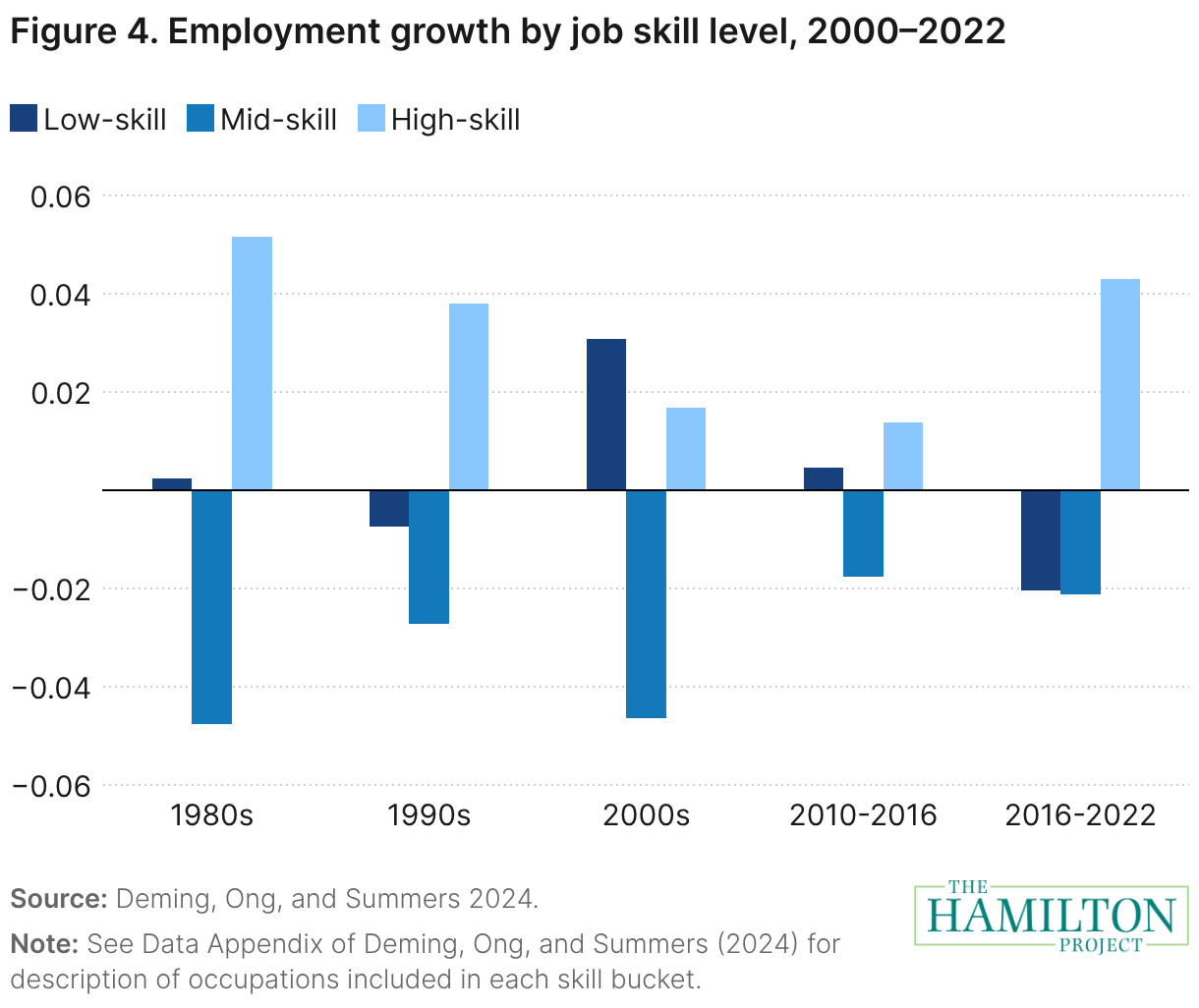
In a wide-sweeping review of past technological changes, Deming, Ong, and Summers (2024) note that significant distributional shifts in employment can occur even during relatively slow periods of economic transformation. U.S. job growth shifted from a barbell pattern in the 1990s and 2000s, when low-skill and high-skill job growth outpaced middle-skill jobs, to a more straightforward pattern in 2016–2022, when high-skill jobs grew faster than both low- and middle-skill jobs (figure 4).
Disruptions can be especially challenging when they are geographically concentrated. For instance, Autor, Dorn, and Hanson (2013) show that the increase in exposure to Chinese imports during the "China shock" varied dramatically across local labor markets, with subsequent analyses showing notable localized economic and political effects. Earlier work by Blanchard and Katz (1992) shows that state-level shocks tend to persist, with local employment on a permanently lower path. Perhaps it's encouraging that many of the occupations highly exposed to AI—such as office administrative and clerical work—are not especially concentrated in particular local labor markets; people whose jobs are at risk from AI might still find plenty of job opportunities locally.
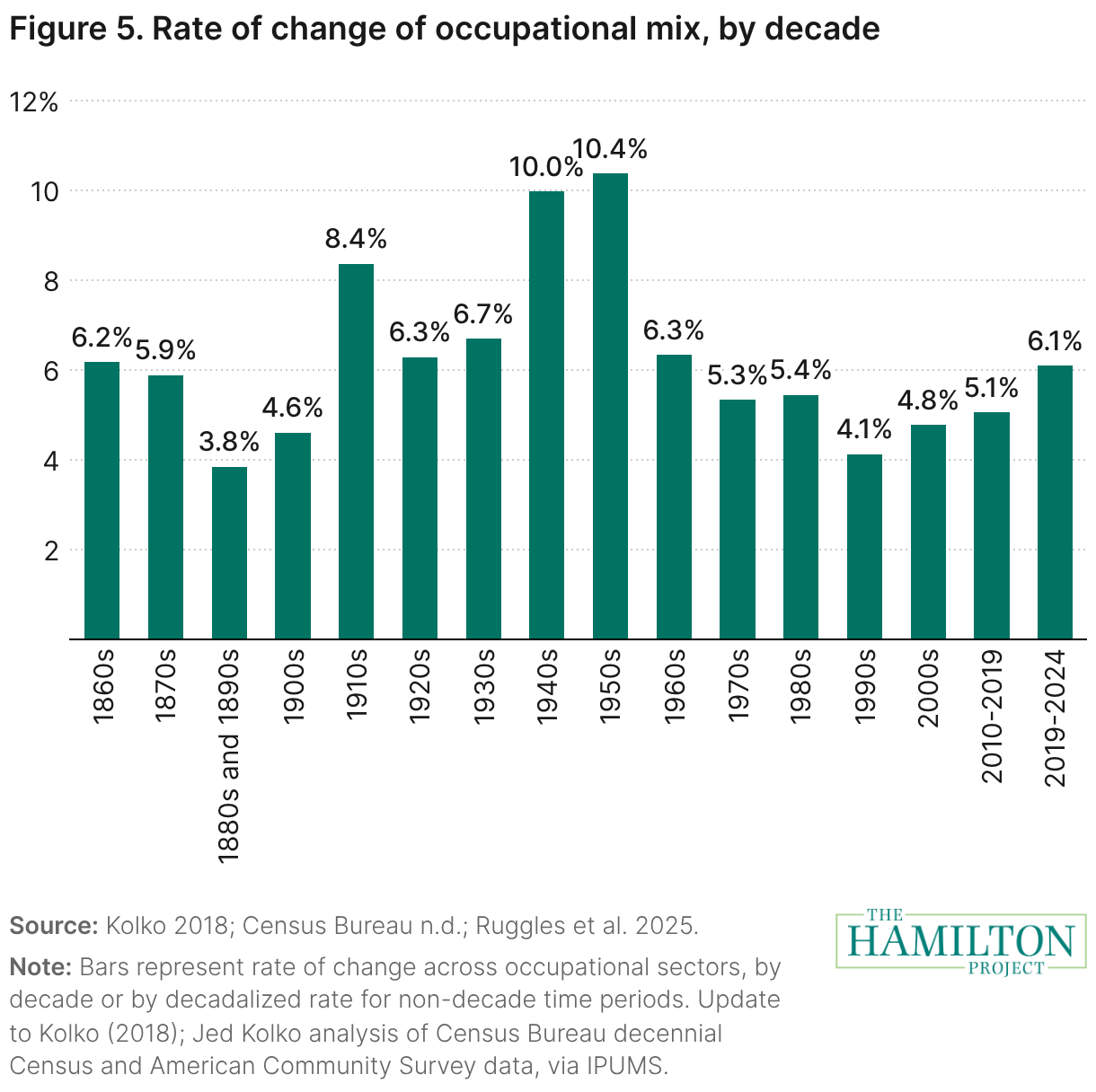
Initial evidence suggests that transitional disruption from AI to date is not outpacing recent technological changes. The occupational mix has changed over the past three years at a similar pace to the years after the start of the commercial computer era (1984) and the commercial Internet era (1996) and has not accelerated since the release of ChatGPT.
Looking over a longer time period, the occupational mix has changed more rapidly since the pre-pandemic baseline (2019–2024) than in several prior decades (figure 5). However, these recent occupational shifts are less dramatic than those during the 1910s and the 1940s and 1950s, when there were dramatic shifts from agriculture to manufacturing and then to both administrative and professional services. Nor was AI the only significant change to the labor market compared to the pre-pandemic period. The current AI transition may turn out not to be unprecedented, and lessons from the past may remain relevant.
Practical principles for research about AI and the labor market
AI might turn out to be the driving force behind dramatic changes in the labor market, and research that anticipates and documents these changes will be essential. Early research on AI and the labor market reveals a range of opportunities, as well as challenges and gaps, pointing to four principles for future work.
- Think comprehensively about labor market effects. Much of the research to date has focused on how AI might change the demand for skills, tasks, and jobs. Researchers should examine the labor supply side too; continue to run experiments and case studies that go deep into AI and productivity; and explore transition dynamics. Wherever possible, research should consider alternative explanations for labor market dynamics and distinguish the effects of AI from other technologies, policy shifts, and macroeconomic conditions.
- Contribute to the collective data infrastructure. AI research is nascent, and researchers are still building taxonomies, classifications, and tools, like AI exposure measures. Make this public and easily usable by other researchers. The more that research can be replicated and data combined with other sources, the faster our collective knowledge base grows.
- Make research results useful for policymakers and decisionmakers. Research on AI and labor markets isn't just academic. Policymakers, educators, employers, and anyone thinking about their career are all eager to know how AI will affect jobs. Researchers should express or translate their findings to be useful for practitioners, or alternatively should provide enough transparency so others can do this essential work of translation.
- Have clear and transparent hypotheses about which historical experiences are useful. We don't yet know how similar AI will be to previous waves of technological innovation, or whether lessons from historical technological innovations will help us understand AI. Even if the ultimate impact of AI on the economy ends up being entirely different from the impact of previous technologies, the process of transition might rhyme with the past, so transition lessons could still be relevant.
Note
1. In addition, AI can boost economic output temporarily through a surge of investment or through higher consumer spending by people whose wealth goes up with AI-related equity valuations.
Acknowledgments
The author thanks Bharat Chandar, David Deming, Sarah Eckhardt, Martha Gimbel, Nathan Goldschlag, and Christopher Ong for permission to reprint figures from their analyses. The author thanks Aviva Aron-Dine, Lauren Bauer, Martha Gimbel, and Nathan Goldschlag for helpful feedback. Ariyasuren Baldansenge, Asha Patt, and Eileen Powell provided excellent research assistance.
References
Armstrong, Robert. 2025. "Lay-offs and AI." Financial Times, November 3, 2025. https://www.ft.com/content/2402d659-9bcf-4036-9593-ec69fc9c45ba
Autor, David, Chin, Caroline, Salomons, Anna, and Bryan Seegmiller. 2024. "New Frontiers: The Origins and Content of New Work, 1940–2018." The Quarterly Journal of Economics 139 (3): 1399–1465. https://academic.oup.com/qje/article/139/3/1399/7630187
Autor, David, Dorn, David, Hanson, Gordon, and Kaveh Majlesi. 2020. "Importing Political Polarization? The Electoral Consequences of Rising Trade Exposure." American Economic Review 110 (10): 3139–83. https://www.aeaweb.org/articles?id=10.1257/aer.20170011
Autor, David H., Dorn, David, and Gordon H. Hanson. 2016. "The China Shock: Learning from Labor-Market Adjustment to Large Changes in Trade." Annual Review of Economics. 8: 205–40. https://www.annualreviews.org/content/journals/10.1146/annurev-economics-080315-015041
Autor, David H., Dorn, David, and Gordon H. Hanson. 2013. "The China Syndrome: Local Labor Market Effects of Import Competition in the United States." American Economic Review 103 (6): 2121–68. https://www.aeaweb.org/articles?id=10.1257/aer.103.6.2121
Bauer, Lauren, and Sarah Yu Wang. 2023. "Prime-age women are going above and beyond in the labor market recovery." The Hamilton Project, Brookings Institution, Washington, DC. https://www.hamiltonproject.org/publication/post/prime-age-women-are-going-above-and-beyond-in-the-labor-market-recovery/
Blanchard, Olivier Jean, and Lawrence F. Katz. 1992. "Regional Evolutions." Brookings Papers on Economic Activity 1: 1–75. https://www.brookings.edu/wp-content/uploads/1992/01/1992a_bpea_blanchard_katz_hall_eichengreen.pdf
Brynjolfsson, Erik, Chandar, Bharat, and Ruyu Chen. 2025. "Canaries in the Coal Mine? Six Facts about the Recent Employment Effects of Artificial Intelligence." Stanford Digital Economy Lab, Stanford, California. https://digitaleconomy.stanford.edu/publication/canaries-in-the-coal-mine-six-facts-about-the-recent-employment-effects-of-artificial-intelligence/
Dell'Acqua, Fabrizio, Ayoubi, Charles, Lifshitz, Hila, Sadun, Raffaella, Mollick, Ethan, Han, Yi, Goldman, Jeff, Nair, Hari, Taub, Stew, and Karim R. Lakhani. 2025. "The Cybernetic Teammate: A Field Experiment on Generative AI Reshaping Teamwork and Expertise." Harvard Business School Working Paper, No. 25-043, March 2025. https://www.hbs.edu/faculty/Pages/item.aspx?num=67197
Deming, David, Ong, Christopher, and Lawrence H. Summers. 2024. "Technological Disruption in the US Labor Market." Aspen Institute, Washington DC. https://www.economicstrategygroup.org/publication/deming_ong_summers/
Eckhardt, Sarah, and Nathan Goldschlag. 2025. "AI and Jobs: The Final Word (Until the Next One)." Economic Innovation Group, Washington, DC. https://eig.org/ai-and-jobs-the-final-word/
Frank, Morgan R., Javadian Sabet, Alireza, Simon, Lisa, Bana, Sarah H., and Renzhe Yu. 2026. "AI-exposed jobs deteriorated before ChatGPT." arXiv preprint arXiv:2601.02554v1. https://arxiv.org/html/2601.02554v1
Gimbel, Martha, Kendall, Joshua, and Ryan Kulsakdinun. 2026. "Labor Market AI Exposure: What Do We Know?" The Budget Lab at Yale, New Haven, CT. https://budgetlab.yale.edu/research/labor-market-ai-exposure-what-do-we-know
Gimbel, Martha, Kinder, Molly, Kendall, Joshua, and Maddie Lee. 2025. "Evaluating the Impact of AI on the Labor Market: Current State of Affairs." The Budget Lab at Yale, New Haven, CT. https://budgetlab.yale.edu/research/evaluating-impact-ai-labor-market-current-state-affairs
Goldin, Claudia, and Lawrence F. Katz. 2002. "The power of the pill: Oral contraceptives and women's career and marriage decisions." Journal of Political Economy 110 (4): 730-770. https://dash.harvard.edu/server/api/core/bitstreams/7312037c-4cdf-6bd4-e053-0100007fdf3b/content
Goldschlag, Nathan. 2025. "How Many Businesses are Using AI?" Agglomerations from EIG, December 19, 2025. https://agglomerations.substack.com/p/how-many-businesses-are-using-ai
Imas, Alex. 2026. "What is the impact of AI on productivity?" Ghosts of Electricity, January 29, 2026. https://aleximas.substack.com/p/what-is-the-impact-of-ai-on-productivity
Iscenko, Zanna, and Fabien Curto Millet. 2026. "Looking for the Ladder: Is AI Impacting Entry-Level Jobs?" Economic Innovation Group, Washington, DC. https://eig.org/wp-content/uploads/2026/01/TAWP-Iscenko-Millet.pdf
Jiang, Wei, Park, Junyoung, Xiao, Rachel (Jiqiu), and Shen Zhang. 2025. "AI and the Extended Workday: Productivity, Contracting Efficiency, and Distribution of Rents." Work Paper 33536, National Bureau of Economic Research, Cambridge, MA. https://www.nber.org/papers/w33536
Kolko, Jed. 2018. "5 Questions We Should Be Asking About Automation and Jobs." Harvard Business Review, December 19, 2018. https://hbr.org/2018/12/5-questions-we-should-be-asking-about-automation-and-jobs
Manning, Sam, and Tomás Aguirre. 2026. "How Adaptable Are American Workers to AI-Induced Job Displacement?" Working Paper 34705, National Bureau of Economic Research, Cambridge, MA. https://www.nber.org/papers/w34705
Marks, Cassandra, and Rubinton, Hannah. 2024. "The Labor Effects of Work from Home on Workers with a Disability." On the Economy, Federal Reserve Bank of St. Louis, St. Louis, MO, February 27, 2024. https://www.stlouisfed.org/on-the-economy/2024/feb/labor-effects-work-from-home-workers-disability
The Budget Lab at Yale. 2025. "Evaluating the Impact of AI on the Labor Market: November/December CPS Update." The Budget Lab at Yale, New Haven, CT. https://budgetlab.yale.edu/research/evaluating-impact-ai-labor-market-september-cps-update
United States Census Bureau. 2026. "Business Trends and Outlook Survey." U.S. Census Bureau, Suitland, MD. https://www.census.gov/hfp/btos/data
Data Disclosure
Related Documents
- Document2026-03-10-kolko-ai-labor.zip (25.46 KB)