
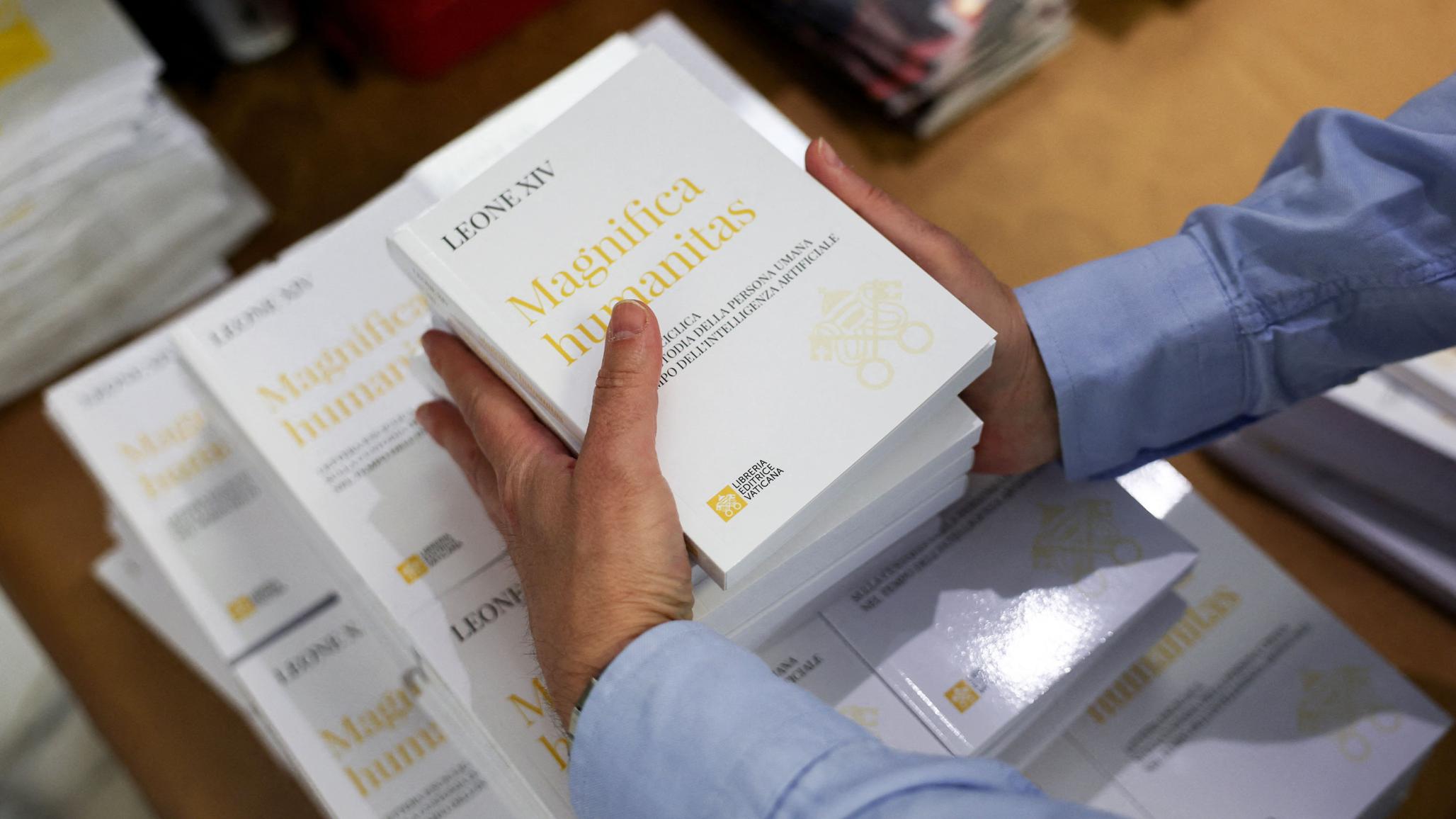
The main thesis of Pope Leo XIV's 2026 encyclical Magnifica Humanitas ("On Safeguarding the Human Person in the Time of Artificial Intelligence") is that artificial intelligence (AI) must serve humanity, rather than humanity adapting itself to AI without reservation. Human dignity, moral responsibility, work, truth, and peace must remain at the center of technological development. There was already an echo of Pope Leo's message to be found in what many would think a most unexpected place: the rules of the World Trade Organization (WTO) written in another time, in 1948 for goods and in 1995 for services. It is this largely ignored corner of the rules of the world trading system that is likely to become central in trade conflicts in the coming years. Pope Leo's encyclical will provide both an impetus and guidance as to how the trading system deals with the moral questions raised by AI when trade is involved.
The WTO rulebook is directed at constraining national conduct with the objective of allowing the freer flow of international trade. There are some exceptions. The very first one, undefined and infrequently used, reads: "nothing in this Agreement shall be construed to prevent the adoption or enforcement by any contracting party of measures … necessary to protect public morals." The core documents of the WTO, the General Agreement on Tariffs and Trade (the GATT) and the General Agreement on Trade in Services (GATS), state that the rules of the trading system must stand aside if there is a valid invocation of this exception.
In the 80 years since the multilateral trading system was founded, the public morals exception has rarely been invoked in formal dispute settlement cases. The most noteworthy case was brought against the United States when it banned most forms of internet gambling. In that case (DS285), concerns relating to (1) organized crime; (2) money laundering; (3) fraud; (4) risks to youth, including underage gambling; and (5) public health were each considered by the WTO Appellate Body to be valid reasons for claiming the exception. Likewise, the protection of animal life was considered covered when the European Union invoked the morals exception to justify its ban on seal products (DS400/401). In a third case, in which the WTO Appellate Body addressed China's restrictions on the importation of books, movies, and music (DS363), China argued that state control over distribution was necessary to protect "public morals" and prevent the spread of undesirable content, and this was deemed an allowable objective.
In each of the three cases, however, the WTO dispute settlement system ruled that while the objectives cited were legitimate, the specific restrictions applied were either unnecessary, discriminated against foreign providers, or both. As a result, the exception has never successfully been raised as a defense of a regulation in litigation at the WTO. That result is likely to change. There are a myriad of ways in which the use of AI can raise policy questions for national governments. Is privacy a reason for regulating the cross-border movement of information? Is national security a reason? Heightened attention will be given to the question of public morals in the context of regulating AI.
Who better than someone like the pope to turn to as an authority by which to consider the question of public morals? But he is not alone: Thupten Jinpa, a prominent Tibetan Buddhist scholar, has said "how human beings come to coexist with AI is going to be a defining question of our time." Secular sources are equally available, from Aristotle to Harvard professor Michael Sandel. WTO arbitral panels dealing with the public morals exception will have a variety of sources to draw upon. Christopher Olah, a co-founder of the AI company Anthropic who was present at the public release of the encyclical, acknowledged that "companies like his own need moral guidance to avoid being swayed by 'a set of incentives and constraints that can sometimes conflict with doing the right thing. We need moral voices that the incentives cannot bend,'" he said.
The WTO does not set standards. The WTO Agreement on Technical Barriers to Trade (TBT) seeks to ensure that AI-related product standards, technical regulations, and conformity assessments are transparent, non-discriminatory, and do not create unnecessary obstacles to global trade. A threshold question on whether an AI standard, when it impedes trade, is consistent with the WTO rules, is whether its objective aims at serving "public morals" (although an alternative is to claim that the measure is justified by being within the essential security exception). That is the frame within which ethical questions will be considered. If it does serve a moral purpose, is the measure necessary, and if so, was it discriminatory? If the answer is that the objective could have been served by a less trade-restrictive measure or was discriminatory, the public morals exception will not be sustained as a defense when WTO obligations are violated. But litigation is not the primary forum in which standards are considered at the WTO.
The process devoted to addressing most standards applies before they are adopted. The country proposing a standard notifies it when it is still in draft and stands ready to discuss specific trade concerns (STC) with any member who files a concern. This is considered one of the features of the WTO that works best. The WTO reports that at least 20 new AI-related concerns were raised in a recent review period. At the November 2025 TBT Committee meeting, members discussed 70 STCs, 12 of which have been referred to as AI-related, including AI conformity assessment, algorithm transparency requirements, cybersecurity rules, data governance, and digital-product regulation. Addressed in the formal consultative process so far is one, the EU AI Act. The volume of STCs regarding AI will clearly grow dramatically in the years ahead. Standards governing AI are likely to pit the US tech giants against the regulators in many foreign capitals.
The questions raised in the cases concerning internet gambling, seal products in the EU market, and Chinese publications were not easy ones, nor will future ones be. The recent spate of US tariff cases on forced labor, brought under Section 301 of the Trade Act of 1974, is also an example of a difficult public morals case. Will any international tribunal consider that the proposed tariffs—although said to be in aid of a noble purpose, suppression of forced labor—are necessary? Were there alternative means to deal with the question other than tariffs? Are the measures going to be nondiscriminatory? In the future, a clear subject for review will be measures that impede digital apps that deliver misleading information, as truth is a question of public morals. This also arises in the case of information about public health. The scope of the exception will be determined by future WTO dispute settlement panels and by international agreements.
A danger that is widely recognized but which still must be successfully addressed is the fragmentation of AI regulation. Brazil's primary AI legislation (Bill No. 2338/2023) is under current consideration by the country's legislature. It bans unacceptable risks and imposes stricter rules on high-risk AI, such as systems used in hiring, health care, and public safety. Violations can result in severe consequences, including fines of up to 2 percent of a company's revenue in Brazil or complete bans on AI operations. South Korea and China already have AI laws. Chile, Mexico, and Argentina are considering AI legislation. Hardware tariffs (on semiconductors and servers), export controls, protection of intellectual property, and dual use regulations, are among the measures being deployed.
The defining issues in international trade relations in the 21st century are unlikely to be Trump's tariffs or the purported new world trading order built around them. Nor is the central question yet whether the middle economic powers can wrest greater control over the trading system from the world's two dominant economic powers, a struggle highlighted by Canadian prime minister Mark Carney at Davos earlier this year. Rather, it is likely to be the contest between the ethical regulation of AI and the unencumbered development and cross-border flow of AI-related goods and services. Questions surrounding AI may well dominate the deliberations of the WTO in the years ahead.
Although influencing international trade relations was not among the pope's stated objectives, his teaching can ultimately prove highly relevant to one of the defining trade policy debates of the century: how to reconcile the ethical governance of AI with the free flow of goods, services, data, and technology across borders. If a globally coherent framework for AI regulation is to emerge, the WTO could play a central role, whether directly or at least through the incorporation of principles first developed in plurilateral agreements and later embraced more broadly by the international trading system.
Data Disclosure
This publication does not include a replication package.
