Our recent working paper is the latest in a series of papers demonstrating the important role official policies play in driving global trade imbalances. The core results are that each $1 increase in a country's fiscal balance raises its trade balance $0.30 and each $1 purchase of official foreign assets raises the trade balance $0.50 or so. These policies work well together, so that a $1 increase in the fiscal balance that is invested entirely in foreign assets raises the trade balance $0.80 or more.
In this post, we show that the experiences of major oil exporters illustrate these results clearly. It is widely believed that major oil exporters automatically have trade surpluses. We show, however, that oil exporters have persistent surpluses only when their governments save the oil revenues in foreign assets, mainly using sovereign wealth funds (SWFs).1
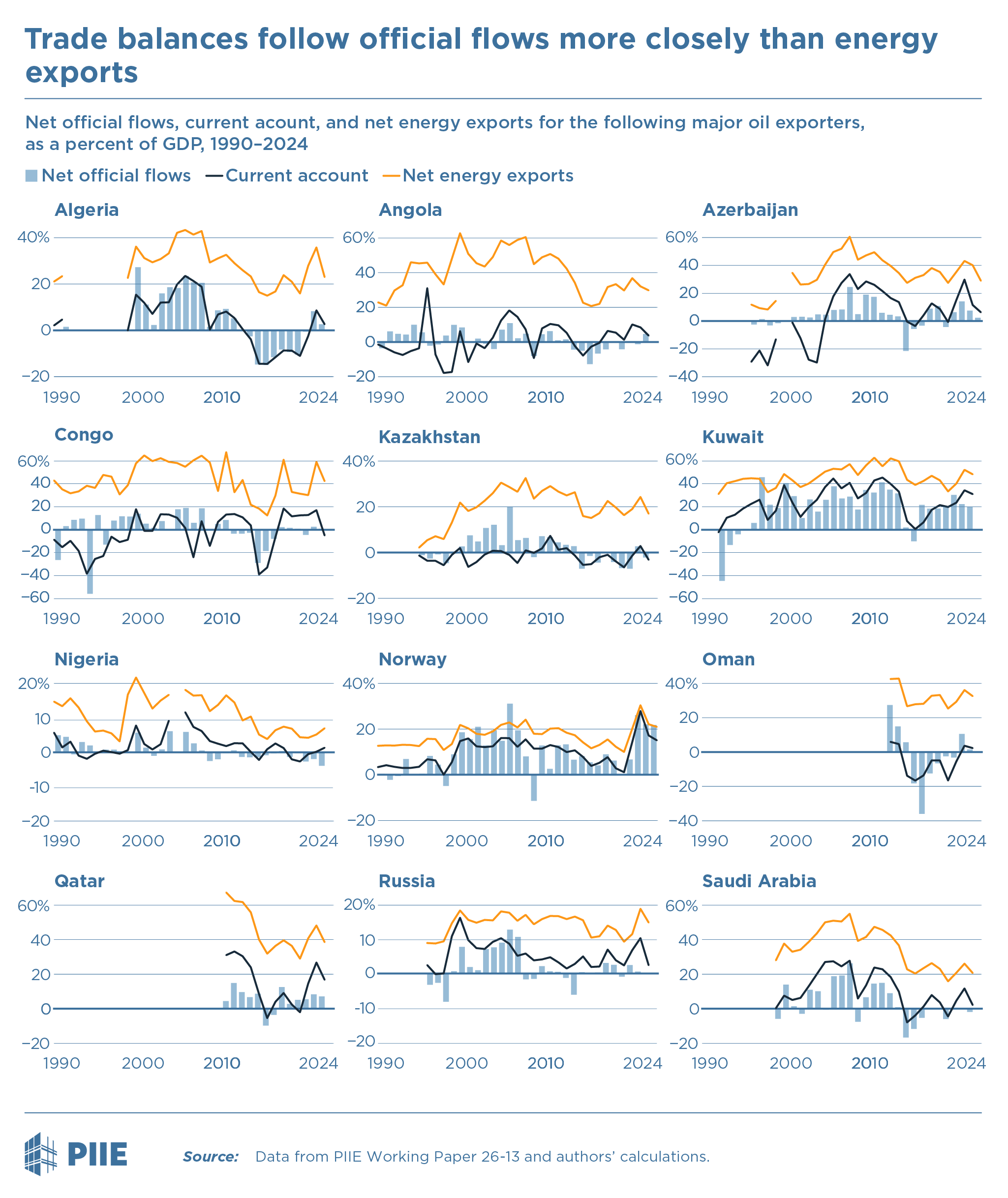
Figure 1 displays data for 12 major oil exporters,2 including net energy exports, the trade (current account) balance, and net official purchases of foreign assets, also known as net official flows (NOF) and typically conducted by SWFs. All variables are expressed in percent of GDP. Net energy exports and net official flows are only two of many factors that influence the current account, as discussed in our paper.
Some oil exporters do have persistent trade surpluses, including Azerbaijan, Kuwait, Norway, Qatar, Russia, and Saudi Arabia. In Kuwait, Norway, and Saudi Arabia, the pattern of trade surpluses matches very closely with NOF.3 In Azerbaijan, Qatar, and Russia, the trade balance is positively correlated with NOF, but gaps in this correlation suggest that other factors matter as well.
Other oil exporters have trade balances that fluctuate around zero. In most of these countries, NOF also fluctuates around zero and is often strongly correlated with the trade balance. The case of Algeria is particularly striking, with the trade balance essentially identical to net official flows. The only exceptions to the pattern of strongly correlated trade balance and NOF are Angola before 2005 and Kazakhstan before 2010.
The data show convincingly that oil exporters have persistent trade surpluses only when their governments save a large part of the oil revenues in foreign assets.
Notes
1. SWFs are a common framework used to save natural resource revenues in countries that are dependent on such exports. All of the countries in figure 1 except the Republic of Congo have resource-based SWFs. Congo's net official flows primarily arise from official development loans and their repayment.
2. We include all countries with at least 10 years of data and for whom net energy exports exceed $10 billion per year on average and 10 percent of GDP on average. We exclude Iran and the United Arab Emirates because of concerns about the quality of their data. We include the Republic of Congo as an example of a low-income country with net energy exports greater than 10 percent of GDP even though it does not meet the $10 billion per year criterion.
3. Fiscal balances are closely linked to NOF in these countries.
Data Disclosure
This publication does not include a replication package.