The US drive for critical minerals from its trading partners is now a top economic and foreign policy priority. In February alone, the United States signed 11 memorandums of understanding (MOUs) with mineral-rich countries, four of which are in South America: Argentina, Peru, Ecuador, and Paraguay. Brazil has yet to yield to mounting pressure from the United States, but an agreement is certain, with the current government or with the next administration after general elections at the end of 2026.
Brazil is one of the most mineral-rich countries in the world. But does it have sufficient leverage to negotiate a framework with Washington to meet its own economic and developmental goals? In a recent online discussion at the Peterson Institute for International Economics, the reaction was unanimous: “No.”
Critical minerals are a set of metals and nonmetals essential to industries such as high tech, defense, and energy. But their sourcing poses economic or security challenges. They include rare earth elements, battery metals, specialty semiconductors and compounds, and industrial inputs. These materials are central to electric vehicles and batteries, wind turbines and high-performance magnets, advanced electronics and data center infrastructure, defense systems, and green energy technologies.
The chokepoint in global critical minerals supply chains lies in the capacity to transform these resources into usable materials
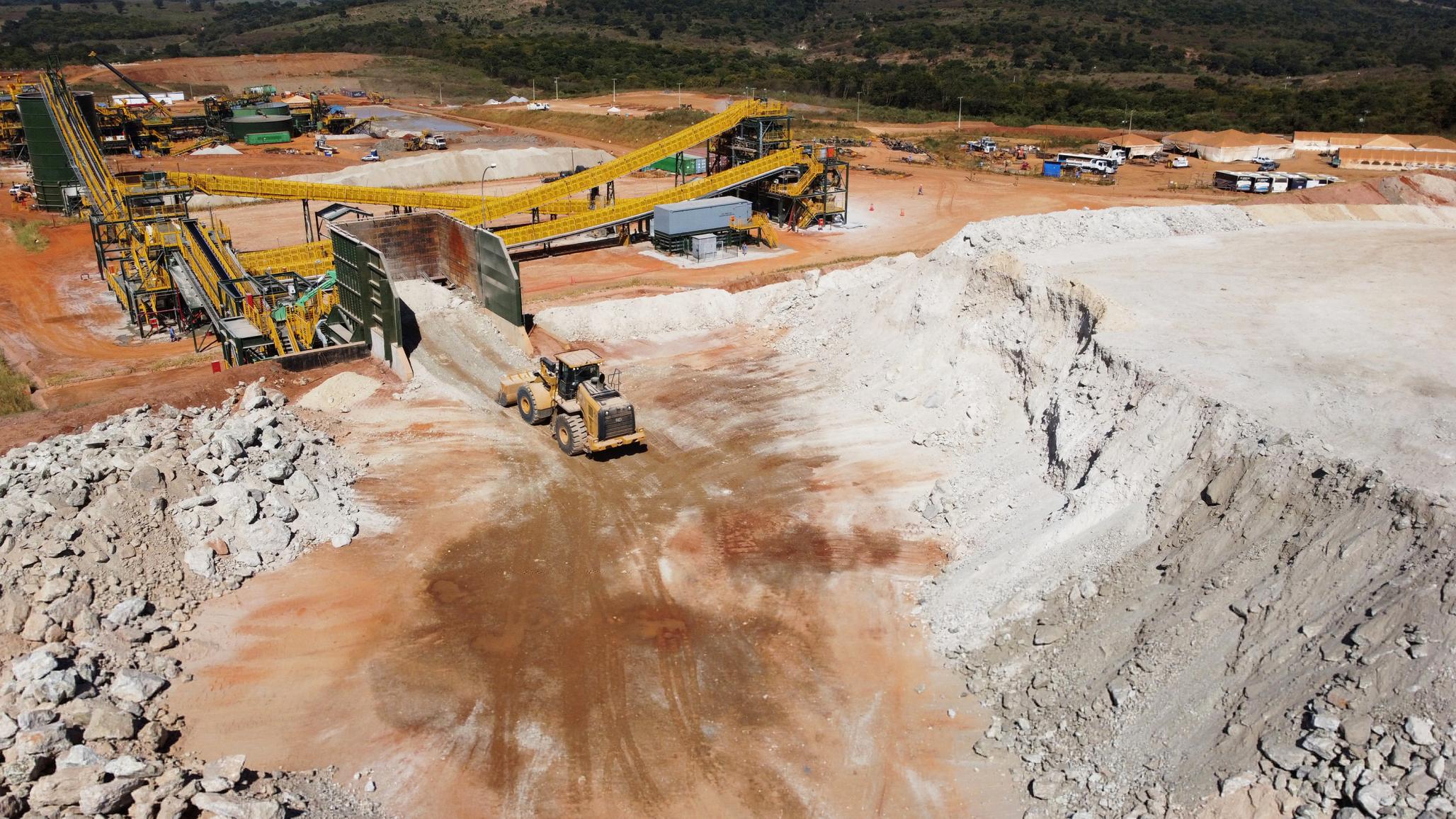
Brazil holds about 95 percent of the world’s niobium reserves, which is used in the manufacturing of steel alloys, superconductors, electronic and petrochemical equipment, and advanced batteries. Brazil also has substantial deposits of rare earth elements and graphite. Less than 30 percent of the country’s territory has been geologically mapped, and the Amazon region is estimated to host sizeable deposits of many critical minerals identified in the 2025 list compiled by the US Geological Survey. And yet, as participants in my discussion at PIIE noted, none of that may matter much unless Brazil can solve the existential problems in the global critical-minerals race: separating, refining, and processing these materials.
The debate around critical minerals has for years been framed by questions of who has the ore and how much they have. That framing, however, is increasingly obsolete. The real chokepoint in global supply chains lies not in what exists underground, but in the capacity to transform these resources into usable materials across the supply chains of multiple products and sectors. In other words, the chokepoint is not concentrated upstream, but in the midstream and downstream of supply chains. These are the stages that China dominates globally.
China’s control over critical mineral processing is the product of decades of deliberate industrial policy. While other countries exported raw ore, China built the infrastructure, technical expertise, and heavily subsidized capacity to refine and process it. The result is a global structural dependency that no amount of new mine discoveries will quickly reverse. As Cullen Hendrix, senior fellow at PIIE, observed during our online discussion, the United States and its partners are confronting “a perfect storm for critical mineral demand in a context where existing supply chains are largely dominated by China, especially at the processing stage.”
Demand for these minerals is being spurred by three distinct drivers: First, the global green energy transition’s demand for lithium, graphite, nickel, and rare earths. Second, artificial intelligence (AI) infrastructure and data centers are consuming many of the same inputs. Third, and perhaps most consequential, modern warfare as exemplified by the Iran war, has become, as Hendrix said, “a competition in applied material science: Drones, cruise missiles, and fifth-generation fighter aircraft are, in a very real sense, bundles of critical minerals in kinetic form.”
Brazil has many advantages that make it an attractive strategic partner for the US, the EU, and China
Against this backdrop, Brazil’s position as a strategic partner for the United States and the European Union looks compelling on paper. It has substantial mineral reserves, a mature mining sector, an electrical power grid that is nearly 90 percent renewable, and limited refining and processing capabilities. Processing and refining critical minerals are extraordinarily energy intensive, underscoring Brazil’s apparent comparative advantage. Performing those operations in the country would have a substantially lower carbon footprint than in many other mineral-rich countries worldwide. This so-called “green premium” is increasingly valued by European buyers seeking to meet their own decarbonization commitments. Not surprisingly, the recently approved EU-Mercosur trade agreement features a detailed chapter on critical minerals.
But Brazil has many challenges in exploiting its advantages. Bruna Santos, director of the Brazil Program at the Inter-American Dialogue, outlined its advantages. “Brazil is one of the few countries that’s large enough to matter, that has diversified enough to be relevant across supply chains, and is politically autonomous to negotiate,” she said. Brazil’s tradition of non-alignment, and its deep economic ties with both Beijing and Washington, is itself a form of leverage, he said. Accommodating both may be difficult, however, given the United States’ stated strategy of securing Latin America for its own economic and national security interests.
Brazil will need to build up financing, industrial policy, and local technological prowess to take advantage of its wealth of critical minerals
“Brazil’s leverage only matters if it can solve its bottlenecks,” Santos said. “Otherwise, we will waste the moment.” Those bottlenecks are institutional, infrastructural, and financial, she explained, adding: “Mining projects are capital-intensive and exposed to commodity price volatility. Processing capacity requires not just investment but a supporting industrial ecosystem with skilled labor, logistics, technology transfer, and stable regulatory frameworks."
China would be eager to work with Brazil, Hendrix said, citing the example of Indonesia, which banned the export of unprocessed nickel ore in 2020. Its move prompted Chinese firms to relocate their processing facilities to Indonesia itself, moving in behind the export ban and shifting midstream activity to where the ore was being extracted. Hendrix cited this as evidence that China “has been willing to negotiate and meet the ore producers where they are,” conditional on those countries being large enough to have real bargaining power. “Brazil, with its continental scale and diversified export base, clearly meets that threshold,” he said.
Whether Brazil would pursue similar policies is an open question, and panelists suggested that softer approaches may prove equally effective. More immediately actionable is the financing architecture. To facilitate investments, Santos argued for moving beyond isolated project-by-project investments toward a more systematic financing pipeline. She called for diversifying the financing base to include the US Development Finance Corporation as well as Brazil’s national development bank, BNDES, and a broader multilateral pool that includes Japan, Canada, Australia, and European partners.
The central piece of legislation to govern its critical minerals approach was outlined by Pedro Guerra, chief of staff to Brazil’s vice president and minister of development, industry, and commerce. He cited a bill before the National Congress that would establish the National Policy on Critical and Strategic Minerals (PNMCE) and create the Committee on Critical and Strategic Minerals (CMCE), linked to the National Mining Policy Council. The legislation is organized around three pillars: taxonomy (defining the critical and strategic minerals), governance (integrated management structures with transparent targets), and financing (new instruments designed to address collateral constraints and price volatility).
The panel agreed that the United States lacks credibility in its offer of partnership. Santos stated bluntly that every US ally in the region is “pricing US political risk into their long-term calculations.” This is certainly the case in Brazil, which the United States hit with 50 tariffs on its exports to the United States for reasons that had little to do with trade but which were aimed at helping Brazil’s embattled former president, Jair Bolsonaro, who is now in prison. Santos argues that US policy volatility makes it difficult for a country of lesser economic and geopolitical clout to accept the high short-term costs of fulfilling agreements in exchange for promises of long-term resilience. Processing infrastructure requires long time horizons and stable demand signals. If the anchor partner’s commitments are uncertain, the risk premium rises and the investment case deteriorates.
The central lesson of this discussion was that for critical minerals, geography determines opportunities, but institutions like financing, industrial policy, and local technological prowess determine who seizes them.
The lesson for supply chain resilience is clear. Brazil has the endowments to be a genuine partner for the United States. Whether it seizes that opportunity depends less on what lies beneath its soil than on what its institutions, and the United States, are willing to build above it.
Data Disclosure
This publication does not include a replication package.