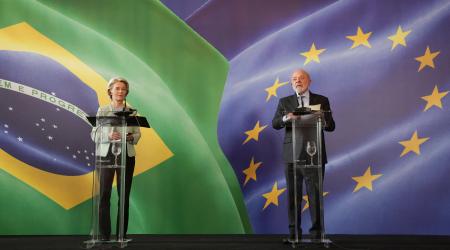
It took a quarter century of negotiations before the European Union and the South American economic bloc Mercosur signed a trade agreement earlier this year despite objections from protectionist interests in France, Italy, Ireland, Poland, and other countries. The agreement must still be fully ratified, though ratification seems inevitable.
But what is striking about this step is the contrast with the United States. While the Trump administration is waging a trade war to obtain critical minerals from its economic partners, Europe is attempting to reach the same goal by making trade deals that encourage capital investment in its partner countries.
The EU-Mercosur Partnership Agreement would create the first binding legal framework aimed at reducing China’s chokehold on critical mineral processing and shifting part of that processing to South America. China has begun investing in the processing of minerals in South America for its own purposes. Now if South American countries can obtain capital investment for processing minerals for Europe, they can take advantage of newly opened markets there.
The US approach to critical minerals in South America amounts to a "handshake"
The United States is far behind on tapping these resources. Three weeks after the EU-Mercosur accord was signed, the United States held its inaugural Critical Minerals Ministerial, producing 11 memoranda of understanding (MOU) with mineral-rich nations, including Argentina and Paraguay.
The sequence is telling. For Mercosur countries included in the agreement—Argentina, Brazil, Paraguay, Uruguay—weighing a handshake represented by an MOU against a contract in high-stakes investment decisions, the preferred course is obvious.
Europe aims to lessen its heavy reliance on China for critical minerals
Europe's dependence on Chinese minerals is nearly absolute. As of 2023, the European Union sourced 100 percent of its heavy rare earth elements from China, as well as much of its lithium and other resources. Demand for lithium alone is projected to increase twelvefold by 2030 and twentyfold by 2050.
The European Critical Raw Materials Act (CRMA), which entered into force in May 2024, tries to address access and supply chain vulnerabilities by setting binding benchmarks: By 2030, at least 10 percent of the European Union's annual consumption should be extracted domestically, 40 percent processed domestically, and no single non-EU country should account for more than 65 percent of any strategic raw material. The act's own text, however, concedes that the European Union will never be self-sufficient and will continue to rely on imports. The question is: from whom?
The EU-Mercosur Partnership Agreement, politically concluded in December 2024 and set for provisional application from May 2026, offers an answer. In addition to creating a free trade area spanning 780 million people, it progressively eliminates over 90 percent of bilateral tariffs, including those on essential aspects of critical mineral value chains. The headline numbers matter less than the structural incentives for critical mineral supply networks woven into the agreement's provisions on tariff escalation, investment access, and export restrictions.
Take tariff escalation, the single most consequential provision for critical mineral supply chains. Under the old regime, the European Union imposed progressively higher duties on more processed goods than on raw ores, penalizing value-added processing at the source. The agreement dismantles this structure, allowing refined and semi-finished mineral products to enter the European Union on equal or better terms than unprocessed materials. For Mercosur countries, the math changes considerably, making investments in refining capacity more likely to become economically viable rather than self-defeating.
The agreement also eliminates export taxes as a general principle and prohibits export monopolies. There will be no taxes on Brazilian exports to the European Union of nickel, copper, aluminum, steel, germanium, and gallium. In Argentina, all export taxes on minerals are waived. On the investment side, EU firms gain the right of establishment in Mercosur countries with non-discriminatory treatment, backed by a binding legal framework covering trade and sustainable development, corporate social responsibility, and environmental and labor standards.
For extractive and refining investments with multi-decade return horizons, regulatory predictability of this kind is what separates a viable project from a speculative one.
The agreement aims to make value-added critical mineral processing financially viable for Mercosur countries
Under the agreement, Brazil retains space for industrial policy. The agreement does allows Brazil to apply export restrictions or taxes on critical minerals and rare earth elements when necessary, however—a carve-out that protects the country's industrialization agenda. This concession enables Mercosur countries to capture value domestically, rather than merely ship raw materials to another buyer.
South America's mineral endowments are enormous and largely unmapped. In Brazil, for example, less than 30 percent of its territory has been surveyed for these resources, and yet the country is a major producer of bauxite, copper, iron ore, manganese, natural graphite, niobium, silicon metal, and tantalum. At the same time, Argentina is known as one of the world’s largest producers of lithium and borates, while Paraguay is estimated to have significant lithium and manganese deposits, among other resources.
The European Union already imports over 80 percent of its niobium from Mercosur, notably from Brazil. Yet most of the region's output has historically been exported in raw form, predominantly to China. The agreement aims to change that. It does so by making local processing financially viable, establishing legal commitments that reduce the risk premia that have historically deterred long-term capital in South American mining, and opening the door to "greenshoring," the relocation of energy-intensive refining to places powered by the region's abundant clean electricity.
Contemplated projects include lithium refining in Argentina, nickel sulphate production in Brazil, and rare earth separation facilities, also in Brazil. If these materialize, they would directly serve the European CRMA's benchmark that no more than 65 percent of any strategic raw material come from a single supplier.
Risks to the EU-Mercosur agreement: Ratification, displacing China's presence, and South American politics
To be sure, realizing the critical minerals potential of the EU-Mercosur agreement is not without significant risks. Full ratification remains the key outstanding question. The European Parliament launched a judicial review of the deal in January 2026, and full ratification by all EU member states and Mercosur parties is not expected before 2027. French agricultural opposition is fierce, and objections from Italy, Ireland, Poland, Austria, and Hungary persist.
Beyond ratification risks, there is China. Chinese companies have been active in South American mineral markets for years, investing in mines, securing offtake agreements, and building infrastructure. Displacing them will require sustained capital commitments and technology transfers from European firms, neither of which is guaranteed. Political cycles add another layer of uncertainty, as exemplified by Brazil's 2026 general elections.
Against this backdrop, the US approach looks thin. MOUs do not change tariff schedules, confer legal rights to establish firms, or create enforceable dispute-resolution mechanisms. They are political instruments, not trade law. Capital mobilization under the MOU framework can be quick and flexible, but it depends on executive-branch discretion, exposing partner countries to the policy volatility that has characterized the current US administration. For investors building processing plants with 15- to 20-year return horizons, the difference between a binding institutional architecture and a statement of intent can be the difference between a bankable project and one with prohibitive risk premia.
The EU-Mercosur agreement, by contrast, locks in non-escalation tariff clauses, guarantees non-discriminatory treatment for investment, provides dispute resolution mechanisms, and includes explicit carve-outs for local value-added policies. For Mercosur countries weighing their options, the institutional depth of the agreement represents a qualitatively different proposition from a stack of memoranda.
Whether it works will depend on ratification clearing its political hurdles, on European companies committing capital at scale, and on Mercosur governments maintaining the policy stability the agreement presupposes, all easier said than done. But the architecture is now in place, and for the first time, so is the economic logic. South America has spent decades exporting raw materials to whoever would buy them. The EU-Mercosur agreement is a bet that it can do more with what lies beneath its soil than ship it to China.
Data Disclosure
This publication does not include a replication package.