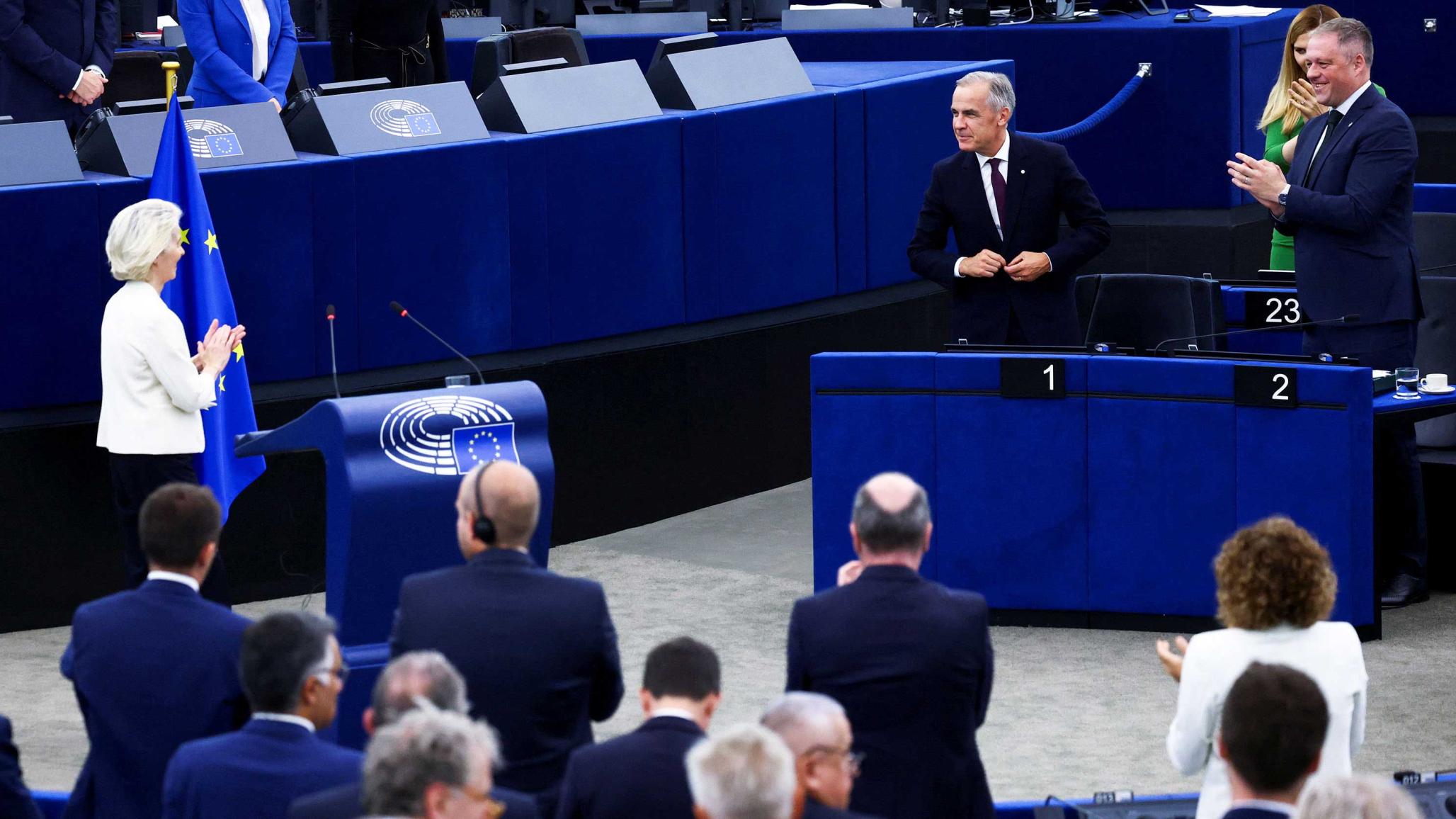
In an apparently impromptu gesture, Ursula von der Leyen, the European Commission president, welcomed Canada as an "associate member" of the European Union in her annual State of the Union speech in September. But while Europeans are nearly unanimously in favor of more cooperation with Canada on such issues as defense and climate change, making Canada an associate member would face many obstacles.
A summit between Canada and EU leaders at the end of October may clarify and deepen the new relationship. An anodyne draft joint statement is already circulating. But taking those ties to new heights will require addressing old objectives that remain unfulfilled.
Prime Minister Mark Carney of Canada was in attendance as a guest of honor for von der Leyen's speech in Strasbourg, but her invitation seemed to catch him by surprise. The term "associate member" does not exist. It has no legal definition in the treaties that make up the body of EU law. The surprised reaction from EU member states and Carney himself was understandable. The idea was not mentioned in the draft circulated the day before the speech.
The term "associate member" may have been borrowed from a similar call by Chancellor Friedrich Merz of Germany last year to offer Ukraine an "associated membership" to fast track the country´s accession to the European Union, but without voting rights or access to the bloc's common budget. Ukraine and several member states rejected his offer. Ukraine seeks full membership, nothing less. But Canada is not and will not become a candidate country to the European Union, nor does it want to be. But there are still strong prospects for deepening EU-Canada ties.
Best friends forever…
Canada and the European Union have a close and trusting relationship anchored in an ambitious Comprehensive Economic and Trade Agreement (CETA) and a strategic partnership since September 2017. They share values, a belief in multilateralism, and support for Ukraine. Under economic and political pressure from the United States, Carney has sought to broaden Canada's alliances, diversify trade relations, and establish Canada as a leader of the world's middle powers playing a greater role in upholding international rules and institutions.
But the CETA trade agreement still has untapped potential. It covers all fields of trade, eliminating 99 percent of all tariff lines, increasing access to each other's markets, and facilitating worker mobility. Trade in goods and services between Canada and the European Union has increased by 81 percent since 2016, or €131 billion, a clear sign of the agreement's success. Total trade in goods was around €92 billion in 2025, only a fraction of Canada-US total trade that amounted to $880 billion in the same year—but this is to be expected, with Canada geographically linked to the United States. There is still more that Canada and the European Union can do to expand trade ties. For example, a Canada-EU digital agreement, aimed at facilitating trade in services, is now also being negotiated.
One way to further CETA's potential is to fully ratify it. As it stands, the agreement is only provisional. While the European Union negotiates trade agreements for its members, the individual countries still need to approve them through their domestic processes. To date, 10 countries have still not ratified the agreement. As a result, several agreed upon rules, on investment and investment protections, are still not applicable.
Accordingly, if von der Leyen's sentiment is shared across the continent, member states should finalize their legal commitments to CETA as a natural first step in building closer relations with Canada. But since elections loom in several of the concerned countries (France, Greece, and Poland), this finalization is not likely to happen soon. As always, concerns about agricultural competition worry some countries. For its part, Canada has not managed to fill its agreed upon quota of beef exports to the European Union because of EU regulations on hormone treated meat. Overall, the European Union has an agricultural trade surplus with Canada, though Europe's farmers are not likely to be assuaged by this fact.
CETA does not give Canada full access to the single market in Europe because it is a traditional free trade agreement. Such access is granted only to countries applying to the European Union and members of the European Free Trade Association (EFTA) community. Neither Canada nor the European Union has expressed ambitions in this regard, even if further trade facilitation and alignment will be considered on a sectoral basis. A major complicating factor, if Canada were ever to show such interest, is that it would have to fully align with the EU body of laws, referred to as the "acquis," on standards and regulations, which is not in the cards because of Canada's close regulatory alignment with the United States.
As proof of the close relation, however, Canadian ministers have regularly been invited to European Council meetings. Canada is the first non-European country to participate in an economic instrument supporting EU member states that seek to invest in defense industrial production through common procurement, called Security Action for Europe, or SAFE. Canada has also been invited to join the biannual meetings of the European Political Community, an intergovernmental forum established after the Russian full-scale invasion of Ukraine in 2022. It has 44 European countries participating.
What comes next?
The EU leaders and Carney will meet in Montreal for a summit on October 29-30, the first opportunity to touch base since the full trade war broke out between the United States and Canada this summer and since von der Leyen's promise of associate membership.
A bland preliminary joint draft statement for the meeting is circulating, and it does not contain the term associate member. Instead, it focuses on concrete steps to further deepen relations and on generalizations about a partnership rooted in trust, economic ties, shared values, and support for multilateralism and reforms at the World Trade Organization. It then goes on to cover basically every possible area of cooperation from sustainable supply chains, investment mobilization, energy, artificial intelligence (AI), carbon pricing, the Arctic, military cooperation and support to Ukraine, critical minerals, student exchange, public health, and cybersecurity.
The stated aim is to build "an alliance for the future," a phrase that Carney used in his own speech to the European Parliament. Yet while the list of action items proposes to build upon the success of CETA, it fails to mention the fact that 10 EU member states still have not ratified that agreement.
A potentially significant way for Canada and the European Union to achieve progress in their relationship would be to build on an agreement signed earlier this year to strengthen cooperation on critical raw materials and rare earths. Canada´s resources can be pooled with European processing capacities, building scale and secure supply. But these efforts will require more long-term actions, such as joint risk assessments and financial investments to back them.
The draft joint statement suggests that the EU-Canada partnership "may become a model for other countries seeking friendship in a challenging world." A natural next step for the European Union would be to join Canada and other Asia-Pacific countries in the Compressive Progressive Agreement for Transpacific Partnership (CPTPP) signed in 2018. A few meetings on a ministerial level between the 12 CPTPP members and the EU trade commissioner have been held, but nothing concrete has happened since early summer. Canada and the European Union could take their new strengthened partnership into that venue as well, where there has already been talk of strengthening the institution by establishing a permanent body to support the implementation and updating of the agreement.
In his speech to the European Parliament, Carney wittily disavowed creation of "a third bloc in order to become a great-power rival—only with better manners." Deciding what to call the EU-Canada partnership matters less than the concrete actions that they take to create the type of international order they want to see. The European Union and Canada may just be getting started in redefining their relationship, but much can be done to strengthen and build upon their existing bonds as a first step.
Data Disclosure
This publication does not include a replication package.