
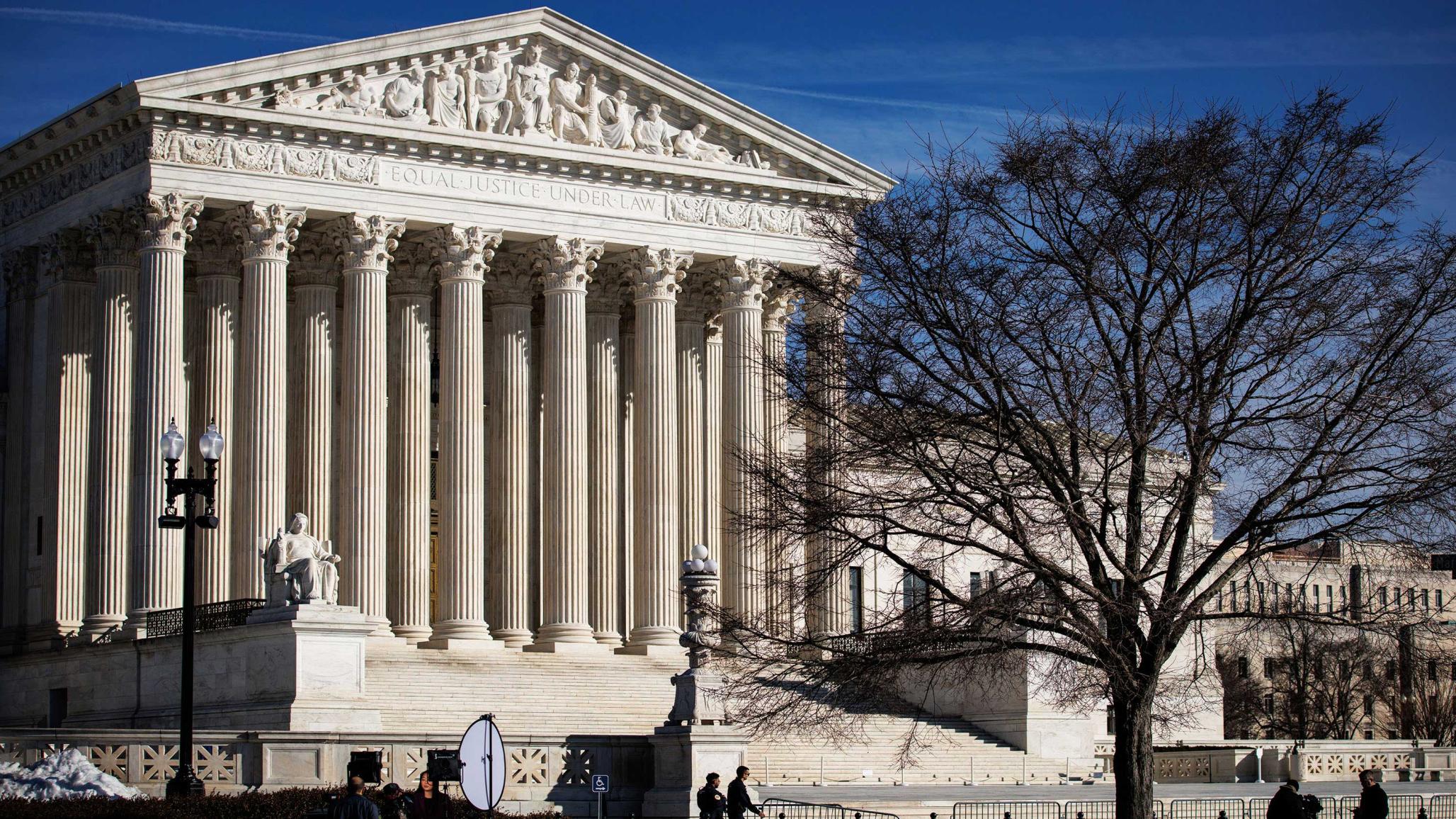
There was rejoicing in the anti-tariff world, including among American consumers and businesses relying on imported inputs on February 20, when the Supreme Court struck down the tariffs of 10 percent or higher that President Donald Trump imposed under the International Emergency Economic Powers Act (IEEPA).
That said, the basic 10 percent blanket tariff stayed in place as if nothing had happened. The president invoked another tariff statute, Section 122 of the Trade Act of 1974, for, the president said, balance of payments reasons. Customs and Border Protection (CBP), a division of the Department of Homeland Security, immediately imposed this new tariff taking effect simultaneously with the end of the now illegal IEEPA tariff. That made the IEEPA victory seem somewhat hollow. Yes, there would be refunds, billions of dollars of them, but the new 10 percent tariff stayed in place.
This second blanket tariff, for supposed balance of payments reasons under Section 122, was declared illegal by the Court of International Trade on May 7. But as the balance of payments authority is limited to 150 days, when it expired on July 24 the administration was ready yet again with a new basis for a presidentially imposed blanket tariff.
The US Trade Representative (USTR), using Section 301 of the 1974 Trade Act, declared retaliation immediately against almost all exporting countries, which account for almost all of US trade, on the ground that these trading partners engaged in acts, policies, or practices that burden US commerce. How did so many countries merit this treatment? They were found by USTR to have fallen short of a newly-created standard none could meet: the vigor with which they could and did act against imports of goods into their own countries that might have been tainted by the use of forced labor. USTR's retaliatory "forced labor" tariffs were set again at a rate of at least 10 percent and took effect at 12:01 a.m. Eastern Time on July 24, 2026, seamlessly, at the same moment that the balance of payments tariff ended.
That latest blanket tariff is still in place. The challenge to its legality is under consideration by the Court of International Trade, with a ruling expected any day.
Why haven't the courts been more effectual in eliminating the tariffs?
First, the administration has been skillful at shifting the basis for its presidential fiat tariff, pivoting from a nonexistent emergency to a nonexistent balance of payments problem to a supposed need for retaliation for an alleged unfair trade practice. There was no precedent for blanket tariffs imposed by presidential fiat in the 250-year history of the country until the second Trump administration took office.
The courts are a co-equal branch of government along with the executive and legislative. Each operates within constraints. The constraints on the Congress are plain to see. The Republican majority does not question this president's acts. The minority may be opposed but it has no effect. The Supreme Court has immunized the president against responsibility, either civil or criminal, for his acts done in the name of official business. He appears to be unconstrained, including by norms, the practices of all prior presidents.
There are certain basic constraints on the courts. There must be a case or controversy (Article III, Section 2, Clause 1 of the US Constitution). The courts cannot take issue with a policy judges do not like absent a case coming before them. But once a court has taken a case, it has wide latitude as to what it will decide, subject only to the norms it usually follows on how courts usually approach a solution. Could the courts have been more effective?
The Supreme Court could have struck down the emergency (IEEPA) tariffs as an unconstitutional invasion of Congress's prerogatives. Instead, perhaps to obtain a basis on which a majority of the justices could agree, it chose to rule against the emergency tariff on a technical reading of the text of the statute, arguing that it did not authorize the use of tariffs. This, however opened a door for the administration to try again to usurp Congress's power to tax.
The legitimacy of the five-month Section 122 balance of payments tariff is now being litigated on appeal. The Court of International Trade, a specialized court established by Congress, refrained from declaring that second tariff power grab unconstitutional. Rather it delved into the mysteries of the nation's international monetary accounts and determined that the statutory tests of what constituted a "balance of payments problem" were not met.
This is what courts do. They do not lightly find constitutional questions to resolve but see if the text of the statute itself serves as a basis for declaring a presidential action illegal, as being ultra vires, beyond the president's powers.
I assume the president will ultimately lose his Section 301 forced labor case, Burlap and Barrel, Inc. v. United States, No. 1:26-cv-03345. I have joined with two other veterans of the Office of the US Trade Representative—former USTR Carla Hills and former USTR General Counsel and White House official Warren Maruyama—to file an amicus brief in the current court case, taking the side of the small importers. We argue that Section 301 is only for use against individual countries' practices, not a global measure like Section 122. We state that no prior administration and no Congress in its drafting of the provision, or subsequently in is amendments of the statute, ever indicated that Section 301 conferred global tariff authority. We argue that Section 301 could not do so under the Constitution and that USTR's forced labor Section 301 cases were arbitrary and capricious, and not authorized by law.
Oral argument was held on September 30 before a three-judge panel of the Court of International Trade (CIT). The two-and-a-half hours of questions from the judges did not address the constitutionality of the forced labor tariff. The judges seemed unwilling to question whether the purpose of bundling 60 notionally separate Section 301 investigations was spurious in its entirety or that USTR was motivated primarily by a desire to deliver for the president a continuation of his invalidated broad tariffs. Rather, the CIT judges focused on the definitions that the Omnibus Trade and Competitiveness Act of 1988 (Public Law 100-418) added to Section 301 and expressed surprise that the administration had not investigated provisions that specifically referred to forced labor. We did not address that Section 301 language in our amicus brief. Indeed, the assistant attorney general arguing the case for the government admitted that USTR did not see this language as particularly relevant. That admission could undermine USTR's use of Section 301 to punish countries over dealing with foreign forced labor practices affecting their own imports.
Whether the CIT could remand the case back to USTR to address any shortcomings of its investigation is not clear. If the court does rule against the government, an appeal is likely, during which the court is unlikely to enjoin collection of tariffs, which has not been considered irremediable harm justifying an injunction.
If the administration loses the forced labor cases, the result will not be the complete elimination of tariffs imposed by this president and his executive branch. Pending are 16 "excess capacity" Section 301 cases1 and that is just a current example; other Section 301 cases can be formulated. Tariffs will not be eliminated until a court, and ultimately the Supreme Court, states that the fundamental issue is that under the Constitution, it is solely the Congress that has the power to tax; it cannot be delegated to the extent that the president sets the tariff of the United States in its entirety or anything approaching that, which he did with IEEPA, with the balance of payments authority, and by bringing multiple claims of unfair trade practices against the United States' more important trading partners.
What we have seen to date is that the executive branch, with its ability to move instantly, has been able to find the means to impose tariffs far faster than the courts can review their legitimacy.
The fundamental question is whether any court, and perhaps finally the Supreme Court, will choose to use the forced labor Section 301 case to bring to an end to Trump's serial attempts to illegally usurp the Congress's power over tariffs. Findings that statutes were misapplied or investigations were inadequate—the normal outcomes in judicial review of executive branch actions—are not enough. No matter how many cases the administration loses, tariffs will likely remain in place for the duration of the Trump administration, absent a finding that there is no broad tariff authority delegated to the president nor can there be.
The court under Chief Justice John Roberts has repeatedly reached for a sweeping result when a majority sees that doing so is warranted. It did so by ending judicial deference to executive agencies' interpretation of their own authority (ending the Chevron doctrine, Loper Bright v. Raimondo) as opposed to deferring to the office of the president.
The challenge to the Section 301 forced labor tariff case is an opportune time and place for the Supreme Court to defend the constitutional division of powers over imposing tariffs. Whether it will do so is far from guaranteed, but there is no evidence that Trump will cease imposing whatever broad tariffs he wishes independently of Congress until it does so.
Note
1. The 16 major US trading partners are: China, the European Union, Mexico, Japan, South Korea, Taiwan, Vietnam, India, Switzerland, Singapore, Malaysia, Indonesia, Thailand, Cambodia, Norway, and Bangladesh. The inquiry spans at least 21 manufacturing and industrial sectors—including steel, aluminum, automobiles, semiconductors, chemicals, machinery, and solar modules, according to reports. The countries being investigated account for 60 to 70 percent of US imports.
Data Disclosure
This publication does not include a replication package.
