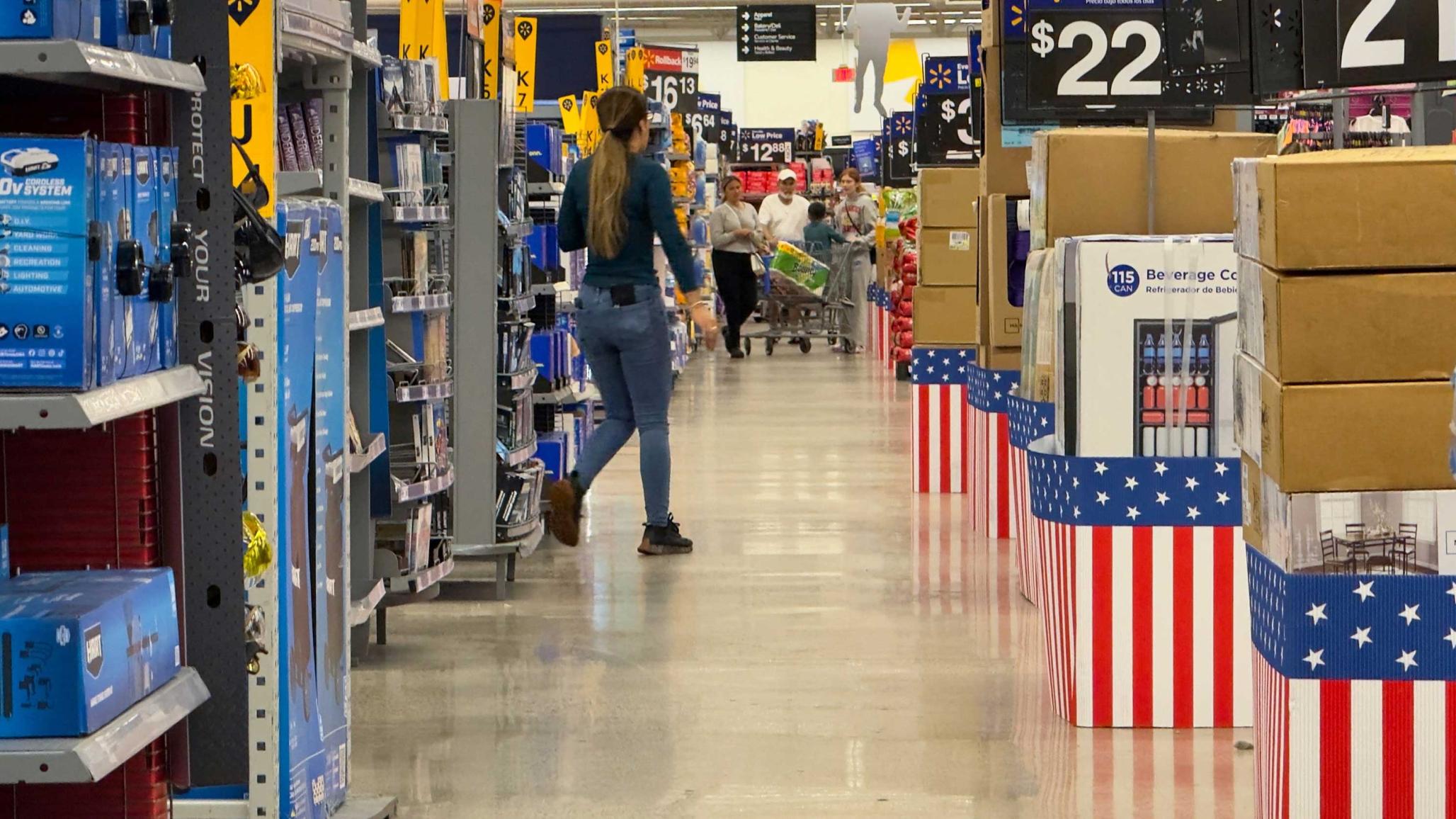
President Donald Trump has an answer for economists who fear tariff inflation: Walmart, Amazon, and other retailers should eat the tariffs. At least one major retailer, Home Depot, saluted the president and said it would do what he wanted—absorb all the higher costs and keep consumer prices steady. If other large retailers follow Home Depot, their average 2024 retail margins[1] of 6.1 percent will take a painful hit, perhaps reducing the average margin to just 3.6 percent. This will matter to consumers if retailers no longer stock imported wares because margins no longer cover their total costs.
Trump’s solution finds a precedent of sorts in President Richard Nixon’s 90-day price controls, imposed in August 1971, as an answer to rising inflation. The controls allowed no exemption for Nixon’s contemporaneous 10 percent “import surcharge,” but the surcharge was dropped in December 1971.
Asking retailers to eat the tariffs conflicts with their economic instincts. For each item on retail shelves, the typical retailer attempts to set a price that equates marginal cost with marginal revenue, thereby maximizing that item’s contribution to the firm’s profits.[2]
As an approximation, a firm’s short-run marginal cost on a day-to-day or week-to-week basis equals the “cost of goods sold.” Over a longer period, a firm’s selling, administrative, research and development, and advertising costs also vary, but not so rapidly as the cost of goods sold. A tariff almost always increases the cost of imported goods by the full amount of the tariff rate. Contrary to assertions by the Trump administration, econometric evidence shows that foreign exporters absorb only a small portion, if any, of the tariff in their selling prices.[3]
These facts imply that the percentage increase in the marginal cost of each imported item increases by roughly the tariff rate. Left to their own devices, and ignoring presidential jawboning, retail firms will increase the shelf price by that amount so that marginal revenue still equals marginal cost for each item.
Complicating the firm’s pricing decisions, marginal revenue typically varies as demand conditions and market competition evolve. Consulting firms such as McKinsey & Company and Bain & Company offer artificial intelligence algorithms that enable retailers to maximize profits by dynamically changing thousands of individual item prices to reflect shifts in marginal revenue and marginal cost over time. According to the literature, there is considerable variation in the pricing power of strong brands compared with commodity items. In practical terms, when marginal cost increases for a strong brand, such as an Apple iPhone or a Barbie doll, the loss in quantity sold is modest as the shelf price is raised, but for commodity items like shirts or clocks the loss in quantity sold is large.[4]
Trump’s tariffs frequently change in response to domestic and foreign reactions. At this writing, new tariffs (beyond those imposed in Trump’s first term) include a 10 percent uniform tariff on almost all imports[5] plus a “fentanyl” tariff of 20 percent on imports from China. Separate sector tariffs of 50 percent apply to steel and aluminum, while 25 percent tariffs apply to autos and may be extended to copper, lumber, semiconductors, trucks, and pharmaceuticals. Auto and pharmaceutical tariffs directly impact retail consumers. In addition, falsely named “reciprocal tariffs” have been scheduled (but now paused) against countries that run bilateral merchandise trade surpluses with the US, and Trump announced and then paused a huge 50 percent tariff against European goods. These may be rescinded if the target countries offer sufficient trade concessions.
Trump’s admonition that retail firms should eat the tariffs, if followed, portends a substantial impact on retail margins—that is, operating income as a percentage of sales. In addition to the cost of goods sold, retail firms have various operating expenses that must be met by markups on the cost of goods sold.[6]
Table 1 shows markups and retail margins for 13 large retail firms. Markups are calculated by subtracting the cost of goods sold from sales, then dividing the result by the cost of goods sold.[7] Retail margins are calculated as operating income divided by sales. The markup average is 48 percent, and the retail margin average is 6 percent.
| Table 1 Markups and retail margins in 2024 for 13 large retail firms | ||
| Company | Markup | Retail margin |
| Amazon | 95.5% | 10.8% |
| Best Buy | 28.4% | 3.6% |
| Costco | 14.4% | 3.6% |
| CVS | 80.7% | 2.3% |
| Dollar General | 43.4% | 6.3% |
| Dollar Tree | 55.9% | 10.6% |
| Home Depot | 50.1% | 14.2% |
| Kroger | 28.6% | 2.1% |
| Target | 38.2% | 5.3% |
| Tractor Supply | 56.9% | 9.9% |
| Walgreens Boots | 21.9% | -9.7% |
| Walmart | 32.2% | 4.2% |
| Williams Sonoma | 74.3% | 16.1% |
| Average | 47.7% | 6.1% |
| Notes: Data are for the financial year ending in 2024. As mentioned in footnote 1, retail margins here refer to the operating margins, calculated as operating income divided by sales. | ||
As table 1 shows, there is considerable variation in markups and retail margins between firms. Amazon with its powerful online platforms and Williams Sonoma with its high-end brands both show high markups. But so does CVS, which offers hundreds of low-ticket items on its shelves.
Faced with high selling and administrative costs, both CVS and Walgreens report very low (and even negative) retail margins. Home Depot and Williams Sonoma report high retail margins, but surprisingly so do Amazon and Dollar Tree.
Individual firm data on the imported component of cost of goods sold is not publicly available. However, a rough assessment can be made from national data. In 2024, US imports of consumer goods, excluding food and autos and parts, amounted to $806 billion. The total cost of goods sold by the US retail sector in 2024 is estimated at $3,776 billion, indicating that imports were 21 percent of the total.[8] Assuming that the same percentage applies to the 13 firms in table 1, their aggregate imports can be estimated at $373 billion out of the reported $1,748 billion spent on cost of goods sold.
For the purpose of this analysis, we assume the average US effective tariff rate from Trump’s new tariffs will settle at the 17.8 percent figure calculated by the Budget Lab at Yale University. At that rate, the retail sector is expected to incur $143.5 billion in tariff costs. Normally retailers would pass the entire tariff cost along to consumers through higher prices. But if retailers, following Trump’s admonition, completely absorbed the tariff cost, that would result in a 2.5 percentage point hit to retail margins, about two-fifths of the reported average of 6 percentage points for the 13 retailers covered in table 1. Table 2 shows the arithmetic. Of course, the hit will vary between retailers, depending on each firm’s reliance on imported merchandise, especially from China.
| Table 2 Tariff cost and retail margins calculation | |
| Average effective tariff rate (1) | 17.8 percent |
| Consumer goods imports in 2024 (2) | $806.1 billion |
| Tariff cost to the retail sector (1)×(2) = (3) | $143.5 billion |
| Retail sales in 2024 (excluding motor vehicles and parts) (4) | $5,669 billion |
| Hit to retail margins (3)/(4) | 2.5 percentage points |
| Notes: Because of data limitations and the fact that consumer goods are mostly distributed by retailers, the calculations assume that all consumer goods are imported by the retail sector. | |
| Sources: Yale Budget Lab, Bureau of Economic Analysis, US Census Bureau Monthly Retail Trade, and authors’ calculations. | |
It remains to be seen how many retailers will follow Home Depot and pledge to eat the tariffs. The slender level of retail margins suggests considerable pain for firms that salute Trump’s admonition and are unable to push losses upstream to their suppliers.
Notes
1. Retail margins in this piece refer to the operating margins, calculated as operating income divided by sales.
2. Retailers also may offer “loss leader” items to attract customers and increase demand for other items.
3. Econometric estimates of passthrough coefficients for tariffs imposed in the first Trump term are close to 1.0. See, e.g., Fajgelbaum et al. (2020), Amiti, Redding, and Weinstein (2020), Cavallo et al. (2021), and Lovely (2024).
4. Expressing this relationship in formal economic language, the relationship between marginal revenue (MR)—which the firm sets to equal marginal cost—and price (P), given the elasticity of demand (Ed, a negative value), is specified by this equation: MR = P(1 + 1/Ed).
5. Imports from Mexico and Canada compliant with the United States-Mexico-Canada Agreement (USMCA) are exempted from the 10 percent tariff. Non-USMCA-compliant imports from those countries are still subject to a 25 percent tariff imposed as retaliation for fentanyl and migration.
6. Over the longer term, markups must also cover fixed costs like interest expense and depreciation.
7. This calculation is equivalent to dividing gross profits by sales.
8. A figure for the total cost of goods sold is not available for 2024. Following the 2022 Annual Retail Trade Survey, the retail gross margin is estimated to be 33.4 percent of total sales (excluding motor vehicles and parts dealers). Given 2024 retail sales of $5,669 billion (excluding motor vehicles and parts dealers), the cost of goods sold is estimated by multiplying sales by 66.6 percent (i.e., 1.00 minus 0.334).
Data Disclosure
This publication does not include a replication package.