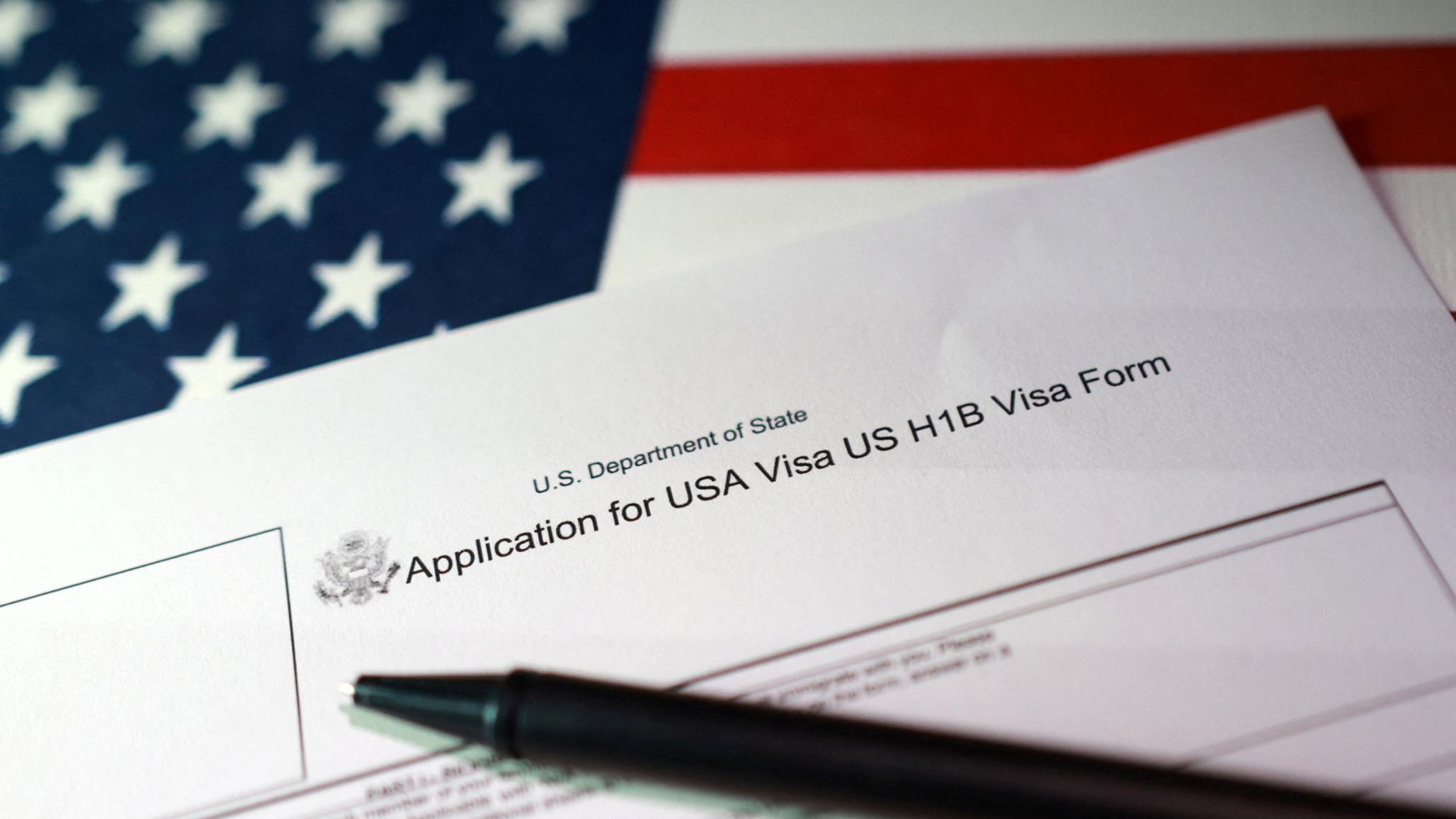
President Donald Trump on Friday ordered an unprecedented new restriction on lawful immigration to the US by high-skill workers. Starting Sunday, new applications for H-1B visas required payment of an eye-watering $100,000 per person fee. This new tax on highly educated workers—127 times higher than the US visa fees for workers without a high school degree—is effectively a skill penalty.
Trump administration officials said the new policy should prompt companies to hire more Americans instead of foreign-born workers. But if successful, the change would severely damage the most important channel for US entry by workers with advanced degrees and specialized knowledge, causing profound and widespread harm to Americans’ incomes and job opportunities.
“This misguided measure could shut down the H-1B program entirely,” fears Jennifer Hunt, an economics professor at Rutgers University and one of the world’s top experts on economic impacts of high-skill immigration.
Watch recommended video (2:50 minutes)
Decades of Research Document Broad Harms from this Unprecedented Tax
H-1B workers are not merely jobholders; their labor is a crucial factor of production that drives US economic growth and opportunity, extensive research has found. From 1990 to 2010, rising numbers of H-1B holders caused 30–50 percent of all productivity growth in the US economy. This means that the jobs and wages of most Americans depend in some measure on these workers.
The specialized workers who enter on this visa fuel high-tech, high-growth sectors of the 21st century economy with skills like computer programming, engineering, medicine, basic science, and financial analysis. Growth in those sectors sparks demand for construction, food services, child care, and a constellation of other goods and services. That creates employment opportunities for native workers in all sectors and at all levels of education.
This is not from a textbook narrative or a computer model. It is what happened in the real world following past, large changes in H-1B visa restrictions. For example, Congress tripled the annual limit on H-1B visas after 1998, then slashed it by 56 percent after 2004. That produced large, sudden shocks to the number of these workers in some US cities relative to others. Economists traced what happened to various economic indicators in the most-affected cities versus the least-affected but otherwise similar cities. The best research exhaustively ruled out other, confounding forces.
That’s how we know that workers on H-1B visas cause dynamism and opportunity for natives. They cause more patenting of new inventions, ideas that create new products and even new industries. They cause entrepreneurs to found more (and more successful) high-growth startup firms. The resulting productivity growth causes more higher-paying jobs for native workers, both with and without a college education, across all sectors. American firms able to hire more H-1B workers grow more, generating far more jobs inside and outside the firm than the foreign workers take.
An important, rigorous new study found the firms that win a government lottery allowing them to hire H-1B workers produce 27 percent more than otherwise-identical firms that don’t win, employing more immigrants but no fewer US natives—thus expanding the economy outside their own walls. So, when an influx of H-1B workers raised a US city’s share of foreign tech workers by 1 percentage point during 1990–2010, that caused7 percent to 8 percent higher wages for college-educated workers and 3 percent to 4 percent higher wages for workers without any college education.
This is what Americans will lose if the new skill penalty stands, slamming the door in the face of the most skilled, specialized workers from around the world. And about a third of these high-skill foreign workers are trained at US universities, staying after graduation to offer their skills to American firms. These are the people whom the new tax is designed to exclude en masse.
Concealing Evidence, Not Overlooking It
What about the numerous assertions in the president’s proclamation that H-1B visas harm competing tech workers who are US natives? It mentions a study finding that “wages for American computer scientists would have been 2.6 percent to 5.1 percent higher … absent the importation of [H-1B] foreign workers into the computer science field.”
It doesn’t identify the study. But I know exactly which study it is, and the president’s order grossly misrepresents it—somehow neglecting to mention that the same study proceeds to describe widespread economic harm from the same skill penalty.
The study is here, with a less technical version here. It was being written by the superb economist Gaurav Khanna and his coauthors when I hired Gaurav as a postdoctoral fellow. That research is based on a computer model. It finds that if the infinitely complex US economy is fully described by a small number of equations, then native computer scientists’ wages decline when more foreign tech workers are available.
It is a brilliant computer model, built carefully at high academic standards for simulations of its kind. But no such simulation provides a secure basis for drastic policy change when the numbers it generates are flatly contradicted by a more direct and transparent approach: simply observing what happened in the real world after past policy shocks. That suggests cautious and measured policymaking, not sledgehammering of entire congressionally mandated visa classes.
Now set aside that concern for a moment. Take as unquestioned truth the wage effect from the computer simulation that the president cites. In that case it is disturbing to read the next two sentences of that same paper.
The study finds that H-1B workers caused vast, nationwide benefits to Americans as a whole. H-1B workers did this by increasing the efficiency of information technology services, benefiting almost all American consumers. It finds that back in the late 1990s, the period it considers, Americans in general benefited by $15.2 billion to $20.2 billion per year in today’s dollars. And H-1B workers caused value-added by US firms overall to rise by 0.7 percent, which today would mean $25 billion each year. More value-added by US firms means higher market value for those firms, and thus greater wealth for the two-thirds of Americans who own shares, especially retired Americans. And these are just the short-run effects, decades ago, studied by that paper (1994–2001), omitting much larger, widespread benefits to productivity emerging over the last quarter century.
In other words, the study trusted by the president to demonstrate economic harms of H-1B visas actually concludes that slashing the H-1B program will cause enormous net economic harms to Americans in general. It finds that those harms vastly exceed any benefits to competing workers. The president’s order simply omits these findings.
The Concealed Evidence Undermines the Legal Basis for the Skill Penalty
This concealment is striking by itself. But it takes on added significance given the legal authority that the US president invoked to impose the new visa fee.
That authority rests on the economic facts that the presidential proclamation suppresses. No US law grants the president the power to impose arbitrary quotas or taxes on the H-1B or any other visa, and certainly not to decimate with a penstroke entire visa classes mandated by Congress. Rather, the proclamation explicitly derives its authority from a 1952 law whose section “212(f)” allows him to “suspend the entry” of “any aliens or of any class of aliens into the United States would be detrimental to the interests of the United States.”
In other words, the US president cannot bar entry to a broad class of immigrants on a whim. He only has the legal authority to take any action like this when there is clear evidence that those immigrants are “detrimental to the United States.” The president rests his case for that authority on a study that reaches the opposite conclusion: that H-1B workers as a class cause massive and widespread net benefits to Americans as a whole, to US firms specifically, and to anyone who owns shares in US firms.
But he ignores this finding, which is extremely prominent in the paper he references. That is not plausibly an oversight.
And what about the effect of H-1B workers on US computer scientists’ wages? The proclamation checks the findings of that computer simulation by quoting another study that seems to offer a smoking gun: “one study of tech workers showed a 36 percent discount for H-1B ‘entry-level’ positions as compared to full-time, traditional workers.”
Again, the proclamation does not tell the public what study that is. I know what study that is, and again, the proclamation grossly misrepresents its findings.
It comes from this study by a think tank, where you can find the 36 percent number in table 2. The US government regulates the wages that employers can pay H-1B workers and sets minimum wages at four levels according to the experience and qualifications of the worker. The study is referring to Level 1 H-1B minimum wages, which are intended in general for young workers just getting their foot in the door. The minimum wage for H-1B workers is set much higher for more experienced workers.
What does the 36 percent number compare those wages to? The study tells you, right in the same table: It’s comparing the entry level wage for H-1B workers to the average wage for everyone in that occupation, at all levels of experience, seniority, degrees, and technical knowledge.
That reasoning would not pass muster in even an introductory economics course.
Of course entry-level computer programmers command a lower wage than others with decades of experience, more personal connections in the industry, more intra-firm seniority, years to search for better firm-employee matches, much higher leverage to ask for wage raises due to outside options that fresh immigrants don’t have—and so on.
That 36 percent entry-level wage gap, which the White House cites as clear evidence that H-1B workers undermine wages, suggests nothing of the kind. It is similar to the wage gap we should expect between all entry-level wages and all average wages—for all kinds of workers, in every firm, in every country, in all of modern history. More experienced workers have more tacit knowledge, have better outside options, and have proven their worth to the firm.
A Crippling Blow to US Innovation and Productivity
The leading economists who study US productivity have produced a ranking of the different policy levers that the government can pull in order to raise productivity. Many such levers exist, such as subsidies to research and development activities. But the single policy lever they believe has the highest impact, backed by the most conclusive evidence, is a broad policy of fostering high-skill immigration.
The American public understands this well. Large majorities of conservative and liberal Americans support lawful, high-skill immigration. That includes 71 percent of those who voted Republican in the last US presidential election and 86 percent of those who voted Democrat. The political mandate for shattering high-skill immigration is nil. High-skill immigration is one of the precious few policies that truly and massively united Americans across the political spectrum.
Yet here is the proposed skill penalty, announced without warning and implemented within 18 hours—with zero public debate, zero impact analysis, and via an announcement that conceals evidence of its economic harms. It remains to be seen whether the proposal will stand: US presidential proclamations do not have the force of law, and the president’s legal authority to enact the penalty has come under immediate attack.
But if it stands, the skill penalty on US immigration will bring tremendous harm to the future of all Americans—harms that will be too large to conceal.
Data Disclosure
This publication does not include a replication package.