
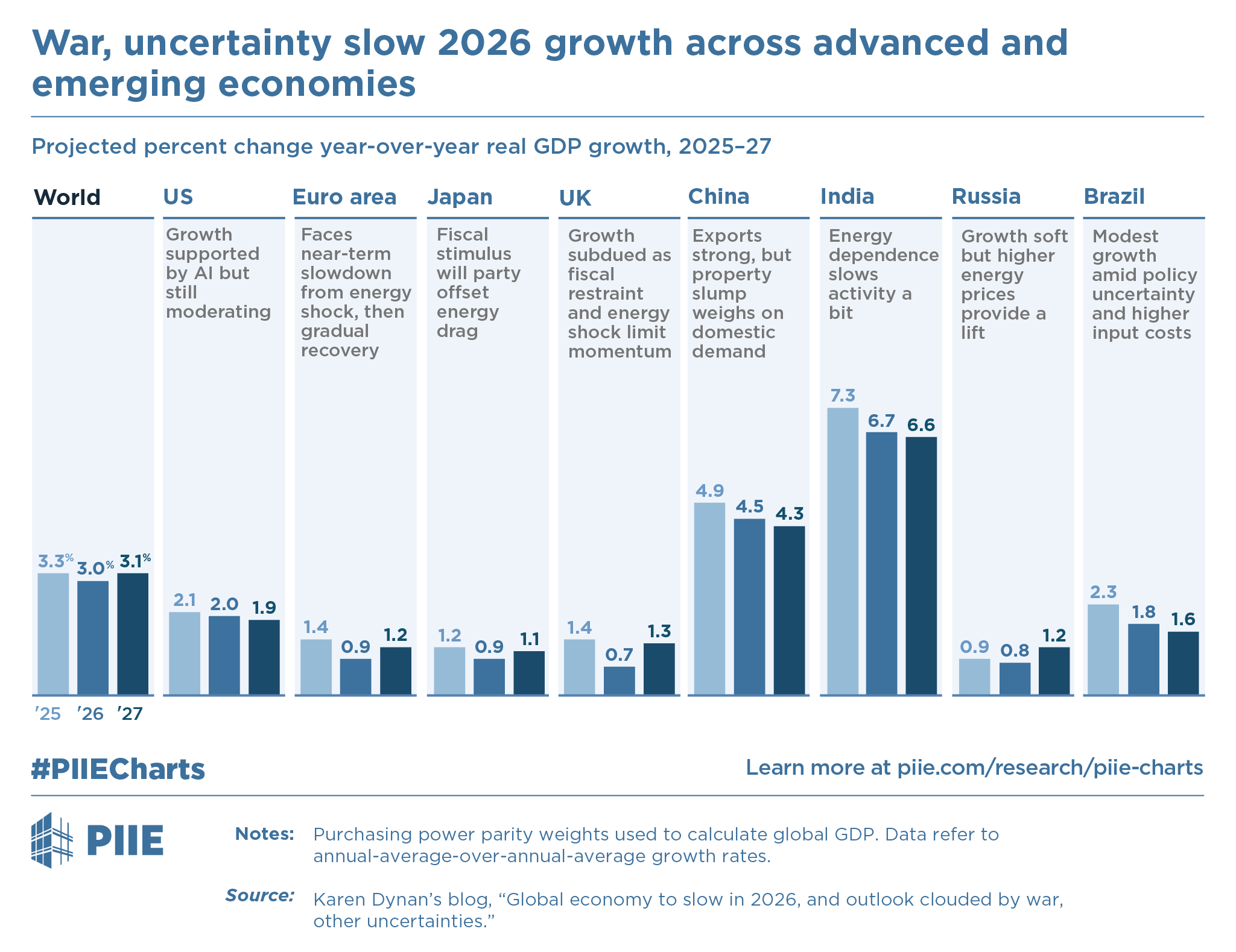
The global economy continues to expand, supported by the artificial intelligence (AI) boom, even as high energy prices, trade tensions, policy uncertainty, and structural challenges weigh on activity. Real global GDP is projected to slow from 3.3 percent in 2025 to 3.0 percent in 2026 before picking up to 3.1 percent in 2027. The disruptions associated with the Iran war have lowered expected economic growth, pushed up inflation, and made the outlook more uncertain.
In the United States, growth continues to be supported by the AI boom, which is boosting investment and, through wealth effects, consumption. But the sharp drop in immigration is constraining labor supply and weighing on potential output, offsetting some of the productivity gains from AI. US real GDP growth is projected to slow from 2.1 percent last year to 2.0 percent in 2026 and 1.9 percent in 2027.
Growth in other large advanced economies is expected to be soft in the near term, reflecting higher energy prices. The energy shock is weighing on activity alongside existing headwinds. Growth is expected to pick up modestly in 2027 as the shock fades.
Economic prospects differ across the large emerging-market economies. China continues to benefit from strong exports, but the property downturn is weighing on domestic demand. India remains the fastest growing large emerging economy, although growth is likely to be dampened somewhat by its energy dependence. Brazil faces slow growth amid election uncertainty, higher input costs, and ongoing structural challenges. Russia’s growth is likely to remain soft despite some support from higher energy prices.
This PIIE Chart is adapted from Karen Dynan’s blog, “Global economy to slow in 2026, and outlook clouded by war, other uncertainties.”
Data Disclosure
This publication does not include a replication package.
