
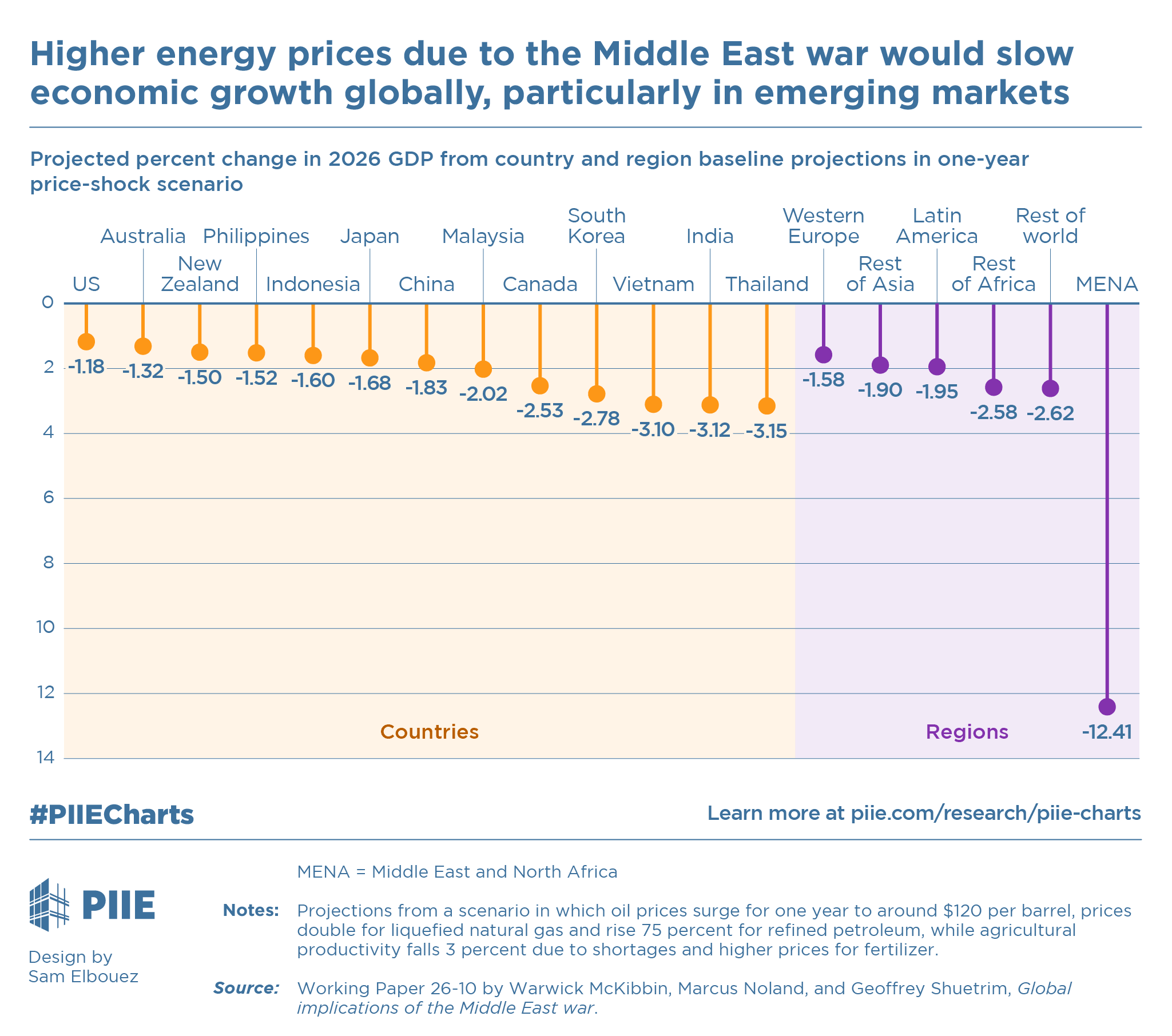
This year's Middle East war has driven up energy prices, disrupting economic activity around the world. If these effects persist for a year, they will slow global growth, hurting emerging economies more than advanced economies, according to our new PIIE Working Paper, Global economic implications of the 2026 Middle East war. In this case, 2026 GDP would be lower than otherwise and inflation higher in most economies, but the effects would be spread unevenly: Countries more dependent on Middle Eastern oil, natural gas, and fertilizers would experience the largest hits to GDP. In emerging markets particularly, higher fertilizer costs reduce agricultural production, which accounts for a larger share of their economies.
These conclusions result from a scenario in which oil prices surge for one year to around $120 per barrel, and prices double for liquefied natural gas and rise 75 percent for refined petroleum, while agricultural productivity falls 3 percent due to shortages and higher prices for fertilizer. We use a model to generate baseline projections of how different economies would have performed without the war, and we show the war's effects as deviations from the baselines.
In this scenario, countries in the Middle East and North Africa as a group suffer the most in economic—as well as human—terms, seeing a collective GDP drop of 12.4 percent below baseline in 2026. Among Asian countries, Vietnam, India, and Thailand are hit hardest economically in 2026, with each seeing about 3 percent lower GDP than otherwise.
The US economy is one of the least affected overall: Its 2026 GDP is 1.2 percent lower than otherwise in this scenario, but certain sectors slow more, such as transportation, agriculture, and durable manufacturing. Meanwhile, China's 2026 GDP is around 1.8 percent lower—despite its large domestic supplies of oil, gas, and fertilizer—as slowing global growth weakens demand for its exports.
A full set of results is available in the online dashboard.
This PIIE Chart is adapted from the PIIE Working Paper Global economic implications of the 2026 Middle East war by Warwick J. McKibbin (PIIE, Australian National University), Marcus Noland (PIIE), and Geoffrey Shuetrim (McKibbin Software Group Pty Ltd.).
Data Disclosure
This publication does not include a replication package.

