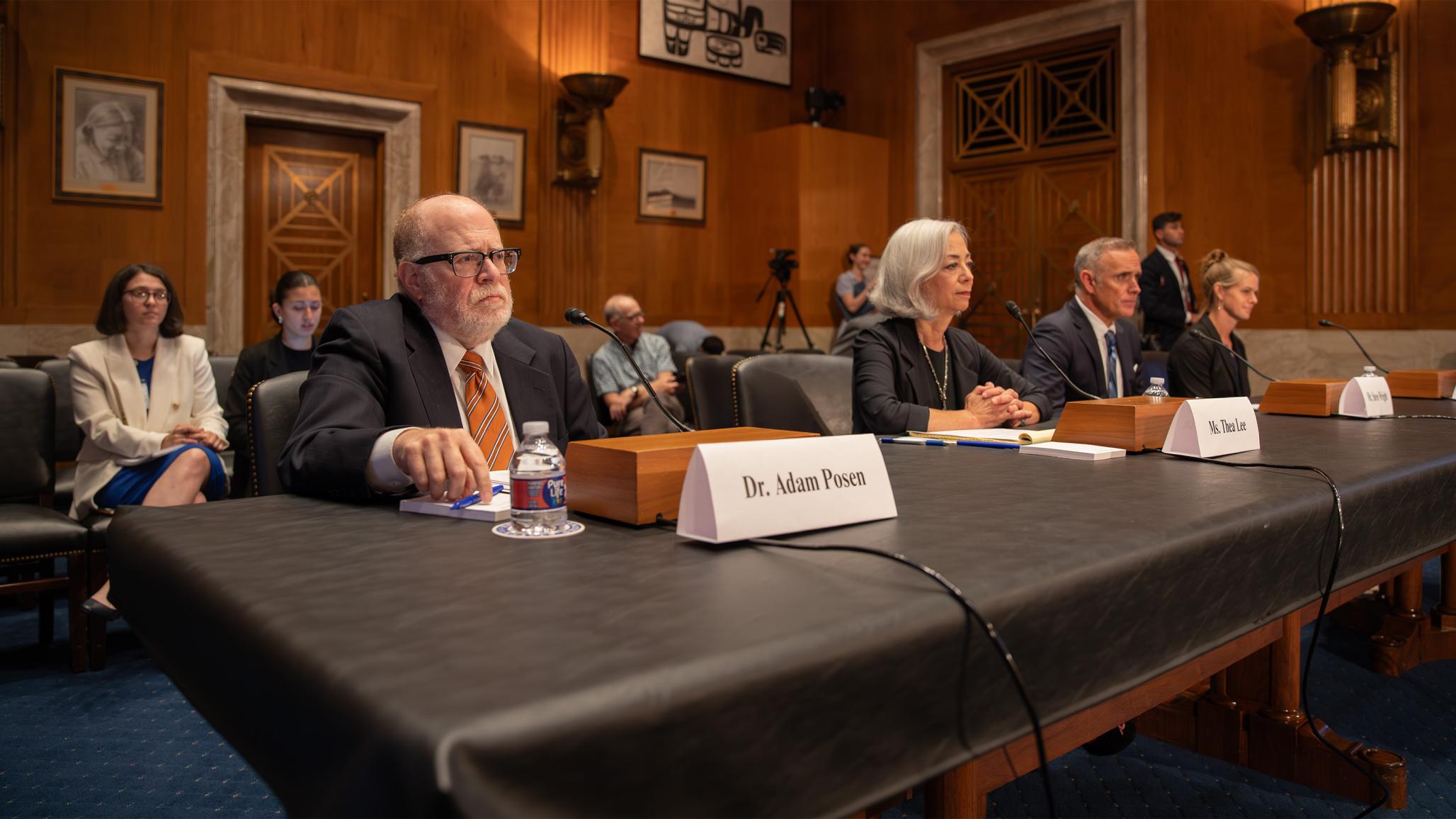
Senator Luján, Senator Cortez Masto, thank you for the opportunity to speak today on the subject of the harmful impact of the Trump administration’s tariff program on American households and on the income and well-being of working families in particular. This is one of the worst ways to impose a tax and one of the most regressive ways to redistribute income from poorer to richer Americans and increase the tax burden on poorer people. In addition, because they cause uncertainty, provoke retaliation by other nations, and create opportunities for government corruption, tariffs have many destructive side effects that other forms of taxes do not.
My name is Adam Posen, and I am president of the Peterson Institute for International Economics (PIIE), a 45-year-old independent nonprofit and nonpartisan research organization dedicated to strengthening prosperity and human welfare in the US and global economies through rigorous expert analysis and practical policy solutions. We are funded by a broad array of more than 100 individuals, foundations, businesses, and government or public institutions, listed annually on our website. None of our supporters dictate or censor what we conclude in our research—our fellows and I have final control and responsibility for our research and policy recommendations. Our staff of 75 includes around 45 senior research scholars focusing on a variety of issues, including macroeconomics, international trade and investment, public finance and exchange rates, and studies of key economic regions. In my testimony, I would like to emphasize that we are analyzing policies through evidence-based publicly reproducible research and not addressing the politics or motivations of US current policies.
My remarks draw on research and writing by PIIE fellows, in particular done over the last 18 months. All of their research shows that tariff increases will impose costs on American consumers, households, and businesses that in turn are likely to impede economic growth. Tariffs also provoke retaliation by foreign countries against US exports. All these costs reduce economic growth, shrink the export sector, and disrupt supply chains, all while increasing costs for American households and businesses. Tariffs are a regressive and distortionary source of public finance. They do not help the groups that some purport they are intended to help. Nor do they restore American manufacturing, since the vast majority of US manufacturing employment and value-added is upstream, requiring imported inputs to be produced at any reasonable cost.
The Trump tariffs imposed also meaningfully weaken the US fiscal position, by reducing revenues on net of the induced decline in growth and of the increase in interest rates paid on US debt. By being subject to large induced swings in currencies, retaliation by other economies, and putting the US government in discretionary charge of tariff exemptions (and thus eliciting corruption), this further erodes the tax base of the United States. This is entirely in line with the overwhelming agreement of mainstream economists ranging across the ideological spectrum, and our work independently contributes to that joint assessment. This is because we have literally 250 years of historical examples of what tariffs do to economies in comparison to other tax measures.
As the members of this committee know well, the administration’s tariffs and tariff proposals are a moving target, and it is difficult to make robust quantitative assessments quickly each time the proposals change. The unpredictable changes to trade policy also increase business uncertainty, dampening investment and further dragging the economy. While the direction of impact is clearly negative, the size of those effects is difficult to forecast since the tariffs being imposed are at levels 10 to 20 times what the United States has seen in 90-plus years. Therefore, I will cite the research we produced at certain times, based on assumed policy at those times, at varying tariff levels and applicability. All of the research and underlying data are available on the PIIE website.