
In a bid to flex his political muscle and highlight his law-and-order and free-market gospel lauded by President Donald Trump, President Javier Milei of Argentina abruptly appeared at the presidential campaign launch of Senator Flávio Bolsonaro in São Paulo in July, creating a diplomatic flap with potential economic consequences for the region. Milei called President Luiz Inácio Lula da Silva a "thief" and "socialist trash," while insulting a respected Brazilian jurist, prompting Brazil's foreign ministry to recall its ambassador from Buenos Aires and summon home Argentina's ambassador in Brasília, a step it had not taken against Argentina before.
Whether Milei's fiery endorsement of Bolsonaro will help or hurt is an open question. Some commentators in Brazil say it may hurt by reminding voters of Flávio's own corruption troubles and the fact that his father, former president Jair Bolsonaro, remains in prison for trying to overthrow the election results in 2022. I have argued that Milei's behavior is not only damaging to the bilateral relations between the two countries but also potentially economically destructive to Argentina's heavy economic dependence on Brazil, its largest trading partner. His antics also threaten the two countries' ability to negotiate and finalize critical trade agreements with Canada, Japan, South Korea, the EU, and the European Free Trade Association (EFTA) comprising Switzerland, Norway, Iceland, and Liechtenstein.
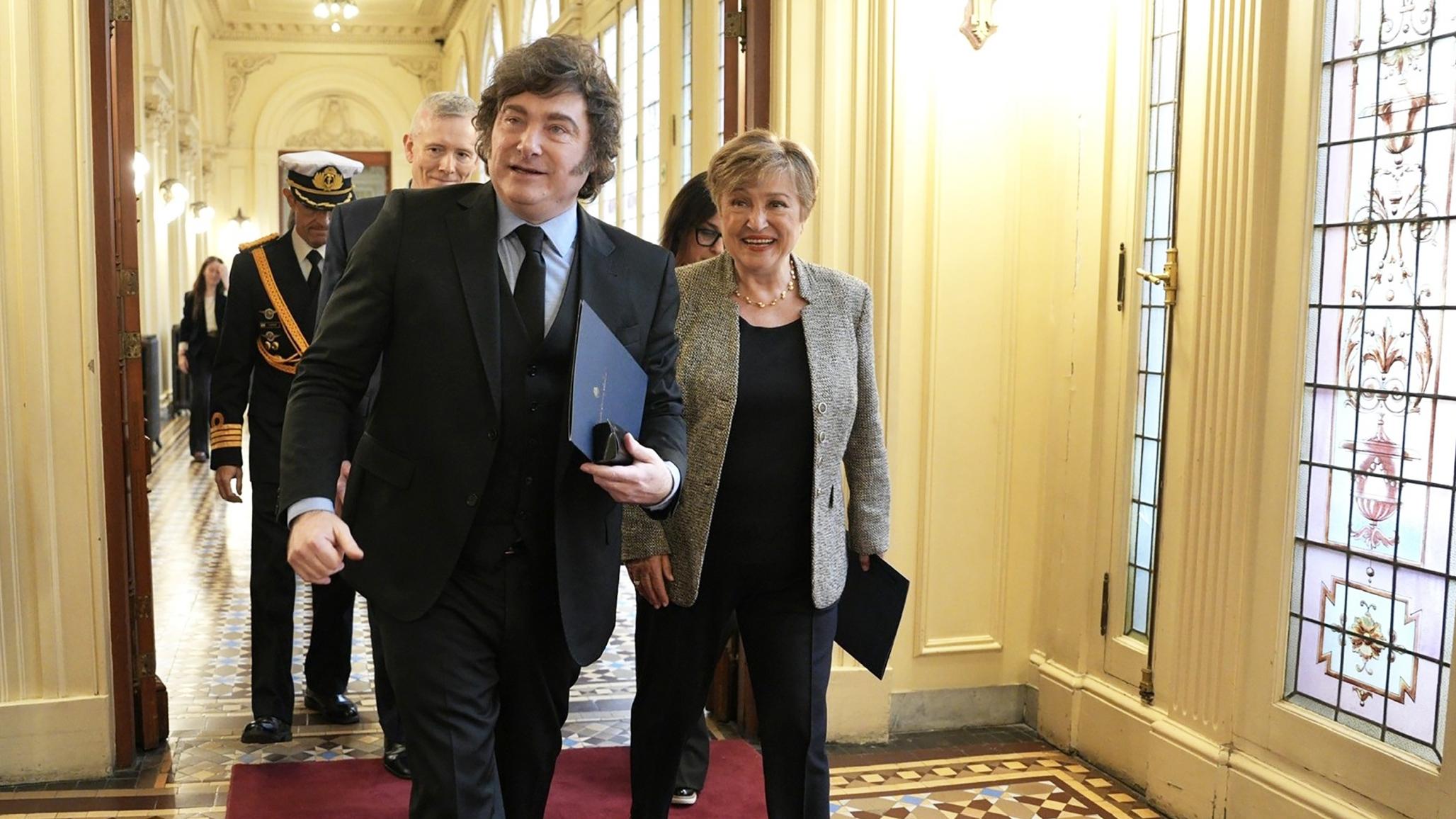
Ironically, the standoff is casting doubt on optimistic statements of Kristalina Georgieva, managing director of the International Monetary Fund (IMF), who visited Buenos Aires two days before Milei's trip to Brazil. In the first visit to Argentina by an IMF managing director in eight years, she praised "the government's hard work and the sacrifice of the Argentine people," and said she did not foresee Argentina needing to return to the Fund for additional financing. Indeed, she suggested that Argentina, a perennial supplicant to the Fund for bailouts, could free itself from dependence on the Fund in coming years. She perhaps was not aware that Milei would make such a prospect harder by insulting Argentina's biggest trading partner, on which it relies for export revenue to pay money it owes the Fund. Principal repayments on roughly $57 billion of outstanding Fund credit begin in September.
To be sure, the $20 billion Extended Fund Facility agreed in April 2025 for Argentina's troubled economy continues on schedule. The third review, expected in September, would release about $860 million. But the repayment schedule she is expressing confidence about is demanding. Principal payments to the Fund are due from September, taking principal and interest in the remainder of 2026 to roughly $3 billion. Payments that Argentina is obligated to make to the Fund more than double in 2027, and from 2028 through 2031 they add to some $9.5 billion a year. The current schedule runs to 2042.
The Fund's own baseline does not reflect Argentina's financing needs from export revenues, but from about $5 billion of domestic foreign-currency bond issuance, $2 billion of privatization proceeds, $3 billion of central bank repurchase operations, and roughly $4 billion of commercial loans guaranteed by multilateral development banks.
Each of these is a one-off transaction that cannot be projected into the future. Gross international reserves are projected to reach only about 85 percent of the Fund's Assessing Reserve Adequacy (ARA) metric by the program's end in 2029. Hence, the financing profile is fragile and supported by a sequence of one-time transactions, which, given Argentina's crisis-prone history, begs for caution.
Put differently, none of the aforementioned transactions adds to Argentina's capacity to earn foreign exchange sustainably over time. After all, net new dollar flows would need to come from the current account, which the IMF projects to be in deficit through 2031. Argentina could boost its reserves beyond the need for current account earnings if it chose to return to world markets, but thus far Milei has resolutely refused.
Argentina's ability to meet all these targets rests on the viability of its trading relations. Brazil has been Argentina's largest trading partner since 1991, and in the first half of 2026, the two countries traded $13.8 billion in goods. Importantly, Brazil does not buy what the rest of the world buys from Argentina. Roughly 38 percent of Argentina's exports of industrial manufactures and some 69 percent of its capital-goods exports shipped within the South American trading bloc known as Mercosur go to Brazil, while the automotive complex has accounted for about 40 percent of bilateral trade over the past decade. Brazil is the fourth-largest source of foreign direct investment in Argentina, and it was the principal trading partner of six Argentine provinces in 2023.
That dependence is directly related to the IMF managing director's recent comment: Argentina's deficit with Brazil narrowed by nearly $2 billion in six months, which is roughly two-thirds of what Argentina owes the Fund between now and December. If relations between the two countries are damaged, Argentina may have significant difficulties meeting its obligations to the IMF.
In addition, the IMF's confidence in a financially self-sustaining Argentina depends on continued export growth to other countries, and this goal depends on Brazil. Mercosur negotiates as a bloc, meaning that negotiations with Canada, Japan, and South Korea cannot move forward if Argentina and Brazil are not aligned. The same holds for the still-outstanding ratifications of the EU and EFTA agreements.
Moreover, the reciprocal trade agreement Argentina signed with the United States on February 5, 2026, is under challenge by Brazil, which accused it of exceeding what Mercosur's rules permit. Argentina's bid to join the Comprehensive and Progressive Agreement for Trans-Pacific Partnership (CPTPP) will likely face the same hurdle.
Think of it this way. Every route by which Argentina intends to widen its export base runs through a government Milei has both insulted and challenged directly.
The IMF managing director may well be right that Argentina can stop borrowing from the Fund. But the plan for doing so assumes the country keeps earning dollars from a neighbor whose cooperation its president has decided to upend.
Data Disclosure
This publication does not include a replication package.
