
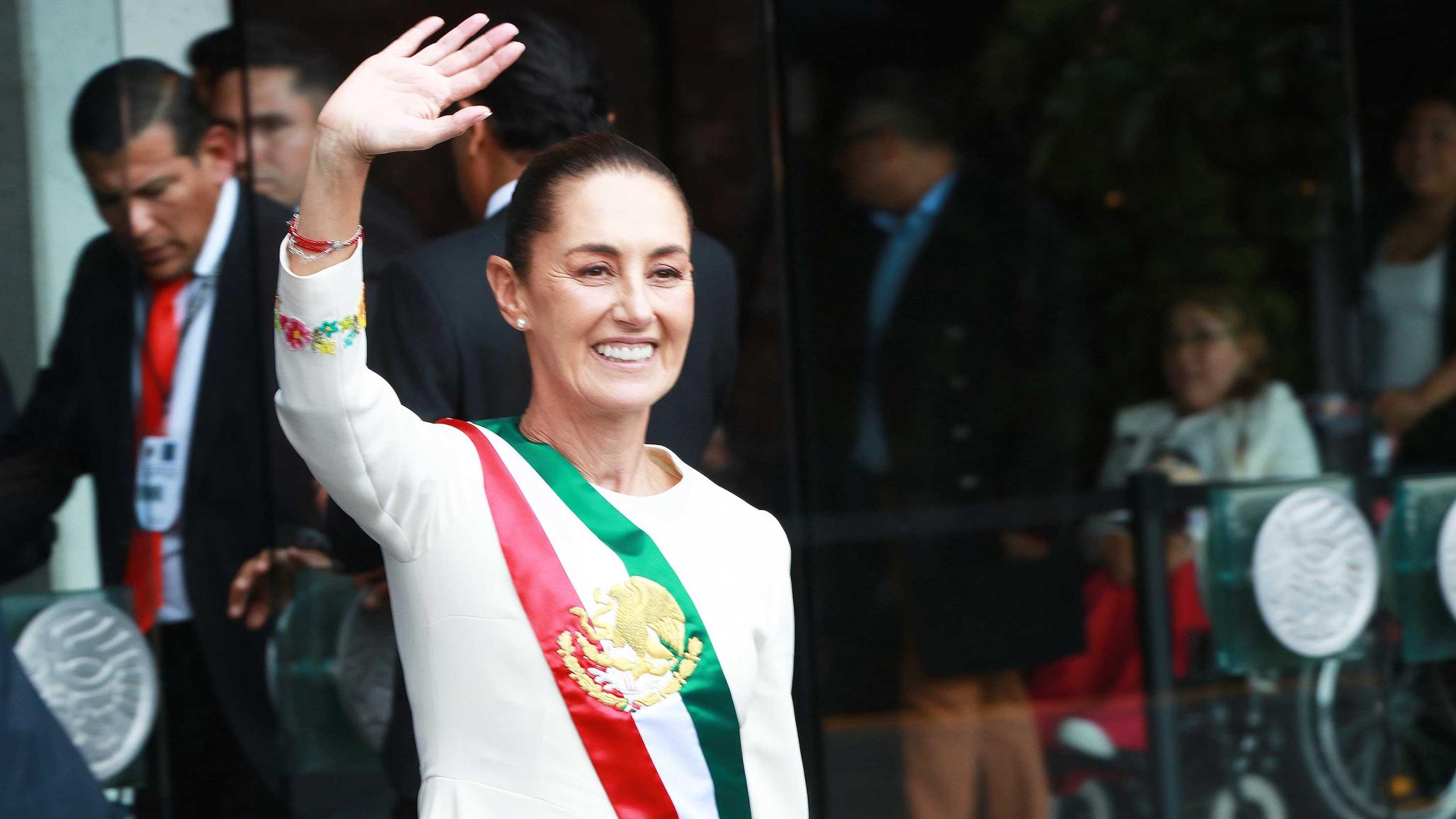
President Claudia Sheinbaum of Mexico is about to complete the first two years of her six-year term. She has just sent her third budget to Congress, and midterm elections are a year away. The picture that emerges is one of continuity: The economy has preserved macroeconomic stability while growing very little, the labor share of income has continued to improve,1 and there has been an intentional weakening of key institutions.
Although economic fundamentals are slowly deteriorating, there are no red flags on the horizon. With an eye on her party's reelection prospects in 2030 and not facing imminent financial challenges, avoiding hard reforms on the fiscal, energy, or growth agendas may prove to be a winning strategy. Therefore, the most likely scenario between now and 2030 is more of the same: low growth, redistribution, financial stability, and no structural reform.
What might a baseline scenario for the rest of Sheinbaum's term look like?2
Fiscal policy
Although Sheinbaum's predecessor, Andrés Manuel López-Obrador, was on average fiscally conservative, the public sector deficit deteriorated during his government, especially during the last year, when it reached almost 6 percent of GDP. President Sheinbaum's fiscal strategy, outlined at the start of her government, set a goal of reaching a deficit of 2.9 percent of GDP in 2027. This fiscal consolidation has stalled at around 4 percent of GDP, a level that implies a primary balance close to zero.
The 2027 budget sets the fiscal target at this same level and points to a very gradual consolidation toward 3 percent of GDP by 2032.3 Yet, judging by the gap between the consolidation path laid out in the original strategy and actual outcomes, deficits of 4 to 5 percent of GDP appear to be the most plausible baseline for the remainder of the presidential term.
To stabilize the debt as a share of GDP, the country needs an improvement of the primary balance of at least 2 percentage points of GDP.4 This will only happen if a tax reform is implemented. At the same time, a growing share of the infrastructure agenda is being financed through quasi-fiscal vehicles whose obligations are difficult for outside observers to trace. Because of the recent fiscal slippages and the low growth rate, credit rating agencies have reduced Mexico's rating by one and two notches in the last six years, putting the country's investment grade at risk. Neither López Obrador nor Sheinbaum have been able to restore state-owned oil company Pemex’s stand-alone financial strength, and it is now another force that pulls Mexico’s sovereign rating towards junk.
Mexico's debt trajectory is also pressured by increasing pension and healthcare expenditures and the r−g differential: very low growth combined with relatively high implicit interest rates. The offsetting strength is the absence of external imbalances and the growth of savings managed by local institutional investors. With the current account expected to be close to balance in 2026 and into the future, fiscal deficits can be financed entirely out of domestic savings, a large share of them from a rapidly growing local pension system.
Banks are well capitalized, international reserves continue to increase, and demand for peso-denominated sovereign debt is deep. These factors have allowed the government to comfortably finance its deficits. Even if public debt rises above 60 percent of GDP—a more negative forecast than the official one—and the sovereign eventually loses its investment-grade rating, Mexico will most likely retain market access and financing capacity, as many non-investment-grade emerging markets do.
Monetary policy
August inflation was 3.26 percent, while core inflation stood at 3.88 percent, and medium-term inflation expectations are 3.80 percent. The central bank has been able to conduct monetary policy without interference and has not intervened in the currency markets in the last eight years. The institutional weakening agenda has left Banco de México's independence untouched. Banco de México has maintained a comparatively hawkish stance in the last three years, and medium-term expectations remain anchored at a level 30 basis points above where they sat during 2012–18.
Trade
Mexico has expertly navigated one of the most challenging bilateral negotiations in its modern history, successfully preserving a meaningful tariff advantage in the US market relative to third countries, despite President Donald Trump's trade threats.5 However, it has yet to secure a durable agreement that alleviates uncertainty regarding the long-term rules governing trade relations.
Uncertainty over the trade regime weighs over investment as the world moves away from a rules-based system that Mexico embraced as one of its most important elements of its growth strategy. In its negotiations with the United States, Mexico has effectively managed its concessions, strategically spacing them out while reserving additional measures to respond to future threats.
For instance, a year ago, Mexico imposed increased tariffs on countries lacking trade agreements, notably China. Recently, the Mexican government sent Congress an initiative to reform its foreign investment regime, de facto establishing a Mexican version of CFIUS, the US foreign investment review mechanism, to limit Chinese investment in Mexico. This strategy has allowed Mexico to become the number one exporter to the United States, increase its bilateral trade surplus, and maintain a very low US average tariff against Mexican imports.
During the last two years Mexican exports to the United States increased by 42 percent, fully explained by the increase in electronic equipment exports that have benefited from the artificial intelligence (AI) investment boom. This positive outcome in Mexico's bilateral trade could become a negative factor in the negotiations, as one of the stated objectives of US trade policy is the reduction of bilateral deficits.
Growth
Mexico has had the weakest average growth rate in Latin America, except for Venezuela, so far this century, as evidenced by its per capita GDP (see figure below). From that low base, growth has slowed during the past eight years. Social, political, and fiscal sustainability ultimately depend on whether that trend can be reversed. The deeper explanation of Mexico's mediocre long-run performance is beyond the scope of this piece. The more recent slowdown, however, points to three proximate causes: the erosion of institutions and the rule of law over the past four years, uncertainty about the future of preferential access to the US market, and the substantial increase in unit labor costs that took place in the past six years. Careful empirical work decomposing their relative contributions is still missing.
For medium-term projections, the relevant question is whether any of these three factors slowing economic growth is likely to improve. On trade, Washington has discovered that not completing the ongoing review and threatening to leave the United States-Mexico-Canada Agreement (USMCA) negotiated in Trump's first term or imposing discretionary tariffs is its most effective instrument for forcing the Mexican government to act on migration, security, and geopolitical alignment. Next in the list of concessions that the United States is demanding is the tightening of rules of origin to limit Asian inputs and expand US content.
On the institutional front, the governing coalition's project of consolidating something close to one-party rule clearly takes precedence over economic policy. In the last two years the government has implemented the most ambitious takeover of the judicial system that Mexico has experienced, followed by other modifications to electoral and media rules and legislation. The absence of a well-respected, popular, and sensible opposition also plays into the government's playbook. In this environment, there is little reason to expect a change in direction unless negative economic or political shocks compel voters to shift from ignoring institutional decay to factoring it into their electoral preferences.
Regarding economic policy, it is hard to envision a sharp change in direction during the second half of the government's term. Income redistribution through the budget and an increase in the minimum wage are putting pressure on public finances and competitiveness. Nevertheless, the government believes that the economic and political benefits of this strategy outweigh its costs. However, if market access becomes restricted, one of two possible reactions could occur: first, the implementation of an ambitious fiscal reform and a shift toward more market-friendly policies; and second, a move towards heterodoxy, characterized by financial repression, capital controls, and higher inflation as preferred methods for managing a complicated macroeconomic scenario.
The equilibrium the administration is relying could prove short-lived
The equilibrium of limited growth, redistribution, and slowly deteriorating public finances worked well for Sheinbaum's predecessor, López Obrador (2018–24), and it appears to be working for her, given that her approval rating continues to hover around 70 percent.6 It is also very likely sustainable for the rest of the government's term. As mentioned above, avoiding hard reforms on the fiscal, energy, or growth agendas may prove to be a winning strategy for Sheinbaum, even though the outlook calls for more low growth, redistribution, financial stability, and no structural reform.
This short-term equilibrium merely delays Mexico's challenges until the next government arrives. However, it could be disrupted sooner by an external shock—whether financial or policy-driven—most likely stemming from US trade policy. It could also be shaken by a sudden drop in Mexico’s oil production or a domestic political shock arising from divisions within the governing coalition. These internal divisions can arise from how to respond to US heightened pressure to act against members of the official party with ties to organized crime or over the choice of the party's presidential candidate for 2030.
Notes
1. As described in an earlier blog post, the redistribution strategy is supported by aggressive increases in the minimum wage, important expansion of social transfers, and widening the coverage and augmenting the real value of pensions.
2. Although not the subject of this note, the administration's security policies represent an important change of course with its predecessor's. The previous policy of "hugs, not bullets" shifted towards proactive enforcement. Importantly, the shift began before Washington started applying serious pressure, which suggests it reflects a domestic policy choice rather than only external coercion.
3. The fiscal numbers in this blog post come from Criterios Generales de Política Económica for 2025and 2026, and from Mexico's Secretariat of Finance and Public Credit (SHCP) for 2027.
4. Estimated with the assumptions made in the last International Monetary Fund Staff Country Report (October 2025).
5. According to BBVA Research, today Mexico's imports face a 3.7 percent average tariff in the US market.
6. See El País, La aprobación de Sheinbaum se mantiene en un 69% en el cierre de su segundo año de mandato.
Data Disclosure
This publication does not include a replication package.


Author's note: Thanks to Martina Copelman, Jose De Gregorio, Cullen Hendrix, Maurice Obstfeld, Luca David Opromolla, and other PIIE colleagues for their comments and suggestions.