
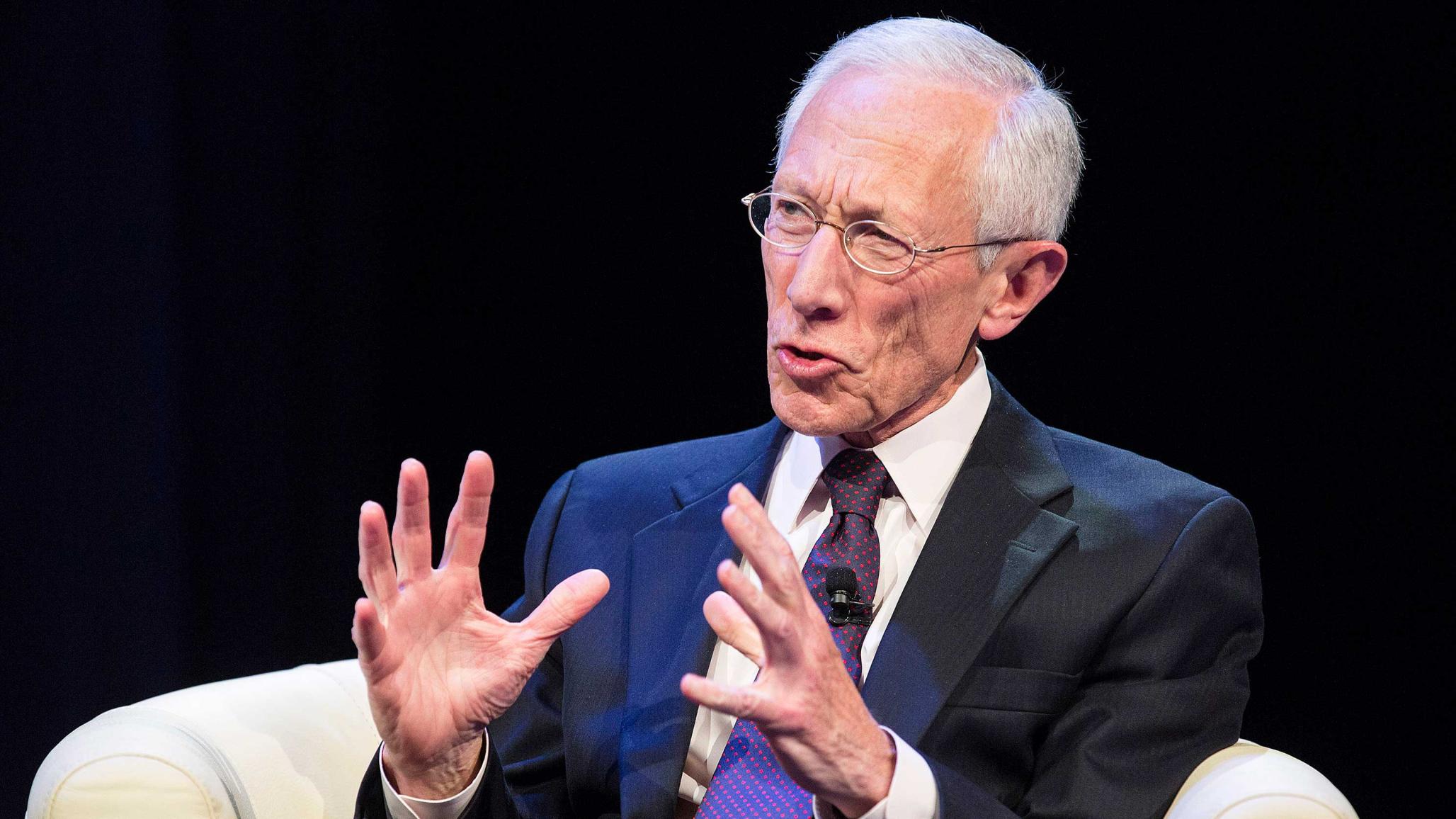
Stanley Fischer was—over the years—my teacher, my colleague, my friend, my predecessor, and my counterpart.
No economist of his generation had more influence on me—or, far more importantly, on the world—than Stan did.
I first met Stan in the fall of 1977. I was 22, taking the T from Harvard to MIT to sit in on 14.462, Graduate Monetary Economics.
As Marty Feldstein had shown me the power of a regression equation to change thinking—and then the world—Stan showed me something else: the power of a simple mathematical framework to guide understanding and shape policy.
The textbook he co-wrote with his indispensable—if slightly odd-couple—partner Rudi Dornbusch became the foundation of what we now call new Keynesian economics.
It is aging, but still vibrant. Just like Stan's wisdom.
Two years later, I joined the MIT faculty and became Stan's colleague. At the time, he and Rudi seemed old—Stan was all of 35.
But to me, they were exemplars of what it meant to live fully in the prime of an academic life.
MIT then attracted the best students in the world, and most of them gravitated to Stan—nothing seemed more important or exciting at the time than fighting back against the new classical macroeconomic heathens' conclusions with their own newly developed methods. And Stan and Rudi led the charge.
Equally important, he was generous with his time, his ideas, and above all, his loyalty.
Stan never reserved his time only for the most brilliant. He had just as much patience—and often more—for the merely solid.
I remember asking him and Paul Joskow whether I could fairly write in a recommendation that a student was in the top third of the class.
They told me yes—because, as Paul said with a smile, "All of our students are in the top half."
When I moved from MIT to Harvard, I became Stan's neighbor in Newton—just 250 yards from the Fischers' home on Gralynn Road.
The Fischer boys were often out on the Ward School field across from our house, playing touch football.
It was there that I got to know Stan and Rhoda as a couple. I've never seen a more devoted, supportive, and loving marital team.
Nor better parents. I hope their sons know how lucky they were.
And Stan's devotion to his family never came at the expense of friendship.
My life has had its share of highs—and some very real lows. Stan was there for the celebrations, but even more, he was there when things were hard.
Always.
In 1988, Stan surprised us all by going on leave from MIT to become chief economist of the World Bank.
But not nearly as much as he surprised me—and probably many career Bank bureaucrats—by recommending me to succeed him.
A stunningly disorganized, disheveled me.
But that was Stan—always more focused on potential than polish.
His were impossible shoes to fill.
Everyone who worked with Stan was in awe of his dedication.
There were stories of marginal notes from him on page 59 of dense reports.
Of complex compromises resolved not with bluster but with clarity and patience.
Of careers quietly shaped by his words of encouragement.
The Bank has never had another chief economist like him.
In 1993, the US had an opportunity to influence the selection of a new deputy managing director at the International Monetary Fund (IMF).
I didn't hesitate. I knew who the right person was.
It was, without a doubt, the best thing I ever did for emerging markets—helping get Stan to the Fund.
Convincing the rest of the US government was easy. A few calls with Stan were all it took.
Michel Camdessus, then managing director of the IMF, was initially hesitant.
Perhaps wary of a friend of mine. Perhaps uncertain about bringing in such a powerful intellect.
But he came around. Later, he told me: It was the best decision he made in all his years at the Fund.
And that's saying something—because those were not quiet years at the IMF.
They were years of upheaval. Mexico. Argentina. Brazil. Korea. Thailand. Indonesia. Russia. Much of Africa.
It was crisis after crisis—and in each of them, Stan was a steady hand, a calm presence, and a voice of reason.
He had what I've seen in almost no one else: deep seriousness without even a trace of self-seriousness.
He could be funny, dry, warm—but when the stakes were high, he had an intellectual clarity that cut through the noise.
He knew what mattered, and he knew how to act.
In rooms where billions of lives could be affected, Stan brought light, not heat.
There has never been before or since a rich country financial official so universally respected, admired, and followed in the developing world as Stan Fischer.
I don't think I'm exaggerating when I say that hundreds of millions of people—who never heard his name—live in more stable, more secure economies because of Stan Fischer.
In a world where the US couldn't always act directly, we leaned on the IMF—and the IMF leaned on Stan. America stood taller in the world because of what Stan Fischer stood for and what he did.
After the Fund, he did a stint in the private sector.
A mutual friend once said he was brilliant there—but his heart was still with the debtor countries, not the shareholders.
That friend had it exactly right.
Then came the Bank of Israel.
Others can speak to how his insight helped Israel weather the global financial crisis better than almost anyone.
What I saw, walking the streets of Tel Aviv with him or sitting at dinner, was how ordinary people treated him.
With a quiet reverence. A rare thing for an economist. But Stan wasn't just any economist.
Intellectual firepower is really important. But to truly matter, it must be paired with character.
Stan had both. As a teacher and mentor, colleague and friend, trusted advisor, and policy leader.
I don't think our profession will see his like again.
Rest in peace, my hero.
Prepared remarks delivered at a memorial service for Stanley Fischer on June 4, 2025, at Temple Emanuel in Newton, MA